You've been there before—standing at the edge of a crowded room, heart racing, palms sweaty. The thought of approaching a group of strangers feels overwhelming until you take that first sip of liquid courage. Suddenly, the anxiety melts away, replaced by that elusive social butterfly energy you've been searching for. The alcohol works really well as social lubrication, helping you "get over the hump of approaching new groups of people."
Sound familiar?
For millions of Americans struggling with social anxiety, alcohol can seem like the perfect solution—a crutch that temporarily transforms you into the confident, outgoing person you wish you could be naturally. As one person put it: "Unfortunately booze does work really well for those of us with social anxiety… but remember with every sip it's a crutch."
While your therapist might say it's fine as long as the drinking doesn't become problematic, there's an important warning to heed: "Plenty of Alkies start this way."
The line between helpful social drinking and harmful dependency can be blurry—and crossing it often happens so gradually that you don't notice until you're already on dangerous ground. This article will help you identify the warning signs that your social drinking is crossing into problematic territory and offer actionable strategies for building genuine sober confidence.
The All-Too-Familiar Story: "It Just Helps Me Get Over the Hump"
The Science Behind the Crutch
Social Anxiety Disorder (SAD) affects approximately 15 million adults in the U.S., causing an irrational fear of embarrassment in social situations. The anxiety can be so intense that many turn to alcohol—a readily available relaxant—to self-medicate.
There's a reason alcohol works: it's a central nervous system depressant that temporarily reduces anxiety by increasing GABA (an inhibitory neurotransmitter) and decreasing glutamate (an excitatory neurotransmitter). This chemical reaction creates a sense of relaxation and reduced inhibition.
The Temporary Fix, The Long-Term Problem
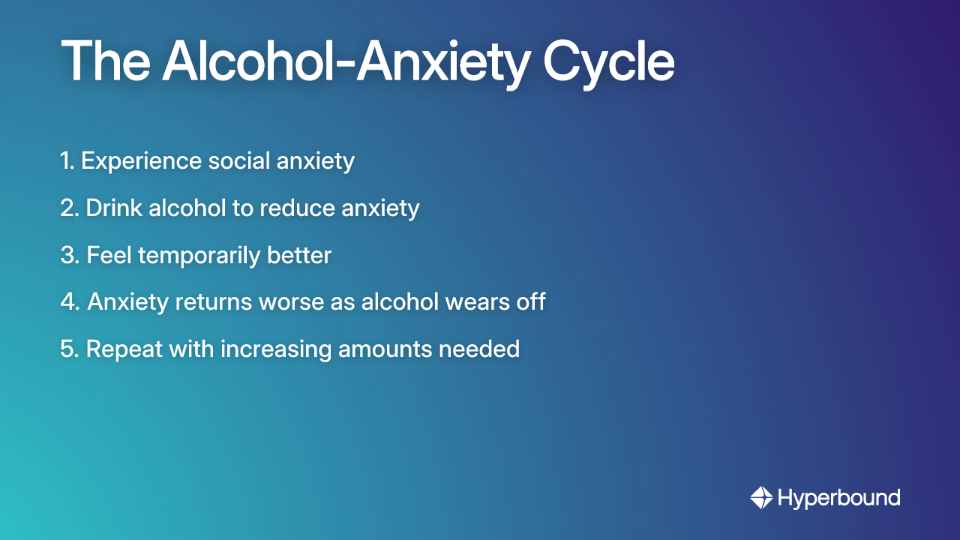
While that tipsy confidence might work in the moment, it creates a dangerous cycle:
- Experience social anxiety
- Drink alcohol to reduce anxiety
- Feel temporarily better
- As alcohol wears off, anxiety returns—often worse than before
- Repeat, with increasing amounts of alcohol needed
As one Reddit user candidly shared: "I've used it as a crutch for a while, and it did the job, but I wouldn't recommend it as I now have a mild drinking problem. Whatever you do, do it in moderation."
This cycle can lead to what experts call "alcohol-induced anxiety," where drinking actually worsens anxiety over time. It's what another user referred to when they said, "I paid the piper a few times." The temporary relief comes with a price tag that increases with each use.
Red Flags: When Your Social Lubricant Becomes a Ball and Chain
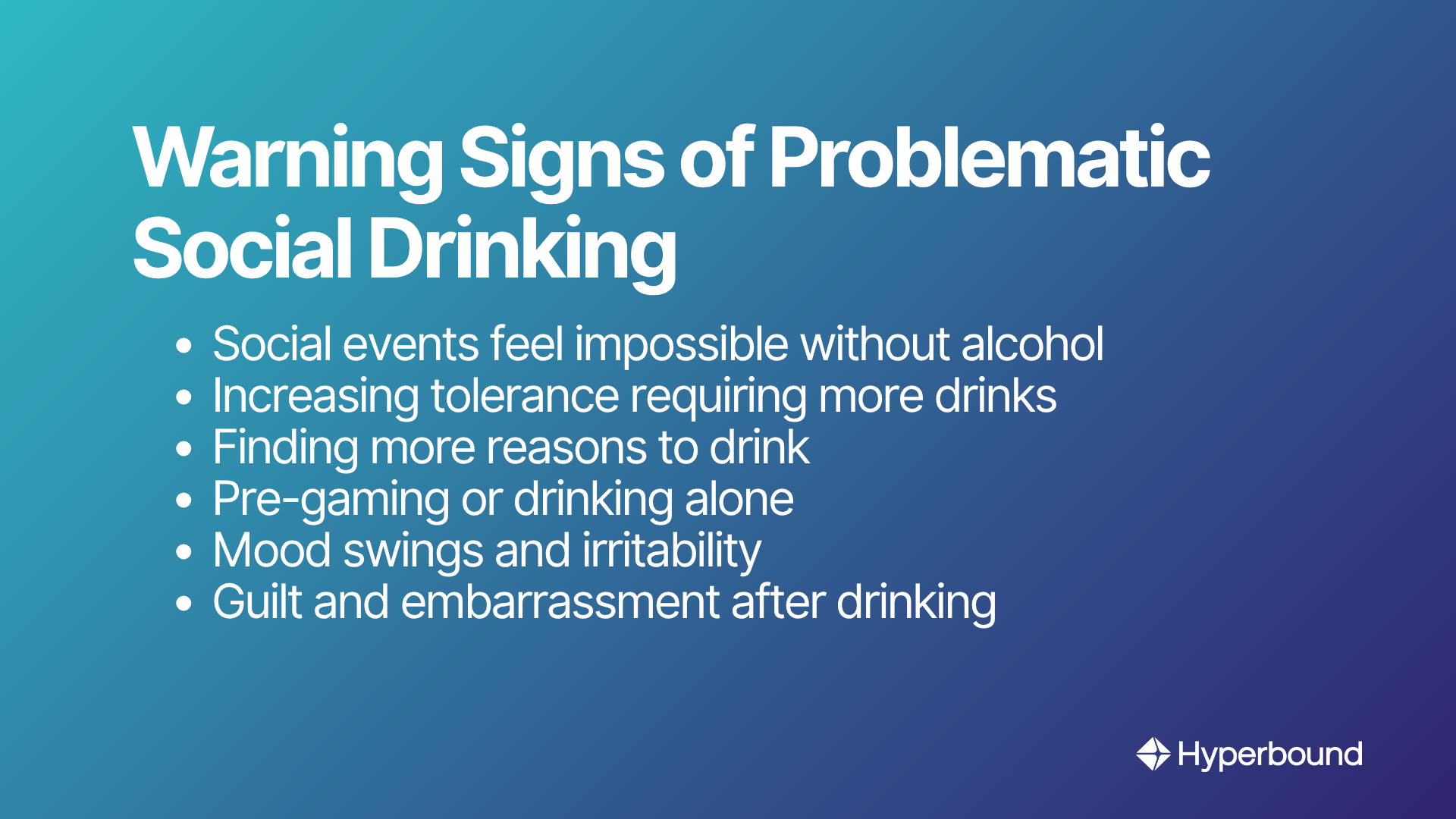
How do you know if your drinking has crossed from helpful to harmful? Here are the warning signs to watch for:
Early Warning Signs
- Social Dependency: You can't imagine attending a social event without drinking first. Every invitation immediately triggers thoughts of how and when you'll get that first drink.
- Increasing Tolerance: You used to need just one drink to feel comfortable in social settings, but now it takes two, three, or more to achieve that same tipsy feeling.
- Finding Reasons to Drink: What started as "just for parties" has expanded to include work functions, casual meetups, and even routine activities like watching TV or making dinner.
- Pre-gaming or Drinking Alone: You find yourself drinking before social events to "prepare" or calm your nerves, or drinking alone to practice social scenarios in your head.
Behavioral and Psychological Alarms
- Irritability and Mood Swings: You become noticeably agitated when you can't drink in social situations or when someone comments on your drinking.
- Guilt and Remorse: The morning after, you frequently feel embarrassed about your behavior or worried about what you might have said while drinking.
- Choosing Drinking Over Responsibilities: You've started prioritizing social events where alcohol will be available over other important commitments or relationships.
- Hiding Your Drinking: You downplay how much you've had to others or hide bottles so people won't know how much you're consuming.
Advanced Symptoms of Alcohol Use Disorder (AUD)
- Blackouts or Memory Loss: You experience gaps in your memory about what happened during social events where you were drinking.
- Inability to Stop: You've tried to cut back on your social drinking but find you can't stick to your limits.
- Experiencing Withdrawal: You feel anxious, irritable, or physically uncomfortable when you haven't had a drink for a while.
- Legal or Professional Problems: Your drinking has led to risky behaviors like driving under the influence or caused issues at work.
Time for a Self-Check: Are You Relying on Alcohol Too Much?
If some of those warning signs felt uncomfortably familiar, it might be time for an honest self-assessment. Here are some tools to help you evaluate your relationship with alcohol:
Simple Journaling Prompts
Before jumping to conclusions, try documenting your drinking patterns for two weeks. After each social event, answer these questions:
- Why did I drink today?
- How many drinks did I have?
- How did I feel before drinking?
- How did I feel while drinking?
- How did I feel the next day?
- Could I have managed the situation without alcohol?
This simple practice can reveal patterns you might not otherwise notice.
The CAGE Questionnaire
This quick four-question screening tool is widely used by healthcare professionals:
- Have you ever felt you should Cut down on your drinking?
- Have people Annoyed you by criticizing your drinking?
- Have you ever felt bad or Guilty about your drinking?
- Have you ever had a drink first thing in the morning (Eye-opener) to steady your nerves or get over a hangover?
Answering "yes" to two or more questions suggests a potential problem that warrants further evaluation.
The AUDIT Self-Test
For a more comprehensive assessment, try the Alcohol Use Disorders Identification Test (AUDIT), developed by the World Health Organization. This 10-question test provides more detailed feedback about your drinking patterns and potential risk level.
Questions from the DSM-5
Mental health professionals use these criteria from the Diagnostic and Statistical Manual of Mental Disorders to diagnose AUD. Meeting just two of these in a 12-month period can indicate a disorder:
- Have there been times you've drunk much more or longer than you intended?
- Have you wanted to cut down or stop drinking but couldn't?
- Have you spent a lot of time drinking, being sick, or getting over the aftereffects?
- Have you experienced a strong craving or urge to drink?
- Has drinking interfered with taking care of your home, family, job, or school responsibilities?
- Have you continued drinking despite it causing problems with family or friends?
When to Seek Professional Support
If you've tried these strategies but still find yourself struggling with alcohol dependency or severe social anxiety, it may be time to seek professional help.
- Therapy: Cognitive Behavioral Therapy (CBT) is highly effective for both anxiety and alcohol dependence, helping you change negative thought patterns.
- Medication: There are FDA-approved medications that can help reduce cravings and manage AUD, as well as medications specifically designed to treat social anxiety disorder.
- Support Groups: Organizations like Alcoholics Anonymous (AA) or SMART Recovery provide community and accountability.
For resources on finding help, visit the National Institute on Alcohol Abuse and Alcoholism.
Ditching the Crutch for True Confidence
Using alcohol as a social crutch is a common strategy—but it's one that carries significant risks. Recognizing the warning signs that you're becoming dependent on alcohol for social situations is the crucial first step toward building genuine confidence.
This principle of building skills through deliberate practice applies everywhere, from our personal lives to our professional careers. For instance, top sales professionals don't rely on luck; they build their confidence by practicing tough conversations in safe environments, using tools like Hyperbound's AI role-plays to prepare for any scenario.
Remember that authentic sober confidence takes time to develop, but it's infinitely more rewarding than the artificial, fleeting confidence that comes from a bottle. The goal isn't to become the life of every party—it's to be comfortable enough in your own skin that you can enjoy social interactions without needing chemical assistance.
As one Reddit user wisely noted: "The best is to be able to connect without any substance—it's just something that you need to work and learn and train." With practice and possibly professional support, you can learn to navigate social waters confidently, authentically, and soberly.

Frequently Asked Questions
What is the alcohol-anxiety cycle?
The alcohol-anxiety cycle is a process where a person drinks to relieve anxiety, feels temporary relief, and then experiences even greater anxiety (often called "hangxiety") as the alcohol wears off. This rebound anxiety prompts the person to drink again to find relief, reinforcing a dependency that can worsen both anxiety and alcohol use over time.
How can I build lasting sober confidence?
Building lasting sober confidence involves developing skills and strategies over time. This includes educating yourself about social anxiety, starting with small social interactions in low-pressure settings, and finding healthier stress-relievers like exercise or meditation. The goal is to gradually build your natural social skills through practice, so you no longer feel the need for a chemical crutch.
Want to see Hyperbound in action?
Try it now