
You've sat through yet another weekly sales coaching session where your manager tells you to "smile more and hammer the phones," while half your team is one rejection away from Googling forest retreat pricing. Sound familiar?
If you're skeptical about AI sales coaching tools, you're not alone. Many sales professionals feel these solutions are "a bit hyped up" or "awful at context-based coaching." The skepticism is warranted—early AI coaching tools often failed to deliver on their promises.
But the data tells a compelling story about why traditional coaching models are failing:
.png)
This isn't always the manager's fault. With 8-10 direct reports, providing deep, personalized coaching to every rep is nearly impossible. The result? Inconsistent performance, long ramp times, and a coaching model that can't keep pace with today's rapidly evolving sales landscape.
AI isn't about replacing managers—it's about giving them superpowers. It automates repetitive tasks and provides the data needed to transform coaching from a subjective art into a data-driven science. Here are five concrete ways AI coaching platforms are solving the oldest problems in sales development.
The Traditional Coaching Shortfall: Manager-led roleplays are time-consuming and difficult to schedule. Reps get limited chances to practice before a live call, especially when handling new products or messaging. There are never enough "at bats."
The AI Transformation: Platforms like Hyperbound provide a safe, repeatable environment for reps to practice critical conversations anytime, anywhere.
How It Works:
"I would love something like this where I can pre-load our most common objections/obstacles and have the system score them," noted one sales professional in a recent discussion about AI coaching tools.
The impact? Reps build muscle memory for handling objections, running discovery calls, or navigating pricing conversations without risking a live deal.
The Traditional Coaching Shortfall: Manager feedback is inherently subjective and varies from one manager to another. A rep's call score can depend on the manager's mood, personal style, or relationship with the rep, creating inconsistency and perceived unfairness.
The AI Transformation: AI analyzes 100% of recorded calls—both real and roleplayed—against a standardized, pre-defined methodology. It removes human bias from the evaluation process, ensuring every rep is measured against the same gold standard.
According to Salesforce, a key feature of AI coaching is its ability to eliminate coaching gaps and biases, ensuring uniform coaching across all sales reps.
How It Works:
The Traditional Coaching Shortfall: A manager with 8-10 direct reports simply cannot provide deep, personalized call coaching to every rep every day. Feedback is often delayed until a weekly 1:1, by which time the context is lost and the "coaching moment" has passed.
The AI Transformation: AI delivers immediate, personalized feedback after every single interaction. This creates a continuous learning loop where reps can self-correct and improve in near real-time.
The power of modern coaching is its ability to deliver training and guidance at the exact moment a rep needs it.
How It Works:
The results speak for themselves: 83% of sales teams using AI saw revenue growth, compared to only 66% not using AI, according to Salesforce AI Statistics.
The Traditional Coaching Shortfall: Coaching is often based on a manager's past experiences or the company's "tribal knowledge." There's no scalable way to confirm if the top performers' techniques are truly the reason for their success or to disseminate those techniques across the team.
The AI Transformation: AI analyzes thousands of sales conversations to identify the specific behaviors, talk tracks, and patterns that correlate with positive sales outcomes (e.g., meetings booked, deals closed).
How It Works:
Research shows that organizations using AI coaching can see 20-25% improvements in proficiency and 15% faster ramp-up times for new hires.
The Traditional Coaching Shortfall: Rolling out a new product message, competitive positioning, or sales methodology is a nightmare of workshops, slide decks, and inconsistent adoption. It's slow, and there's no way to certify that reps have actually mastered the new material.
The AI Transformation: AI platforms turn training from a one-time event into a continuous, measurable process. You can create specific roleplay scenarios based on the new playbook and require reps to practice until they are certified.
How It Works:
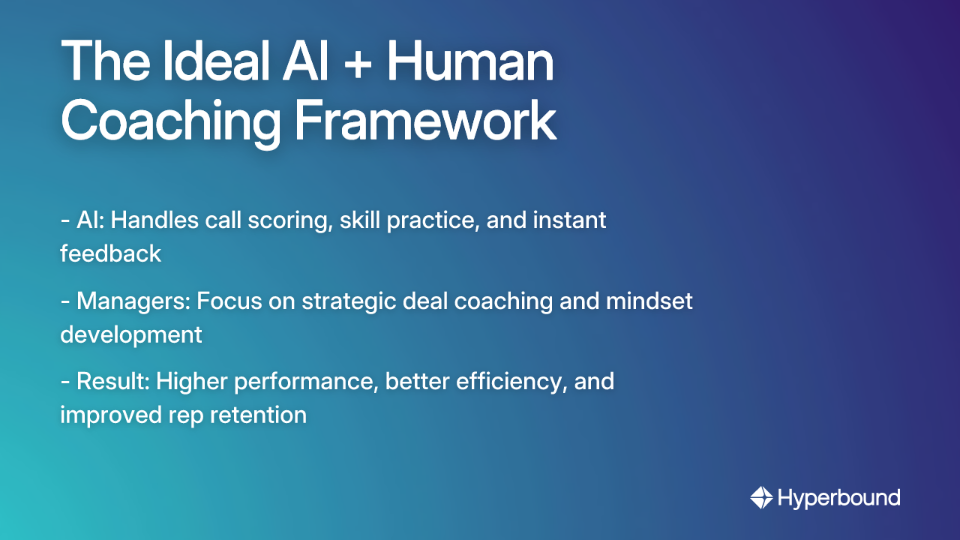
This isn't about creating robot sellers. The goal is to build a holistic coaching culture where technology and human insight work together—directly addressing the sentiment that "real learning happens on the job."
Let AI Handle:
Let Managers Handle:
This blended model allows managers to evolve from call reviewers into true performance coaches, driving both immediate results and long-term team development.
Traditional sales coaching is failing to keep pace due to its inherent limitations in scalability, consistency, and data analysis. AI selling tools aren't just a trend; they represent a fundamental shift, offering on-demand practice, objective feedback, personalized coaching at scale, data-driven insights, and rapid playbook adoption.
The most successful sales organizations won't choose between AI and human coaches. They'll leverage both, using platforms like Hyperbound to create a powerful, efficient, and holistic coaching engine that drives sustainable revenue growth.
By embracing AI-powered coaching tools, you can move beyond generic advice like "smile more and hammer the phones" to create a data-driven coaching program that delivers real results and addresses both the tactical and emotional aspects of selling in today's complex environment.
AI sales coaching is a technology that uses artificial intelligence to analyze sales conversations, provide feedback, and offer practice opportunities for sales representatives. It automates repetitive coaching tasks and provides data-driven insights to improve sales performance, complementing the strategic guidance provided by human managers.
AI provides feedback by analyzing 100% of recorded sales calls—both real and roleplayed—against a pre-defined set of criteria based on your company's sales methodology. It scores calls objectively, tracks adherence to talk tracks, identifies key moments like objections or buying signals, and provides immediate, unbiased feedback without the subjectivity of human review.
No, AI sales coaching is designed to augment, not replace, sales managers. The goal is a blended coaching model where AI handles tactical, time-consuming tasks like call scoring and providing instant feedback. This frees up managers to focus on high-value activities such as strategic deal coaching, motivation, mindset, and long-term career development.
The key benefits include unlimited on-demand practice for reps in a risk-free environment, objective and consistent feedback on every call, personalized coaching delivered at scale, data-driven insights into what winning behaviors actually look like, and faster, more uniform adoption of new sales playbooks.
AI accelerates playbook adoption by turning training into a continuous, measurable process. You can create specific AI roleplay scenarios based on a new product message or methodology. Reps can then practice these scenarios until they are certified, and management can track progress to ensure the entire team has mastered the new material consistently and effectively.
Yes, leading AI coaching platforms like Hyperbound are highly customizable. You can tailor roleplay scenarios to your specific Ideal Customer Profiles (ICPs), products, competitive landscape, and sales methodologies. This ensures that the practice and feedback reps receive are directly relevant to the real-world conversations they will be having.











Use Cases
Legal