
You've just wrapped up another discovery call that went sideways. The prospect threw you a curveball — a budget objection you didn't see coming, or a "we already use a competitor" line that left you scrambling. You practiced, sure, but the practice felt nothing like the real thing.
That's the core problem with most AI roleplay tools in 2026: they're built on generic scripts, not the messy, unpredictable reality of B2B sales. Sales reps on Reddit put it bluntly — AI tools "[lack] the ability to counter objections realistically, resulting in unchallenging role-plays," and many find them "a bit unrealistic for B2B sales role-playing." One commenter even pinpointed the fix: "I think that can be fixed by training the model with call recording data."
They're right. And that gap — between tools that feel like a quiz and tools that feel like a real conversation — is exactly what this guide is designed to help you close.
Discovery calls are the highest-leverage moment in any B2B deal. Get it right, and you set a trajectory toward close. Get it wrong, and you've burned a pipeline opportunity while still learning. The stakes are too high for generic practice.
This is the definitive buyer's guide for sales reps and enablement leaders evaluating AI tools specifically for discovery call roleplay practice — not generic training platforms. We'll walk through the four criteria that actually matter, then give you an honest evaluation of the top tools in 2026.
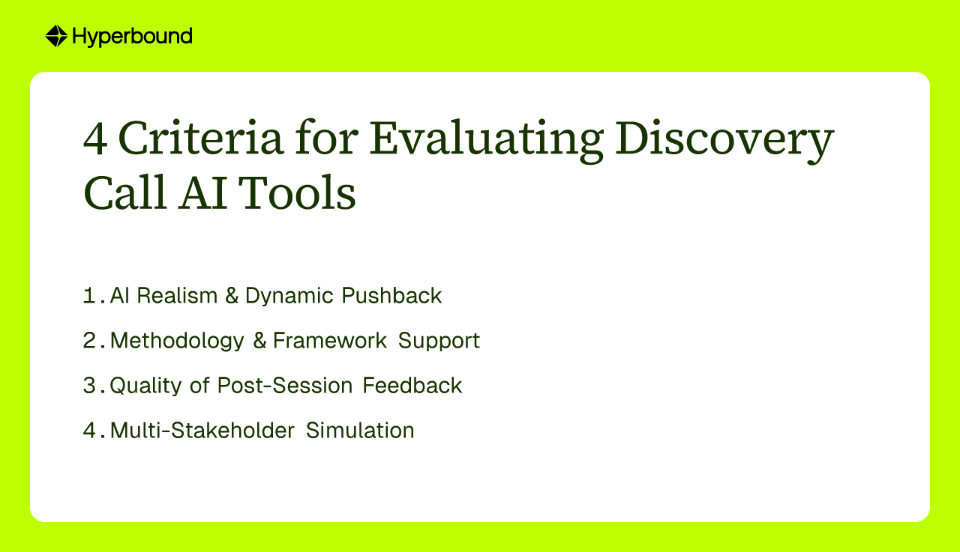
Before looking at any specific platform, get clear on your evaluation lens. Most tools market themselves as "AI roleplay," but that label hides enormous differences in quality. Here's what to look for.
The single biggest failure mode in AI roleplay tools is predictability. If a rep can "win" the simulation by memorizing a script, the tool isn't preparing them for real buyers — it's giving them false confidence.
A tool worthy of discovery call practice must handle unexpected questions, push back with nuanced objections, and adapt mid-conversation. Look for AI that's been trained on real buyer conversations, not internal scripts written by a content team.
Discovery isn't improvisation — it follows a methodology. Great discovery call roleplay practice should reinforce the frameworks your team runs on. In 2026, the most common for B2B SaaS teams include:
According to Sales Assembly's 2026 methodology guide, the best methodology depends on your deal size, sales motion, and team maturity. Your AI roleplay tool should support whichever framework you've chosen — and score reps against it after every session.
Reps don't improve from completing a simulation. They improve from understanding what they missed and why it mattered. Feedback needs to be instant, specific, and actionable.
Sales enablement leaders in practitioner communities are clear on this: "Management will not buy a tool like this on its own — they see feedback as being the most important element." Look for tools that track talk ratios, key selling moments, methodology adherence, and specific missed questions — not just a score out of 100.
Real discovery calls are rarely 1-on-1. In complex B2B deals, you're often navigating a champion (end-user), an economic buyer (CFO or VP), and sometimes a technical evaluator — all in the same call, with "different goals, different constraints, different definitions of 'success'."
If a tool can't simulate multi-stakeholder scenarios, it's not built for enterprise discovery. Full stop.
Here's a summary comparison of the leading tools, evaluated against the four criteria above:
.png)
G2 Rating: 4.9/5 | Simulations Delivered: 250,000+ | Training Data: 2M+ hours of real B2B sales conversations
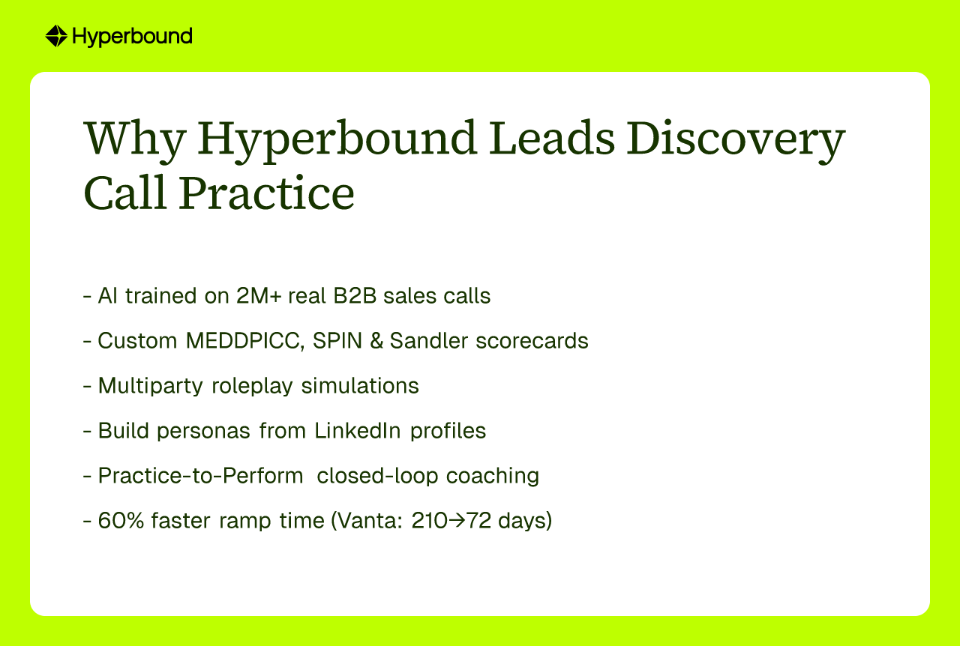
Hyperbound is the only platform in this list built specifically to close the gap between call data and rep performance. It coined the category "Revenue Activation" — the idea that data alone doesn't change outcomes; reps need to practice the behaviors that win deals before they're on a live call.
Why it's #1 for discovery call practice:
The biggest differentiator is what powers the AI. Hyperbound's buyer personas are trained on 2M+ hours of real B2B sales conversations — not internal scripts or generic templates. That means when a rep practices a discovery call, the AI buyer pushes back the way a real CFO or VP of Operations actually would: skeptically, unpredictably, and with real objections that don't follow a script.
Key features for discovery teams:
Honest trade-off: Hyperbound is a comprehensive platform. If you're a solo enablement leader supporting 10 reps with no implementation bandwidth, expect to invest some time in setup. The white-glove onboarding (Planning Call → Bot Buildout → Scorecard Buildout → Launch) is thorough, but it's not a tool you'll deploy in an afternoon.
Best for: B2B SaaS sales teams serious about shortening ramp time, improving discovery quality, and connecting training to real deal outcomes.
Second Nature is a well-regarded AI roleplay platform that uses engaging avatars and a gamified experience to make practice sessions feel less like homework. It works well for standardized onboarding and getting new reps comfortable with basic discovery frameworks.
Strengths: Strong multilingual support, solid scenario library, approachable UX for new reps who find roleplay intimidating.
Trade-offs for discovery call practice: Second Nature relies on templates and pre-built content — not real buyer call data. The result is AI that can feel predictable once reps run a few sessions. It doesn't push back the way a real skeptical buyer would, which limits its effectiveness for practicing high-stakes discovery calls where the buyer actively tests you. It also lacks multi-stakeholder simulation, making it less suitable for complex enterprise deals.
Let's be clear: Gong is an excellent tool. It records, transcribes, and analyzes your team's real sales calls, surfacing patterns across thousands of conversations. If you want to understand what your top reps are doing differently in discovery calls, Gong's library is invaluable.
The problem: Gong has no practice layer. Reps can watch great discovery calls in Gong's library. They can read coaching notes. But they can't practice — they can't run their own simulation, fail safely, and try again. Analysis without rehearsal is like watching game film without ever running the play.
That's why Hyperbound and Gong are complementary, not competitive. Hyperbound integrates directly with Gong — real call data flows into Perform, gaps are identified, and reps are routed to targeted roleplay sessions in Practice. It closes the loop Gong can't close on its own.
SalesHood is a sales enablement platform that emphasizes peer video sharing and manager-led learning paths. It's genuinely useful for building a library of best-practice discovery calls from your top reps and distributing that knowledge across the team.
Trade-offs for discovery call roleplay practice: SalesHood is LMS-first. Its "roleplay" feature primarily means recording yourself and submitting for peer or manager review — not interacting with a dynamic AI buyer. That means feedback is slow (it requires a human to watch and comment), inconsistent across managers, and doesn't scale when you have 100+ reps who need practice. It's a great complement to a dynamic simulation tool; it's not a substitute for one.
Pitch Monster brings strong gamification to AI roleplay — leaderboards, scoring, and competitive mechanics that drive adoption among junior reps. For early-stage teams running high-volume SDR motions, it can be a solid entry point.
Trade-offs for discovery call practice: Pitch Monster uses generic sales scenarios and lacks the customization needed for complex B2B discovery. It's not trained on real call data, so the AI buyer tends to be less nuanced. For teams practicing straightforward cold calls or basic objection handling, it works. For teams that need to master consultative, multi-threaded discovery against sophisticated buyers, it falls short.
Mindtickle is a full-stack revenue enablement suite — LMS, content management, coaching, and roleplay combined into one platform. For enterprise organizations that need curriculum management, certifications, and compliance training alongside roleplay, it offers real breadth.
Trade-offs for discovery call practice: Roleplay in Mindtickle is a feature, not the core product. It uses traditional learning content as its foundation rather than real call data, so AI simulation realism is more limited. Multi-stakeholder practice isn't available. For organizations that already have Mindtickle deployed for LMS purposes, adding its roleplay module is a natural extension — but teams prioritizing discovery call fidelity should weigh whether a dedicated tool would deliver better outcomes.
Discovery calls don't get better through slidedecks, call recordings you watch once and forget, or AI bots that fold the moment you go off-script. As one sales practitioner put it plainly: "Sales teams today don't really learn from slides and PPTs; they learn through practice and real context."
The tools that actually move the needle are the ones built on real buyer data, grounded in your methodology, and connected to what's happening in your live deals.
Most tools in this list offer some version of roleplay. But there's a meaningful difference between a simulation built from generic scripts and one trained on 2M+ hours of how real B2B buyers actually respond — with skepticism, curveballs, competing priorities, and the occasional "I have to run, let's reschedule."
If discovery call roleplay practice is a priority — and it should be, given that discovery sets the trajectory for every deal that follows — the evaluation criteria are clear: realism of AI pushback, methodology alignment, quality of post-session feedback, and multi-stakeholder simulation capability. Stack every tool in this guide against those four pillars, and the decision becomes straightforward.
An AI tool for discovery call roleplay is a software platform that allows sales representatives to practice their discovery conversations with a simulated AI buyer. Unlike traditional methods, these tools provide a safe, repeatable environment for reps to hone their skills, handle objections, and master their sales methodology before engaging with real prospects.
Realistic AI roleplay is crucial because real-world sales conversations are unpredictable and don't follow a script. A realistic AI, trained on actual B2B call data, can push back with nuanced objections, ask unexpected questions, and mimic the behavior of a real buyer. This prepares reps for the messy reality of sales, building their confidence and competence in a way that generic, script-based tools cannot.
A good AI discovery call practice tool should excel in four key areas. First, it must offer AI realism and dynamic pushback to challenge the rep. Second, it needs to support and reinforce your team's specific sales methodology, like MEDDPICC or SPIN. Third, it should provide high-quality, instant post-session feedback that is specific and actionable. Finally, for complex sales, it must be capable of multi-stakeholder simulation, allowing reps to practice navigating conversations with multiple buyers at once.
Advanced AI platforms can simulate calls with multiple stakeholders by creating distinct AI personas within a single roleplay session. For example, a rep can practice a call with both a champion (like an end-user focused on features) and an economic buyer (like a CFO focused on ROI). Each AI persona has different goals, objections, and communication styles, mimicking the complexity of a real enterprise discovery call.
Yes, the best AI roleplay tools are designed to integrate directly with established sales methodologies. Platforms like Hyperbound allow sales enablement leaders to build custom scorecards based on frameworks like MEDDPICC, SPIN, or Sandler. After each practice session, the AI scores the rep's performance against the specific criteria of that methodology, such as whether they successfully identified pain points, confirmed the decision process, or established metrics for success.
The main difference is their core function: practice versus review. A conversation intelligence tool like Gong records and analyzes past calls to identify what has happened. A practice tool like Hyperbound provides a simulated environment for reps to rehearse and prepare for what will happen. While analysis is valuable for insight, practice is essential for changing behavior. The two are complementary; insights from Gong can inform what a rep needs to practice in Hyperbound.











Use Cases
Legal