
If you lead sales enablement at a B2B SaaS company, you already know the question is coming. Leadership will ask — probably this quarter — for "the ROI of sales enablement." And if your answer is a slide deck with completion rates and satisfaction scores, the budget conversation is over before it starts.
As one enablement leader put it on Reddit: "The biggest pain in my ass question that I get from my leadership team at least once a quarter is some sort of quantitative reporting that asks for the 'ROI of sales enablement.'" (Source)
The real problem isn't that sales training doesn't work. It's that most AI sales training platforms can't produce evidence that it does. Training is always "nice to have" until someone asks "cool, but where's the revenue?" (Source)
This article evaluates five AI sales training platforms for B2B SaaS through one lens only: can they prove ROI? Not vague "readiness improvement" — actual, revenue-centric metrics your CRO will recognize.
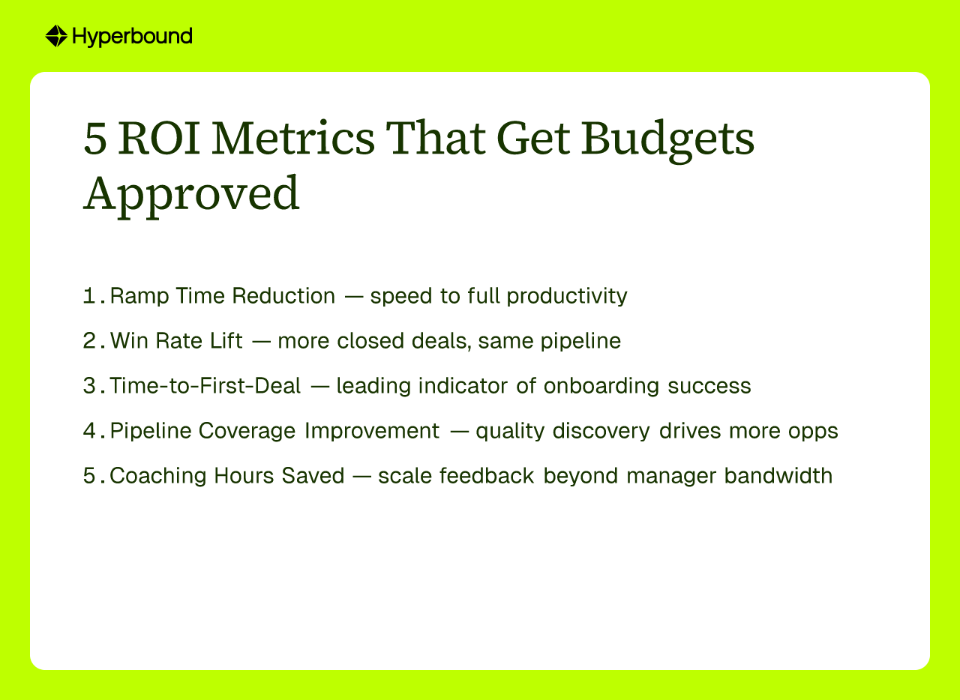
Before we review a single platform, we need to agree on the evaluation criteria. These are the metrics that get budgets approved:
With those criteria established, here's how the leading platforms stack up.
What they can prove:
.png)
Hyperbound is the only platform here that leads with a validated proof-point stack — not aspirational case study language, but specific, named-customer numbers. Vanta's CRO Stevie Case publicly credited Hyperbound with shrinking BDR ramp from 210 days to 72 — a 60% reduction — while growing the BDR team 4x and driving 5x pipeline. Nivoda's Director of Sales Performance Rob Rangel cited a 150% increase in demo conversion rates alongside 2x revenue YoY after deploying the platform.
How Hyperbound delivers those numbers:
Hyperbound coined the term Revenue Activation to describe what happens when teams stop just analyzing call data and start using it to change outcomes. Its three products form a connected loop:
The operational loop — Score Real Calls → Identify Skill Gaps → Practice Roleplays → Score Real Calls — is what separates Hyperbound from platforms that treat training as a one-time event rather than a continuous improvement cycle.
With a 4.9/5 G2 rating, 45,000+ active users, and customers including Autodesk, LinkedIn, Monday.com, and Bloomberg, Hyperbound enters this list as the clearest example of an AI sales training platform for B2B SaaS that can walk into a CFO's office with data.
What they can prove:
.png)
These tools focus on rep certification and structured simulation — they're competent for running reps through scripted objection handling and compliance-style certifications. For teams that need a scalable way to verify playbook knowledge before reps go live, they're a reasonable choice.
The gap: Their AI roleplays aren't trained on your specific customer conversations or the behaviors of your top performers. When reps describe wanting training that doesn't give "generic answers", generic scenario libraries are exactly the problem. More critically, these platforms don't lead with quantified business outcomes. You can build a case for "reps completed certification," but you'll struggle to answer "what did that do to ramp time or quota attainment?"
Best for: Teams with structured certification requirements who don't yet need to tie training to revenue metrics.
What they can prove:
These are comprehensive platforms: content management, call coaching, onboarding, and AI roleplay are all bundled into one suite. For large enterprise enablement programs with complex content libraries and multi-team rollouts, these suites have real breadth.
The limitation for ROI-focused buyers is that their value proposition centers on "readiness" — a proxy metric rather than a revenue metric. If your leadership team is asking "what did this do to win rates?", their reports will show you completion percentages and readiness scores, not pipeline outcomes. These platforms lack the deal-level coaching layer that connects training behavior to closed-won results.
Best for: Large enterprises with mature enablement programs that prioritize content governance and structured learning paths over real-time deal coaching.
What they can prove:
These tools' core strength is speed-to-deploy. Their AI practice scenarios and virtual avatar capabilities let enablement teams spin up and distribute training content quickly, which makes them useful for product launch enablement or fast-changing competitive messaging.
Where these platforms fall short in an ROI evaluation: they are built around content consumption, not behavior change measurement. Watching and practicing scenarios is a starting activity — the question that matters is whether the behavior shows up on real calls and in real deals. These platforms don't close that loop, and without that connection, the evidence chain from training to revenue breaks down.
Best for: Teams with high-frequency content update cycles who need rapid deployment of training materials.
What they can prove:
These point solutions position themselves around performance management with integrated reporting — the idea being that practice and performance data live in the same system. Their roleplay fidelity is solid, particularly for custom and technical scenarios that require specific domain knowledge.
The challenge is the same as the others: these tools don't lead with validated, publicly available ROI metrics that an enablement leader can cite in a budget conversation. The "closed-loop" framing is conceptually strong, but without proof points attached to real customers and real revenue outcomes, the loop is more aspirational than evidenced.
Best for: Teams that want a unified practice and performance reporting environment and are willing to build their own ROI case from internal data.
You can't walk into a budget conversation with vendor marketing copy. You need your own numbers. Here's how to build the case — using Hyperbound's validated metrics as your benchmark targets.
This approach borrows from the Six Sigma DMAIC framework that experienced RevOps practitioners recommend for exactly this situation: measure, analyze, and control the data before and after any enablement intervention.
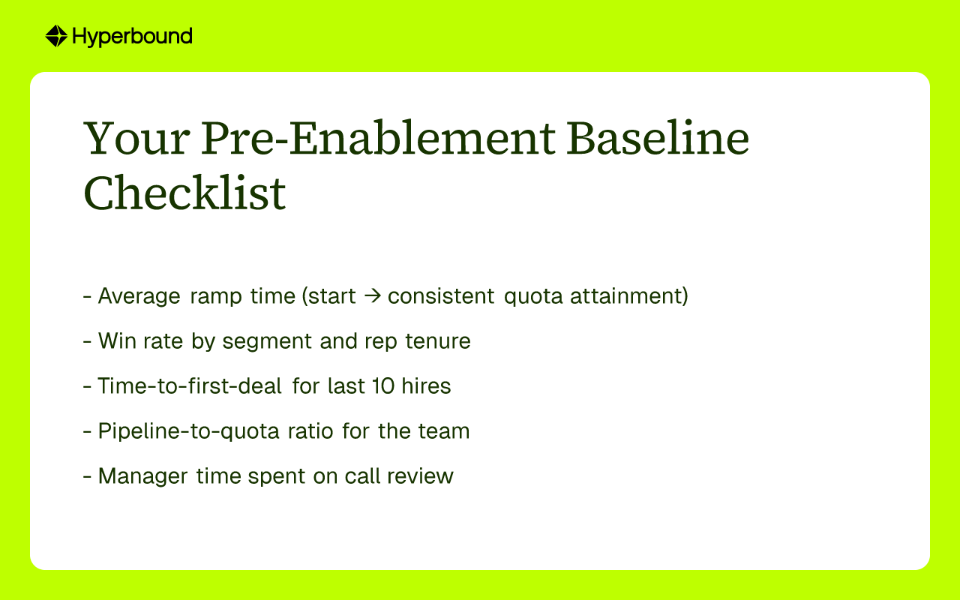
You cannot prove ROI without pre-enablement data. Pull at least two to three quarters of the following:
These numbers are your CFO's starting point. Without them, every claim you make about improvement is anecdotal.
As one RevOps practitioner recommended: "What are the leading indicators that influence win rates? Focus your enablement efforts on those." (Source)
Work with your sales leadership to identify one or two specific behaviors that correlate with closed-won deals in your environment — quality discovery questions asked, multi-threading into a second stakeholder, handling a specific recurring objection. Don't try to train everything at once. Narrow the target so the impact is measurable.
Select a pilot cohort — a new hire class, one pod, or a single regional team — and run them through the AI sales training platform. Keep a control group on your existing training approach. This is the only reliable way to isolate the tool's impact from other variables like market conditions or territory changes. Even a six-to-eight week pilot with clean data is enough to build a credible story.
After the pilot period, pull the same metrics from Step 1 for both groups and calculate the gap. Then convert improvement into revenue terms:
Present these numbers as a range — conservative, base case, and upside — so leadership can see the floor, not just the ceiling.
The AI sales training market is crowded and the feature lists are long. But most platforms are selling inputs — simulations completed, certifications earned, hours of content consumed. None of that answers the question your leadership team is already drafting for their next QBR.
The distinction that matters is simple: can your platform of choice tell you — with a customer name attached — what happened to ramp time, deal velocity, or conversion rates after deployment? For most platforms on this list, the honest answer is no.
For enablement leaders at B2B SaaS companies who need to walk into a budget conversation with proof, the evaluation should start with the platform that has already built that case: Hyperbound. A 60% ramp reduction at Vanta, 2x faster time to first won deal, 150% demo conversion lift at Nivoda, and 3.5 workweeks of coaching saved per manager aren't marketing estimates — they're the benchmark your own pilot should be measured against.
Training that can't prove its impact on revenue isn't an investment. It's a cost center waiting to be cut. The platforms that survive the next round of budget scrutiny will be the ones that come with receipts.
The five most important ROI metrics are Ramp Time Reduction, Win Rate Lift, Time-to-First-Deal, Pipeline Coverage Improvement, and Coaching Hours Saved. These metrics directly connect enablement efforts to revenue outcomes that CFOs and CROs care about, moving beyond vanity metrics like completion rates or satisfaction scores. Tracking these provides concrete evidence of a platform's financial impact.
To prove ROI, you must first establish baseline performance metrics, run a controlled pilot with a specific training intervention, and then measure the improvement (the delta) and attach a dollar value to it. This involves tracking data like average ramp time and win rates before the pilot. Then, compare a pilot group using the new platform against a control group. The difference in performance, translated into revenue, forms a credible business case.
An AI sales training platform is a tool that uses artificial intelligence to help sales representatives practice and improve their skills in a simulated environment. These platforms often include features like AI role-playing with dynamic buyer personas, call analysis, and personalized coaching recommendations. The goal is to provide scalable, consistent, and data-driven training that directly impacts sales performance on real deals.
Many AI role-playing tools feel unrealistic because they are built on generic scripts rather than real-world conversation data specific to your industry and customers. This results in AI personas that can't handle unexpected questions or adapt to a real B2B sales conversation. Platforms like Hyperbound solve this by training their AI on millions of hours of actual B2B sales calls, creating more realistic and challenging practice scenarios.
AI sales training reduces ramp time by allowing new hires to practice critical sales skills in a safe, simulated environment, accelerating their path to full productivity. Instead of learning on live customer calls, reps can run through hundreds of AI roleplays to master objection handling, discovery, and product messaging. This intensive, targeted practice compresses the learning curve, with some platforms delivering ramp time reductions of up to 60%.
Hyperbound's primary differentiator is its focus on providing validated, public proof points for revenue-centric ROI metrics like ramp time reduction and conversion rate lift. While many "sales readiness" suites focus on broad features and proxy metrics like "readiness scores," Hyperbound connects training activities directly to deal outcomes. Its platform creates a continuous improvement loop—analyzing real calls, identifying skill gaps, generating targeted AI practice, and measuring the impact back on real-world performance.









Use Cases
Legal