In today's hypercompetitive sales landscape, the difference between hitting quota and falling short often comes down to your tech stack. But with the explosion of AI tools flooding the market, many reps are experiencing serious FOMO while simultaneously feeling overwhelmed by options. As one frustrated BDR recently shared on Reddit, "I'm struggling to find effective uses of AI outside of personal entertainment" – a sentiment echoed across sales floors everywhere.
This isn't just another listicle of shiny AI objects. We've cut through the noise to deliver a practical, role-based roadmap for building an AI sales stack that actually delivers results. Based on real-world feedback from top-performing reps and backed by concrete data, these 12 tools will save you time, boost performance, and help you close more deals in 2025.
.png)
What it is: A powerful data enrichment platform that uses AI to automate the creation of highly personalized outreach campaigns.
Why it matters: Moving beyond basic "[First Name]" personalization is crucial for breaking through inbox clutter. Clay allows you to pull in a prospect's recent LinkedIn post, company funding announcements, or specific pain points from job descriptions.
Proven results: According to Clay's blog on AI Sales Prospecting, teams using AI-driven personalization have seen a 5x boost in positive response rates, doubling responses while sending half the volume of emails.
Pricing: Tiered pricing based on usage/credits, starting at $149/month.
Pro tip from top performers: Use Clay's AI to identify uncommon connection points between you and your prospect that aren't obvious from a LinkedIn scan. The FOMO trigger of "I noticed you were also at..." can dramatically increase open rates.
What it is: An AI-powered answer engine that functions like a conversational research assistant, providing sourced answers to complex questions.
Specific use cases:
User pain addressed: This directly solves the problem of "inefficiencies in the manual process" of research that so many SDRs struggle with.
Pricing: Free tier available, Pro subscription at $20/month.
Integration potential: Can feed insights directly into your CRM or outreach sequences.
What it is: The ubiquitous large language model that has transformed how sales professionals draft their communications.
Best uses for sales:
Pricing: Free version (GPT-3.5) and paid Plus/Team/Enterprise tiers (GPT-4) starting at $20/month.
Warning from the field: One rep noted, "I run my emails through ChatGPT for polish, but you still need to add your personal touch or risk sounding like everyone else." The key is using ChatGPT as an enhancer, not a replacement for your authentic voice.
What it is: An AI assistant known for its large context window (up to 200,000 tokens) and nuanced text analysis.
Unique advantage: Claude excels at analyzing lengthy documents and providing more contextual understanding than most competitors.
Best applications:
Pricing: Free tier available, with Claude Pro at $20/month and Claude Team at $30/user/month.
What it is: A core feature of the Hyperbound platform that uses AI to record, transcribe, and automatically score real customer conversations against your specific sales methodology.
Key metrics that matter:
Pricing: Included with the Hyperbound platform (custom pricing).
Integration capabilities: Integrates with your CRM and call recording systems to analyze conversations wherever they happen.
What it is: A free AI meeting assistant that records, transcribes, highlights, and summarizes your meetings so you can focus on the conversation instead of note-taking.
Why sales teams love it:
Pricing: Free for basic functionality, Team tier at $19/user/month.
What it is: An AI-powered roleplay platform where reps can practice any sales conversation—from cold calls to competitive takeouts—in a hyper-realistic, safe-to-fail environment.
Game-changing features:
ROI metrics: By enabling reps to practice effectively at scale, customers report up to a 50% reduction in new hire ramp time and a 30% increase in meeting conversion rates.
When to use it: Ideal for onboarding new reps, rolling out new messaging, certifying teams on a new sales methodology, or preparing for tough negotiations.
What it is: Microsoft's AI assistant that works across Office applications to streamline workflows.
Sales-specific applications:
Pricing: $30/user/month for business users.
What it is: Native AI capabilities built directly into Salesforce that enhance data management and provide predictive insights.
Key features for sales teams:
Pricing: Included with various Salesforce editions or as add-ons starting at $50/user/month.
What it is: An AI-powered email assistant that coaches reps to write more effective emails and provides real-time scoring.
Why reps love it: Lavender analyzes your email draft against thousands of successful sales emails and provides specific recommendations to improve response rates.
Pricing: Starting at $29/user/month for the Pro tier.
What it is: An AI-enhanced document and e-signature platform designed specifically for sales teams.
Stand-out capabilities:
Pricing: Starting at $15/user/month.
.png)
To avoid the overwhelm that comes with adopting too many tools at once, here's a phased implementation approach:
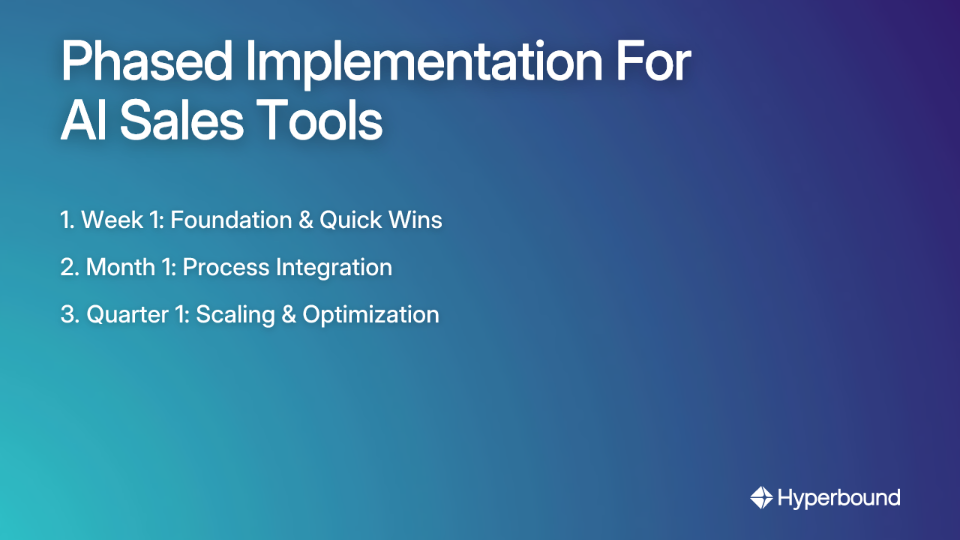
Week 1: Foundation & Quick Wins
Month 1: Process Integration
Quarter 1: Scaling & Optimization
The goal of an AI sales stack isn't to automate the humanity out of selling—it's to eliminate tedious work so you can focus on what you do best: building relationships and solving customer problems.
Start with your biggest pain point. Is it slow prospecting? Inconsistent messaging? Ineffective coaching? Pick one tool from this list that addresses that specific challenge, master it, and build from there.
The future belongs to sellers who learn to partner effectively with AI, using it to augment their natural talents rather than replace them. As one top-performing rep put it: "AI doesn't close deals. AI-empowered salespeople do."
An AI sales stack is a curated set of artificial intelligence tools designed to enhance every stage of the sales process, from prospecting to closing. This collection typically includes tools for data enrichment (like Clay), communication assistance (like ChatGPT), meeting analysis (like Fathom), and skill development (like Hyperbound). The primary goal is to boost efficiency and performance, freeing up reps for high-value human interactions.
To choose the right AI tools, first identify your team's most significant pain point—whether it's inefficient prospecting, inconsistent messaging, or a lack of effective coaching. Then, select a tool that directly addresses that specific need. Use the article's role-based decision matrix to guide your choice. It's more effective to master one or two high-impact tools before expanding your stack.
AI transforms sales prospecting by automating research and enabling hyper-personalization at scale. AI platforms like Clay can automatically pull relevant, personalized details for outreach, while research assistants like Perplexity can instantly summarize a company's strategic priorities. This allows you to craft messages that resonate deeply with prospects, leading to significantly higher response rates.
For sales coaching and practice, Hyperbound's AI Sales Roleplays platform is a leading solution. It provides a hyper-realistic, safe-to-fail environment where reps can practice any sales scenario against AI buyers trained on your company’s specific use cases and objections. It offers instant, objective feedback that helps reps quickly master winning behaviors, reducing ramp time and improving conversion rates.
No, AI is not expected to replace sales reps; it's designed to augment their abilities. AI excels at handling repetitive, time-consuming tasks like data entry and initial research. This frees up sales professionals to concentrate on strategic activities where humans excel: building relationships, complex problem-solving, and closing deals. Sellers who partner effectively with AI will become more valuable, not obsolete.
Yes, you can build a solid foundational AI sales stack with free tools. Platforms like Perplexity, Fathom, and the free versions of ChatGPT offer excellent value for research, meeting summaries, and drafting content. While these are great starting points, specialized paid tools like Hyperbound (for coaching) or Clay (for scaled outreach) are often necessary to achieve a significant competitive advantage and higher ROI.
While all are powerful AI assistants, they serve different sales functions. ChatGPT is a versatile writing partner, ideal for drafting email sequences and scripts. Claude excels at analyzing and summarizing very long documents due to its large context window, making it perfect for digesting annual reports. Perplexity is a conversational research engine that provides sourced answers to complex questions, making it invaluable for pre-call research.










Use Cases
Legal