
You've seen the headlines. You've heard the promises. "AI will revolutionize sales!" "Replace your SDRs with bots!" "10X your pipeline with one click!"
Yet if you're like most sales professionals, your experience with AI has been far less impressive. Perhaps you've used ChatGPT to draft some "bullshit internal emails" or generate "generic content" that needed substantial reworking. Maybe you feel "behind in ever AI" as new tools and capabilities emerge daily.
The gap between AI hype and reality in sales is vast. While vendors promise automated voice avatars that close deals while you sleep, most salespeople are just trying to find practical applications that actually save time and drive results.
Here's the truth: The most valuable AI applications in sales aren't about replacing humans—they're about eliminating the low-value tasks that drain your energy and amplifying your uniquely human abilities to connect, understand, and solve problems.
This article cuts through the noise to showcase three concrete, proven AI applications that deliver tangible ROI for sales teams today:
No hypotheticals. No vague promises. Just practical applications that top-performing sales teams are implementing right now.
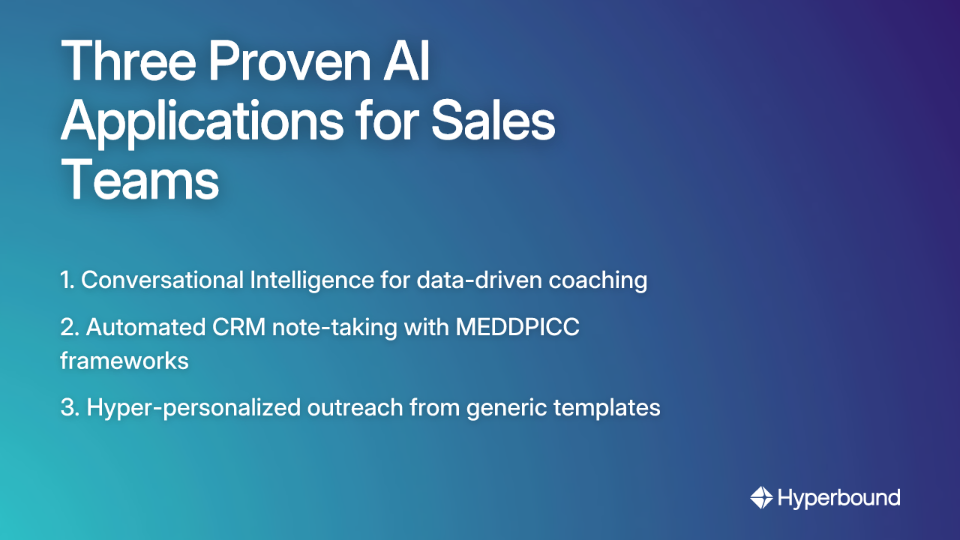
Perhaps the most mature and impactful application of AI in sales today is what many refer to as Conversational Intelligence. As one sales leader on Reddit noted, "The stuff Conversational Intelligence companies are doing with AI call coaching are the best applications so far."
But what makes this technology so valuable?
Traditional sales coaching relies heavily on managers listening to a handful of calls, providing subjective feedback based on what they remember, and hoping reps implement their suggestions. This approach is inconsistent, time-consuming, and often biased toward recent interactions.
Conversational Intelligence platforms change the game by analyzing every customer interaction at scale:
According to recent industry research, organizations investing in AI for sales enablement see a 13-15% increase in revenue and a 10-20% increase in sales ROI. These aren't hypothetical benefits—they're measurable results from real implementations.
While analyzing past calls is valuable, the most innovative teams are taking AI coaching a step further by using it proactively. This is where platforms like Hyperbound are changing the game.
Hyperbound's AI Sales Roleplays allow reps to practice their skills in a safe, repeatable environment before high-stakes customer conversations. They can simulate everything from cold calls and discovery to handling specific objections related to a new product launch.
This approach scales coaching beyond manager availability. Reps get instant, personalized feedback from Hyperbound's AI Coaching engine after every roleplay, aligned perfectly with company methodology.
The result? Reduced ramp time for new SDRs and consistent execution of sales playbooks across the entire team.

The second high-impact application of AI tackles one of sales' most persistent pains: administrative work and CRM data entry.
Consider this startling reality: According to Gartner, only 7% of sales teams achieve 90% accuracy in their forecasts. A primary culprit? Inconsistent, incomplete CRM data because reps hate manual note-taking and data entry.
One sales professional found a practical solution: "We have some tool that takes the transcripts from our calls, takes notes in MEDDPICC form and auto updates them into SFDC. Saves me a ton of time as I found it to be accurate enough for the CRM."
This application demonstrates how AI should be deployed in sales—not to replace the human-to-human conversation, but to eliminate the administrative burden that follows it.
For those unfamiliar, MEDDPICC is a comprehensive sales qualification framework that helps reps systematically qualify opportunities:
.png)
Traditionally, salespeople would have to listen back to their calls, identify relevant information for each category, and manually update their CRM. It's tedious, time-consuming, and often neglected.
AI transforms this process:
The benefits extend beyond time savings. When your CRM contains accurate, comprehensive MEDDPICC data for every opportunity, sales leaders can conduct more effective deal reviews, provide targeted coaching, and generate more accurate forecasts.
As one sales manager put it: "My reps spend more time selling and less time typing, and I have better visibility into our pipeline than ever before."
The third practical application addresses perhaps the most common (and most disappointing) use of AI in sales today: content generation.
Many salespeople have experimented with tools like ChatGPT for creating outreach messages, only to be underwhelmed by the results. As one Reddit user bluntly stated, "AI is terrible at generating good text copy, but it is phenomenal at modifying and processing existing texts."
This insight reveals the true power of AI in sales communication: not as a replacement for human creativity, but as a tool for efficient personalization at scale.
The most successful sales teams are using AI not to generate emails from scratch, but to customize proven templates for specific customer niches:
Specialized AI email coaching tools can enhance this process by analyzing your messaging in real-time and suggesting improvements before you hit send.
This approach yields dramatically better results than asking AI to generate content from scratch. One sales leader reported: "Our response rates jumped from 2% to 11% when we started using AI for personalization rather than generation."
A telecommunications company implemented this approach for their telemarketing team with impressive results. Rather than using generic scripts, they created strong baseline templates and used AI to customize them for each prospect's industry and specific pain points.
The results were striking:
The key insight? AI wasn't writing the core message—it was tailoring proven messaging to specific contexts, making each interaction feel personalized without requiring hours of manual research.
As we've seen, the most valuable AI applications in sales today aren't about replacing human sellers or generating generic content. They're about:
The companies seeing the greatest ROI from AI in sales understand a fundamental truth: AI should handle data and repetitive tasks, freeing humans to do what they do best—build relationships, think strategically, and close deals.

If you're looking to implement AI in your sales organization, start with these concrete steps:
The future of sales isn't about replacing humans with automated voice avatars or letting AI handle customer relationships. It's about creating a powerful partnership where AI handles the mundane so that human sellers can focus on what truly matters: understanding customer needs, solving complex problems, and building lasting relationships.
By focusing on these practical applications rather than chasing every shiny new AI feature, you'll cut through the hype and deliver measurable improvements to your sales performance.
Ready to see how AI can transform your sales team's practice and performance? Explore Hyperbound's AI Sales Roleplays to discover how your team can master the conversations that close deals without risking real opportunities.
Sales teams should start by using AI to automate low-value administrative tasks and enhance existing workflows, rather than trying to replace core human functions. Focus on identifying the biggest time-wasters, such as manual CRM data entry or sifting through call recordings. Implementing tools for automated note-taking or using AI to personalize proven email templates are excellent starting points that deliver immediate, tangible value.
AI-powered sales coaching uses technology to analyze sales conversations at scale, providing objective, data-driven feedback to help representatives improve their skills. Unlike traditional coaching, which relies on a manager's subjective review of a few calls, AI tools transcribe and analyze every interaction. They can score calls against a set methodology, identify key moments, and even provide a safe environment for practice through AI roleplays.
No, the most effective use of AI in sales is not to replace reps, but to act as a co-pilot that eliminates administrative tasks and amplifies their ability to sell. The core of sales relies on uniquely human skills like building relationships and strategic thinking. AI is best suited to handle repetitive, data-heavy tasks, freeing up salespeople to focus on high-impact activities that close deals.
While AI can generate generic email drafts, its true power lies in personalizing proven, human-crafted templates at scale, not creating them from scratch. Relying solely on AI to generate outreach often results in generic copy. A more effective approach is to start with a strong template and use AI to incorporate specific insights about a prospect, combining human creativity with AI's efficiency for higher response rates.
AI improves CRM data and forecasting accuracy by automating the process of capturing and structuring call notes into sales frameworks like MEDDPICC. AI tools can listen to sales calls, automatically extract key information related to metrics, decision criteria, and pain points, and sync that structured data directly into the correct CRM fields. This ensures consistent, high-quality data, giving leaders a much clearer view of the pipeline.
The main benefit of AI sales roleplays is providing a safe, scalable environment for reps to practice critical conversations and receive instant, objective feedback without needing a manager present. This allows for consistent coaching and skill development across the entire team, reducing ramp time for new hires and ensuring everyone can execute key playbooks effectively before engaging with real customers.










Use Cases
Legal