
You're in the middle of what should be a routine discovery call when suddenly the prospect hits you with an unexpected objection about your pricing model. Your mind goes blank. That confident sales persona you've carefully crafted starts to crumble, and you find yourself stumbling through a disjointed response.
Sound familiar? You're not alone.
According to sales professionals across industries, one of the most anxiety-inducing aspects of selling is handling unexpected objections or technical questions on the spot. As one salesperson confessed on Reddit, "I completely freeze when prospects hit me with unexpected objections or ask technical questions I wasn't ready for."
The good news? AI software for sales teams has evolved dramatically, offering everything from real-time coaching to personalized practice environments designed to eliminate those dreaded "deer in headlights" moments.
The shift in sales coaching has been remarkable. Traditional methods relied heavily on:
Today's AI-powered coaching tools are changing this paradigm by:
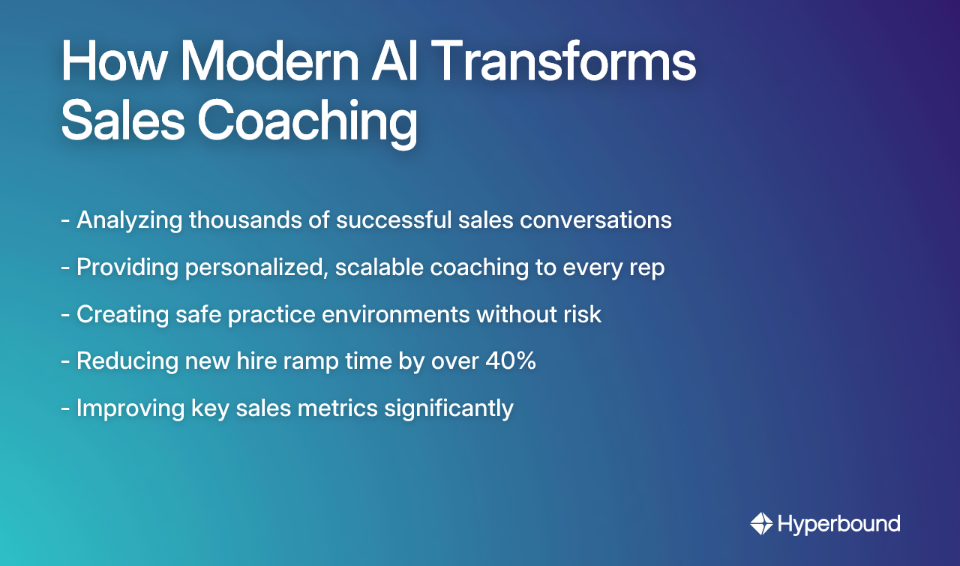
The results speak for themselves: companies implementing AI-powered practice tools have reduced new hire ramp time by over 40% and seen significant improvements in key sales metrics.
Let's dive into the nine best AI software options for sales teams, with a special focus on those offering real-time coaching features that can turn average performers into sales superstars.
Hyperbound stands out as the most comprehensive AI sales coaching platform specifically designed to transform how sales teams learn, practice, and perform.
Core Capabilities:
Who It's Best For: New sales reps needing to quickly ramp up, tenured reps adapting to new messaging, and sales leaders who need to scale coaching effectively across remote or large teams. Hyperbound also offers AI Roleplay Hiring Assessments to screen candidates with lifelike sales simulations.
Gong.io has established itself as a leading conversation intelligence platform that records, transcribes, and analyzes sales calls to provide actionable insights.
Key Features:
Best For: Data-driven sales teams seeking deep analytical insights into their customer conversations and validation of market messaging effectiveness.
Chorus.ai (now part of ZoomInfo) focuses on improving sales conversations through AI-driven analysis and actionable insights.
Key Features:
Best For: Mid-sized to large sales teams that prioritize manager-led call coaching based on real-world interactions.
Highspot combines traditional sales enablement with AI-powered coaching capabilities in one platform.
Key Features:
Best For: Organizations looking for a unified GTM enablement platform that connects content management with coaching and training.
Outreach has evolved from a sales engagement platform to include sophisticated AI coaching features.
Key Features:
Best For: High-volume sales teams that need to manage multi-channel outreach at scale while improving rep productivity and messaging consistency.
Salesloft combines sales engagement with conversation intelligence in one platform.
Key Features:
Best For: Outbound teams focused on improving the efficiency and effectiveness of their calls and emails through structured processes.
Apollo.io serves as an all-in-one sales intelligence and engagement platform with AI capabilities.
Key Features:
Best For: SDRs and sales teams focused on scaling top-of-funnel lead generation and prospecting activities efficiently.
Salesforce Einstein embeds AI directly into the Salesforce CRM platform for seamless workflow integration.
Key Features:
Best For: Teams already heavily invested in the Salesforce ecosystem who want to enhance their CRM with native AI capabilities without adding another tool to their stack.
Clari is a revenue operations platform that uses AI for advanced pipeline management and forecasting.
Key Features:
Best For: Larger sales organizations and revenue leaders who need cohesive performance tracking and reliable revenue forecasting across complex sales cycles.
The right implementation approach varies based on your team size, existing tech stack, and specific challenges. Here's how to get started based on your organization's profile:
Focus: Skill mastery and confidence-building
Action Plan:
This approach maximizes impact with limited resources and creates quick wins that build enthusiasm for AI adoption.
Focus: Scaling consistency and manager leverage
Action Plan:
Medium-sized teams benefit from tools that amplify manager effectiveness rather than replacing coaching entirely.
Focus: Standardization, data-driven insights, and enterprise-wide enablement
Action Plan:
Enterprise organizations should look for solutions with strong security features, extensive integration capabilities, and customizable analytics that align with specific business objectives.
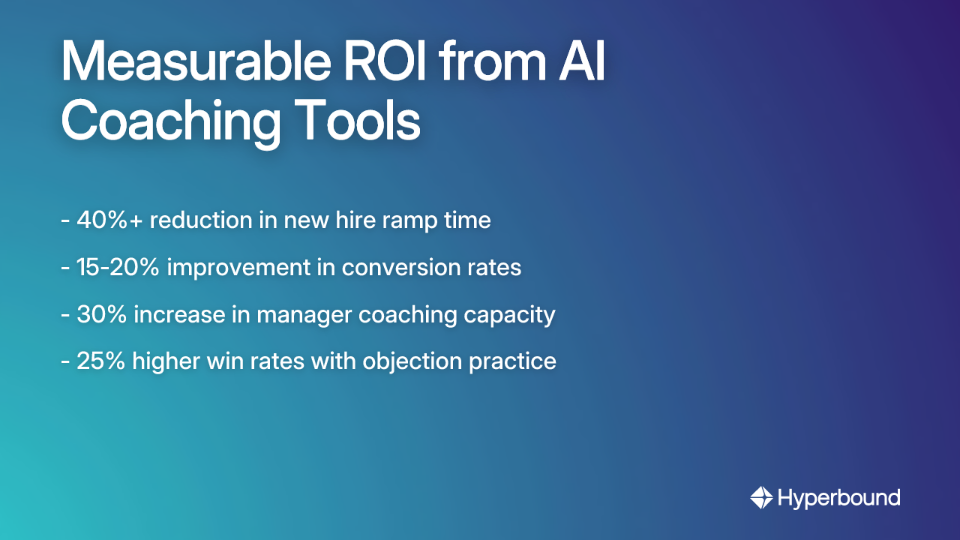
Organizations implementing AI coaching tools are seeing measurable returns on their investment:
As one sales leader noted after implementing Hyperbound: "We're seeing new reps hit productivity metrics in their second month that used to take four months to achieve. The ROI is undeniable."
There's a common concern in sales communities about becoming "overly reliant" on AI tools. As one Reddit user put it: "It's probably better to practice and get better than try to use an AI crutch."
This perspective misunderstands the purpose of today's best AI sales tools. The goal isn't creating dependency—it's building mastery through deliberate practice.
Think of AI coaching tools as a flight simulator for sales. Pilots don't learn to fly solely in actual aircraft—they spend countless hours in simulators where they can safely practice handling emergencies and difficult conditions. When they encounter these situations in real life, they've already developed the muscle memory to respond effectively.
Similarly, platforms like Hyperbound don't just whisper answers in your ear—they provide a training environment where you can develop the skills to handle any situation confidently, with or without technological assistance.
As markets become more competitive and buyer expectations continue to rise, sales organizations can't afford to rely on traditional, ad-hoc coaching methods. The organizations that will thrive are those that leverage AI to:
By implementing the right AI software for sales teams, particularly those with real-time coaching features, you're not just adopting new technology—you're creating a sustainable competitive advantage by building a more skilled, confident, and effective sales organization.
The tools listed above represent the best of what's available today, with Hyperbound leading the way in comprehensive skill development through AI-powered practice and feedback. The question isn't whether you should implement AI coaching—it's how quickly you can get started before your competitors do.
AI sales coaching software is a category of tools designed to improve sales performance through automated analysis, personalized feedback, and simulated practice environments. These platforms use artificial intelligence to analyze sales calls, identify winning behaviors, and provide reps with targeted coaching and role-playing scenarios to master their skills.
AI software helps reps master objection handling by providing a safe, repeatable practice environment. Platforms like Hyperbound use AI-powered roleplays where reps can practice responding to common and unexpected objections from a hyper-realistic AI buyer persona. This allows them to build "muscle memory" and confidence without risking live deals.
The primary difference is their focus: conversation intelligence tools (like Gong or Chorus) analyze past conversations to provide insights, while AI coaching platforms (like Hyperbound) focus on proactively building future skills through practice and simulation. Conversation intelligence is about review and analysis; AI coaching is about active training and development.
No, the goal of modern AI coaching tools is to build skill mastery, not dependency. Much like a pilot uses a flight simulator to practice for emergencies, sales reps use AI roleplay platforms to develop the core skills and confidence needed to handle any situation independently. The AI is a training tool, not a real-time crutch.
Small teams can start by piloting a practice-oriented tool to address a single, specific challenge, such as handling pricing objections. By allocating 15-30 minutes per week for each rep to practice in AI-powered scenarios, teams can achieve quick wins, build confidence, and see a measurable impact with minimal resource investment.
The ROI for AI sales coaching is typically measured through metrics like reduced new hire ramp time, improved conversion rates, and higher win rates. Companies often see a 40%+ reduction in ramp time, a 15-20% improvement in conversions, and a significant increase in manager coaching capacity as AI handles initial call scoring and feedback.










Use Cases
Legal