
Every sales leader knows the math, even if they hate doing it. A new rep who takes six months to ramp and generates $0 in closed revenue for the first half of their tenure is a six-figure liability — before you factor in salary, benefits, and the deals they fumble while they're still finding their footing. Research consistently shows that B2B sales reps forget up to 70% of training content within a week if it isn't reinforced with deliberate practice. Yet most onboarding programs are still front-loaded with product slides and methodology decks, leaving reps to figure out the actual conversations on live prospects.
That's the "practicing on live prospects" problem, and every sales leader knows exactly how it plays out: deals slow down, prospects get bad first impressions, and the manager spends hours in call debrief doing triage rather than coaching. As one rep put it bluntly on a recent Reddit thread: "Most onboarding is product-focused. The ICP, problems the solution solves, and practical examples are left to the field." (Source)
AI sales roleplay tools are changing this equation. Instead of risking live deals, reps can practice the same scenario fifty times — adjusting objection handling, tightening their discovery, or sharpening a cold call opener — before they ever pick up the phone for real. But not all tools are created equal. Many reps have tried using generic AI like ChatGPT for practice, only to find that "it just agrees and tells me why I'm right" instead of pushing back the way a real prospect would. (Source)
This guide isn't a generic roundup. It's organized by a clear taxonomy so you can jump to what matters for your team:
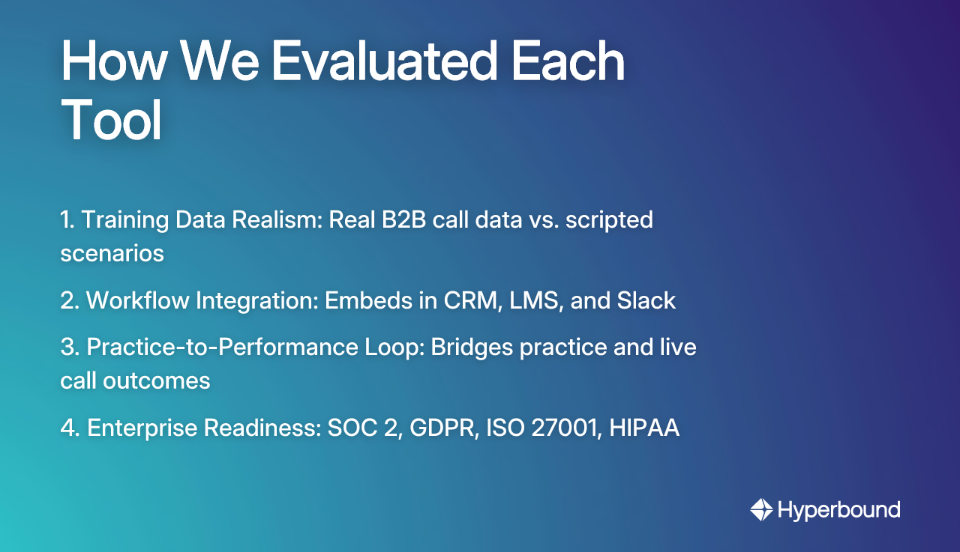
We evaluated each tool against four criteria that separate surface-level simulations from tools that actually move the needle:
Let's get into the list.
Best for: High-volume outbound teams (SDRs, BDRs) who need to master cold calls, objection handling, and appointment setting at scale — and sales enablement leaders who want to tie practice directly to performance outcomes.
If your team is still practicing cold calls on each other or winging their first few hundred live dials, Hyperbound Practice is the most direct solution to that problem. It's the only platform in this list whose AI buyer personas are built from 2M+ hours of real B2B sales conversations — not generic scripts, not synthetic data, not a lightly prompted LLM. That distinction matters enormously in practice quality.
The common complaint about AI roleplay — that it feels "robotic" or that prospects in simulations "take the conversation in different directions which it doesn't handle well" (Source) — is a direct consequence of using AI that hasn't been trained on how real buyers actually behave. Hyperbound's personas handle unexpected questions, push back on weak pitches, and follow the unpredictable paths real prospects take because they've been built from data on how real prospects actually talk.
The proof points are hard to argue with:
Key features:
Where Hyperbound stands apart from the rest of the list is the practice-to-performance loop. It's not just a training tool — it's the entry point into a broader Revenue Activation platform. Reps practice against realistic AI buyers, get scored instantly, and those scores connect to real call analysis and coaching recommendations. More on this in the closing section.
G2 Rating: 4.9/5 | SOC 2 Type II | GDPR | ISO 27001 | HIPAA Compliant
Best for: Teams focused on pitch certification and who value an immersive, avatar-based simulation interface.
Second Nature offers a visually engaging roleplay experience, with 3D avatar-based simulations and the ability to generate custom practice scenes from existing sales decks. It's a reasonable choice for teams looking for structured certification workflows and a polished user experience.
Where it falls short: User reviews and community feedback suggest the AI can struggle with accent recognition and maintaining topic relevance when conversations stray from the scripted path. For teams whose reps will face unpredictable, technically complex buyer conversations, this gap can matter.
Best pairing: Teams with relatively standardized sales motions where pitch consistency and certification are the primary training goals.
Best for: SDR teams who want to maximize the volume of live conversations — not simulated ones.
Orum is an AI-powered parallel dialer, not a roleplay tool in the traditional sense. It filters out voicemails, bad numbers, and dial trees so reps connect only with live prospects, dramatically increasing the number of real conversations a rep has per day.
This earns its spot in the SDR category because one of the most consistent ramp challenges cited by sales leaders is "inadequate lead generation for new reps" — new hires ramping into cold outbound without enough at-bats to build pattern recognition. (Source) Orum solves the volume problem. Pair it with a roleplay tool like Hyperbound that ensures reps are ready for those conversations and you cover both ends of the equation.
Limitation: Orum doesn't offer practice, feedback, or coaching. It's purely a live-call productivity tool.
Best for: Large enterprises that need a comprehensive sales readiness platform where AI roleplay is one feature within a broader ecosystem.
Mindtickle is one of the most established names in sales readiness. It offers 3D avatar-based roleplays, manager performance dashboards, and deep LMS functionality — and the numbers reflect its scale, with a large number of role plays completed across its customer base.
For AEs working through complex multi-stakeholder deals, the manager review and scoring workflows are a genuine strength. Sales leaders can review roleplay recordings, add feedback, and track readiness across the team.
Where to weigh the tradeoff: Mindtickle is a broad platform, and AI roleplay is one module within a larger system. Teams seeking the highest simulation fidelity and the tightest connection between practice and real call performance may find purpose-built alternatives more effective.
Best for: Mid-market to enterprise teams focused on video-based learning who want to layer in AI conversation practice.
Allego offers a "Live Dialog Simulator" for practicing buyer meetings alongside its more established video-based training and content management features. Its strength lies in peer-to-peer video feedback and the ability to build a library of practice content that mirrors your actual sales plays.
For AEs preparing for structured discovery or demo conversations, Allego's scenario builder and video review capabilities offer a thoughtful experience. It's a solid choice for organizations where video coaching culture is already established and AI roleplay is being added as an enhancement.
Consideration: As a more recent entrant into the AI roleplay space, its simulation depth for handling complex, unscripted B2B buyer conversations is still developing relative to more specialized platforms.
Best for: Individual reps or small teams focused on communication fundamentals — pacing, filler words, vocal presence — rather than structured B2B sales scenario practice.
Yoodli sits at the intersection of public speaking coaching and sales communication training. It provides real-time feedback on delivery mechanics: how often you say "um," whether you're speaking too fast, and how your body language reads on camera.
This is genuinely useful for newer reps who are still developing the basic confidence and composure that underlies good sales conversations. However, it is not purpose-built for sales and won't replicate the complexity of a B2B discovery call or handle challenger-style objections with the depth that a dedicated ai sales roleplay platform offers.
Best use case: Pre-onboarding communication polish or supplemental coaching for reps who've identified delivery as a specific development area.
Best for: Enterprises that want to integrate practice capability within their existing sales enablement and content management ecosystem.
Both Highspot and Seismic are mature sales enablement platforms that have added AI-driven coaching and roleplay features alongside their core content management and deal support functionality. The value proposition is unification: instead of a separate training tool, coaching capabilities live alongside the content reps are already using to run their deals.
For organizations where adoption of a standalone practice tool is a concern, embedding lightweight roleplay within a platform reps already use every day has real advantages.
Where it falls short: The roleplay experience in both platforms tends to be a supporting feature rather than a core product. Teams looking for deep simulation fidelity, real-time AI feedback on specific selling behaviors, or a tight feedback loop between practice and live call performance will find more capability in purpose-built tools.
Best for: Teams that want to analyze 100% of their real sales calls to understand what top performers are doing differently — and who want that intelligence to inform their coaching.
Gong and Chorus are the gold standard in conversation intelligence. They record, transcribe, and analyze real sales calls at scale — surfacing patterns in talk ratios, topic coverage, questions asked, and how deal-winning behaviors differ from deal-losing ones.
Here's the honest gap: both tools are exceptional at telling you what is broken. They don't provide a safe, repeatable environment to fix it. A Gong scorecard can show a manager that their team is consistently failing to establish next steps in discovery calls, but it doesn't give reps a place to practice that skill until it becomes instinctive.
How Hyperbound complements them: Hyperbound Perform integrates directly with Gong, Chorus, and Salesloft — pulling in real call data and scoring it against your methodology. Those scores then feed into targeted roleplay recommendations in Hyperbound Practice, so reps are practicing the exact skills surfaced in their real call analysis. It's the missing layer that turns conversation intelligence into behavior change.
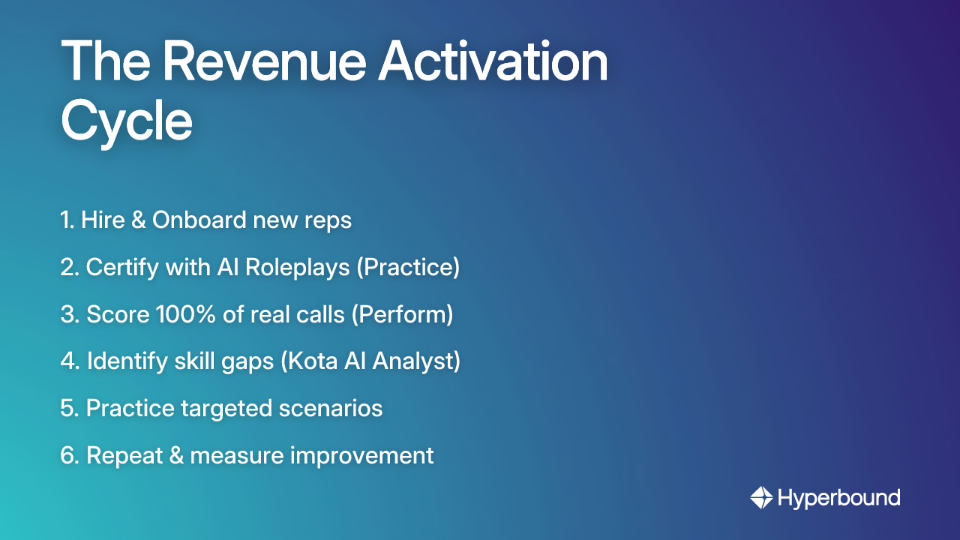
The best-in-class teams aren't treating practice and performance as separate workflows. They're running a continuous improvement cycle: score real calls → identify skill gaps → practice targeted roleplays → score real calls again.
This is the core idea behind Hyperbound's Revenue Activation framework. Data alone doesn't change outcomes. Knowing that your team's discovery calls are weak doesn't fix them. What changes outcomes is connecting that insight to structured practice — and then measuring whether the practice is actually translating to better behavior on live deals.
Hyperbound Perform is the product that closes this loop. It deploys AI scorecards on 100% of real customer conversations, rolling up insights across the entire deal lifecycle — not just individual calls — to surface deal-level coaching recommendations while there's still time to act on them. It integrates with your existing call recording stack (Gong, Chorus, Salesloft) and automatically updates CRM fields so nothing falls through the cracks.
Kota Activate — Hyperbound's AI Revenue Analyst — sits above Practice and Perform to orchestrate the whole system. Ask Kota which reps are struggling with competitive objections based on their last 30 real calls and their roleplay history. Get coaching intervention recommendations timed to when they'll actually make a difference. It's the intelligence layer that makes the whole platform greater than the sum of its parts.
The operational cycle looks like this: Hire → Onboard & Certify (Practice) → Score Real Calls (Perform) → Identify Gaps (Kota) → Practice Targeted Scenarios → Repeat. That's how Vanta went from a 210-day ramp to 72 days. That's how Nivoda more than doubled their demo conversion rate.
Slow ramp time is expensive, and "practicing on live prospects" is a risk no sales leader should be comfortable accepting. Modern AI sales roleplay tools give reps a place to fail safely, build pattern recognition fast, and enter their first real conversations with the confidence and muscle memory that used to take months of live-fire experience to develop.
The single most important factor in your evaluation: is the AI trained on real call data? Generic chatbots and lightly prompted LLMs won't cut it for B2B sales preparation. The realism of the simulation determines how much of it transfers to the real conversation. That's why tools trained on millions of hours of actual buyer conversations produce meaningfully different outcomes than tools built on scripted scenarios.
Ready to see what a 50–60% reduction in ramp time looks like for your team? See a demo of Hyperbound Practice and find out how the world's fastest-growing sales teams are turning practice into pipeline.
AI sales roleplay tools are software platforms that allow sales representatives to practice conversations with AI-powered buyer personas in a safe, simulated environment. This practice helps them master skills like cold calling, objection handling, and discovery without risking live deals. Unlike practicing with colleagues, AI tools provide instant, data-driven feedback and can be used on-demand, allowing for unlimited repetition to build muscle memory.
Practicing with AI is more effective than traditional sales training because it solves the problem of knowledge decay and eliminates the risk of "practicing on live prospects." Research shows reps forget most training content within a week if it's not reinforced. AI roleplay provides that reinforcement through deliberate practice, allowing reps to fail safely, refine their messaging, and build confidence before engaging with real buyers, leading to faster ramp times and better deal outcomes.
No, using a generic AI like ChatGPT for sales roleplay is generally ineffective because it hasn't been trained on the nuances of B2B sales conversations. Generic AIs tend to be agreeable and lack the ability to push back like a real prospect, as noted by many sales reps. Specialized tools like Hyperbound are trained on millions of hours of real B2B sales calls, enabling their AI personas to handle objections, ask tough questions, and behave unpredictably, just like actual buyers.
AI roleplay tools reduce ramp time by providing new hires with unlimited, risk-free practice on core sales scenarios from day one. Instead of spending months listening to calls or fumbling through their first live deals, new reps can rapidly build pattern recognition and confidence. Platforms like Hyperbound have demonstrated the ability to cut ramp time by over 50% by compressing the experience needed to become effective into a matter of weeks, not months.
The single most important factor is whether the tool's AI is trained on real-world B2B sales conversation data. This is critical for creating realistic simulations that translate to live calls. Other key criteria include the platform's ability to provide specific, actionable feedback, integrate with your existing CRM and LMS, and connect practice results to real-world performance data to prove ROI.
While excellent for new SDRs, AI sales practice tools are valuable for the entire revenue team, including seasoned Account Executives (AEs) and Customer Success Managers (CSMs). SDRs can master cold calls and objection handling. AEs can practice complex discovery calls, demo presentations, and multi-stakeholder negotiations. The best platforms offer scenarios spanning the full customer lifecycle.
Leading platforms connect practice to performance by integrating with conversation intelligence tools like Gong or Chorus to analyze real calls. This creates a continuous improvement loop. The system analyzes real call data to identify skill gaps (e.g., a rep struggles with pricing objections), then automatically recommends targeted roleplay exercises to fix that specific weakness. This ensures that training efforts are directly tied to improving live call outcomes.








Use Cases
Legal