
"Getting thrown into a meeting blind is the absolute worst."
If you've ever been pulled into a sales call with thin context, an unfamiliar buyer, or a deal someone else set up — you know exactly what that feels like. And the worst part? The first few minutes of that call set the trajectory for the entire deal.
Here's the thing most sales training programs get wrong: they're built for onboarding and SKOs — not for the 24 hours before a real meeting. But that window right before a live call is the highest-leverage practice moment that exists. Training your reps three months ago on objection handling doesn't help them tonight when they're staring at a calendar invite for tomorrow's discovery with a VP they've never spoken to.
That's compounded by a brutal reality for sales enablement leaders: 80% of training is forgotten within 30 days. All that onboarding investment? Faded by the time the rep needs it most. Pre-meeting sales roleplay is how you close that gap — making training sticky, applied, and relevant to the actual deal on the line.
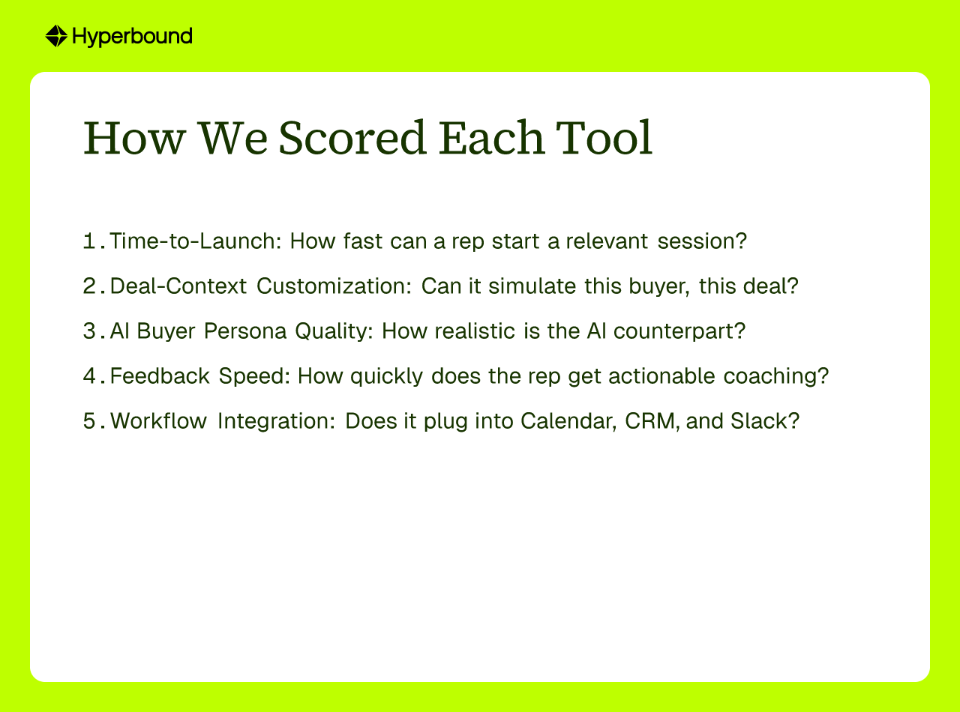
But not all AI sales roleplay tools are built for this moment. To evaluate them fairly for just-in-time pre-meeting use, we'll score each tool on five criteria that matter:
Let's get into it.
Best for: Deal-contextual, just-in-time pre-meeting sales roleplay
Hyperbound is the only platform purpose-built for the exact problem this article is about. While most tools offer a library of generic scenarios, Hyperbound lets reps practice for the meeting they actually have tomorrow — not a hypothetical one from a training module.
Time-to-Launch: Excellent. Bite-Sized Roleplays can be launched directly from a rep's calendar, CRM, or Slack in minutes. There's no context-switching into a separate training platform. The practice meets the rep where they already are.
Deal-Context Customization: Unmatched. This is where Hyperbound separates entirely from the rest of the field:
AI Buyer Persona Quality: Highest fidelity available. Hyperbound's AI is trained on over 2 million hours of real B2B sales conversations — not generic scripts. The result is dynamically responsive buyers who take conversations in unexpected directions, handle pressure realistically, and don't just fold the moment a rep pushes back. Multiparty Roleplays let you practice with a champion and an economic buyer simultaneously, and Screen Comprehension means the AI actually understands the slides you're presenting during a mock demo.
Feedback Speed: Instantaneous. Every session ends with an AI Scorecard covering talk ratios, methodology adherence, and key selling moments — plus AI Coaching that flags weak responses and missed opportunities. As one sales professional put it, "feedback is the most important element" management looks for before approving a tool. Hyperbound delivers it immediately.
Workflow Integration: Deep. HubSpot, Salesforce, Google Calendar, Slack, Teams, and LMS platforms like Seismic and Highspot are all supported. The practice loop is embedded in daily workflow — not bolted onto it.
Proof it works: Vanta cut ramp time by 60% (from 210 to 72 days) and saw 5x pipeline growth. Nivoda achieved a 150% increase in demo conversion rates and 2x revenue year-over-year. Hyperbound has delivered 250,000+ simulations across 7,000+ companies.
➡️ Start your free Hyperbound trial
Best for: Structured avatar-driven practice with scoring
Second Nature is a well-established AI roleplay platform with an Avatar-driven interface that makes practice feel more engaging than a text-based simulation. It excels at helping reps work through structured scenarios with clear scoring rubrics.
Time-to-Launch: Good. Reps can access a pre-built scenario library relatively quickly, and administrators can configure new roleplays with uploaded materials.
Deal-Context Customization: Limited. Second Nature supports custom scenario creation, but it requires manual setup and doesn't dynamically pull context from a live CRM opportunity or a LinkedIn profile. It's better suited for practicing types of meetings (e.g., "a skeptical CFO") than preparing for this specific CFO at this specific company.
AI Buyer Persona Quality: Good. The Avatar format adds a layer of visual engagement that some reps respond to positively. However, the personas aren't built from the same depth of real B2B call data, which can make them feel more scripted when conversations go off-track — the exact limitation reps call out when they say the AI "doesn't really handle well" unexpected questions.
Feedback Speed: Solid. Second Nature provides scoring and coaching summaries after sessions, covering areas like confidence, clarity, and key message delivery.
Workflow Integration: Primarily a standalone destination. Integration with CRM and calendar for contextual triggering is not a core feature.
Verdict for pre-meeting prep: A strong foundational practice tool, but not optimized for the 24-hour pre-call window where deal-specific context is everything.
Best for: Enterprise communication skills assessment
Quantified takes a data-science-heavy approach to sales coaching, analyzing vocal delivery, word choice, and presence to give reps a detailed communication profile.
Time-to-Launch: Slower. Quantified is built for programmatic, scheduled training — not the kind of spontaneous "I have a call in an hour" practice session that pre-meeting prep demands.
Deal-Context Customization: Low. Its strength is in industry-specific scenario templates and foundational communication benchmarking, not in injecting a live deal's specifics into a simulation.
AI Buyer Persona Quality: High realism in a clinical sense — Quantified reports a 92% realism rating on scenario accuracy — but the AI is designed for predictable assessment scenarios. Real B2B buyers aren't predictable, and practicing against a stable, testable persona only goes so far.
Feedback Speed: Detailed but not immediate in a coaching-loop sense. Quantified produces rich analytics dashboards, which are valuable for enablement leaders tracking trends over time — less useful for a rep who needs a quick fix before a 9am call.
Workflow Integration: Functions as a dedicated analytics and communication platform, with less native integration into the CRM-calendar-Slack stack where reps live.
Verdict for pre-meeting prep: Excellent for building and measuring foundational communication skills, but not the right tool when a rep needs to practice handling a specific objection from a specific buyer in the next 24 hours.
Best for: Analyzing calls that already happened
Chorus is a conversation intelligence platform. The key phrase: what it already did. It captures, transcribes, and analyzes real sales calls to surface patterns, coaching moments, and deal risks.
Time-to-Launch (Roleplay): Not applicable. Chorus is not an AI roleplay tool.
Deal-Context Customization (Roleplay): Not applicable.
What it does well: Chorus gives reps and managers visibility into what happened on recorded calls — talk ratios, competitor mentions, key topics, coachable moments. For managers reviewing call libraries to identify skill gaps, it's a powerful tool.
The gap for pre-meeting prep: Chorus tells you what went wrong on your last call. It doesn't let you practice what to do differently on your next one. As one tech sales rep put it bluntly: you need reps to fix the problem before it costs you the deal. Chorus is the game tape; Hyperbound is the batting cage.
Workflow Integration: Excellent for capturing and routing call recordings. Integrates cleanly with CRM and communication tools for its intended purpose.
Verdict for pre-meeting prep: Not a roleplay tool. Valuable as part of a broader coaching stack, but doesn't solve the pre-meeting practice problem on its own.
Best for: Broad sales readiness and certification programs
Mindtickle is a comprehensive sales readiness platform that bundles training modules, coaching, content management, and AI roleplay into one suite. It's particularly popular with large enterprise teams running structured enablement programs.
Time-to-Launch: Moderate. Mindtickle's roleplay functionality lives inside a larger enablement platform, which means navigating a heavier interface to get to a practice session. For a rep who has 30 minutes before a call, that friction matters.
Deal-Context Customization: Limited for just-in-time prep. Mindtickle shines when certifying reps across a new product launch or onboarding cohort — scenarios are pre-configured by enablement teams and don't dynamically pull from a live deal's CRM data or a buyer's LinkedIn profile.
AI Buyer Persona Quality: Roleplay is one feature within a much larger platform, not Mindtickle's core specialty. The AI interactions are functional but tend toward the scripted side compared to platforms where dynamic conversation simulation is the entire product.
Feedback Speed: Feedback is typically delivered as part of a structured training module — useful for ongoing development, but less optimized for the immediate "what do I fix before this afternoon's call" use case.
Workflow Integration: Mindtickle aims to be a central enablement hub and integrates broadly, but the platform's weight can make it a heavy lift for daily, spontaneous use.
Verdict for pre-meeting prep: Strong for programmatic readiness and certification. Not the right fit when deal-specific, just-in-time practice is the priority.
Best for: Sales content management and guided selling
Highspot is one of the most widely deployed sales enablement platforms in the enterprise market. Its core strength is organizing and surfacing the right sales content — pitch decks, case studies, battle cards — at the right moment in the deal.
Time-to-Launch (Roleplay): Not applicable as a native capability.
Deal-Context Customization (Roleplay): Not applicable as a native capability.
What it does well: Highspot ensures reps walk into meetings with the right content. It's the "what to say" layer of sales prep — and it does that job very well. Highspot is also SCORM-compatible, which means it can host roleplay modules created in other tools (like Hyperbound), embedding practice alongside your actual sales collateral.
The gap for pre-meeting prep: Highspot delivers information. It doesn't help a rep practice the conversation. Knowing that the VP of Finance cares about ROI and having the right one-pager ready is valuable — but it doesn't prepare you for when they push back hard on implementation costs, go off-script, or ask a question you haven't heard before.
Workflow Integration: Excellent as a content hub. Integrates with CRM and communication tools to surface relevant assets in-context.
Verdict for pre-meeting prep: An essential part of the sales stack, but a content platform, not a practice platform. Works best alongside a roleplay tool like Hyperbound that handles the "how to say it" side of meeting prep.
Most tools on this list are genuinely valuable — but they're solving a different problem. Chorus (by ZoomInfo) and Highspot focus on analysis and content delivery. Mindtickle and Second Nature are built for broader enablement programs. Quantified is excellent for communication benchmarking at scale.
None of them are designed for the specific, high-stakes moment that defines deal outcomes: the 24 hours before a real meeting with a real buyer at a real company.
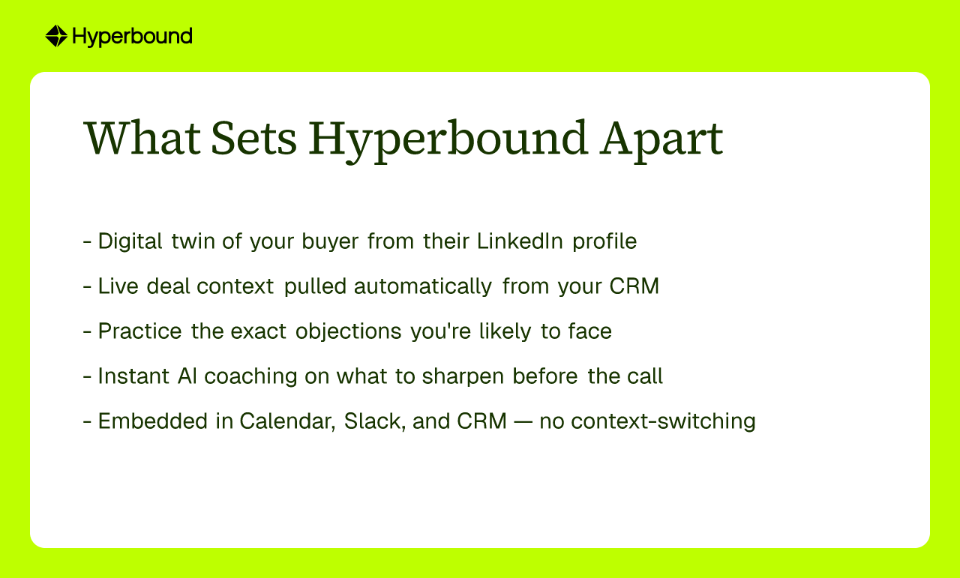
That's the moment Hyperbound is built for. The ability to spin up a digital twin of tomorrow's buyer from their LinkedIn profile, pull live deal context from your CRM, and practice for the exact objections you're likely to face — then get instant AI coaching on what to sharpen — is a fundamentally different capability than anything else in this list.
As one rep put it: "If it doesn't feel real, it defeats the whole purpose." Hyperbound is the only platform built to make pre-meeting sales roleplay feel exactly that real — tailored to your deal, your buyer, and the conversation you need to have tomorrow.

AI sales roleplay is a training technology that uses artificial intelligence to simulate realistic sales conversations. Sales representatives can practice their pitch, handle objections, and refine their communication skills by interacting with an AI buyer persona in a safe, repeatable environment before a real customer call.
Pre-meeting practice is critical because it directly impacts the outcome of a live sales call, which sets the trajectory for the entire deal. Traditional sales training is often forgotten, but just-in-time practice in the 24 hours before a meeting makes coaching sticky and immediately applicable, closing the gap between general knowledge and deal-specific execution.
Advanced AI roleplay tools like Hyperbound can simulate a specific buyer by creating a "digital twin" from publicly available data. By providing a LinkedIn profile URL, the AI can adopt the buyer's role, industry, company details, and likely priorities, allowing you to practice a conversation tailored to the actual person you'll be speaking with.
Deal-specific roleplay focuses on preparing for a single, upcoming meeting with a real buyer, using context from your CRM and the buyer's profile. General sales training, on the other hand, covers broader skills and hypothetical scenarios (e.g., "handling a price objection") that are not tied to a specific deal, making it less effective for immediate, high-stakes preparation.
AI roleplay is for proactive practice before a call, while conversation intelligence tools are for reactive analysis after a call. A tool like Chorus analyzes recordings of past conversations to find coaching moments (the "game tape"), whereas a tool like Hyperbound lets you practice and fix mistakes before they happen on a live deal (the "batting cage").
AI roleplay is designed to augment, not replace, human sales coaching. It provides a scalable way for reps to get frequent, on-demand practice and receive instant, data-driven feedback. This allows sales managers to focus their limited coaching time on higher-level strategy and complex deal reviews, rather than repetitive drills.
Ready to stop walking into meetings unprepared?
See how deal-specific AI roleplay changes your team's performance. Start your free Hyperbound trial today →










Use Cases
Legal