
You just got promoted. Last quarter you were crushing quota as an AE — now you're responsible for a team of five reps who are looking to you for coaching, direction, and answers you're still figuring out yourself.
It's one of the most common anxieties in sales leadership: the fear of transitioning from peer to manager without losing rapport, and the deeper worry that you might become the kind of manager who doesn't actually move the needle for their team. You want to coach, but between pipeline reviews, forecasting, and one-on-ones, coaching is often the first thing that gets cut. Research backs this up — most frontline managers spend just 5–8% of their time actually coaching.
Here's the good news: you don't have bad habits yet. First-time managers haven't inherited the legacy training playbook — the awkward peer roleplay sessions, the static LMS modules that feel like compliance training, the quarterly workshops where 80% of the content is forgotten within 30 days. You're in a rare position to skip all of that and build something better from day one.
That something better is AI sales roleplay — and it's changing how modern managers coach their reps at scale.
Traditional peer-to-peer roleplay has a ceiling. It depends on manager availability, it's subjective, and it's awkward — most reps hate doing it because there's no structured feedback and the "buyer" is a colleague who knows all the same scripts they do.
AI roleplay removes those constraints. According to Highspot's State of Sales Enablement Report 2025, teams using AI in their sales coaching programs are 20% more likely to improve revenue outcomes compared to those that don't.
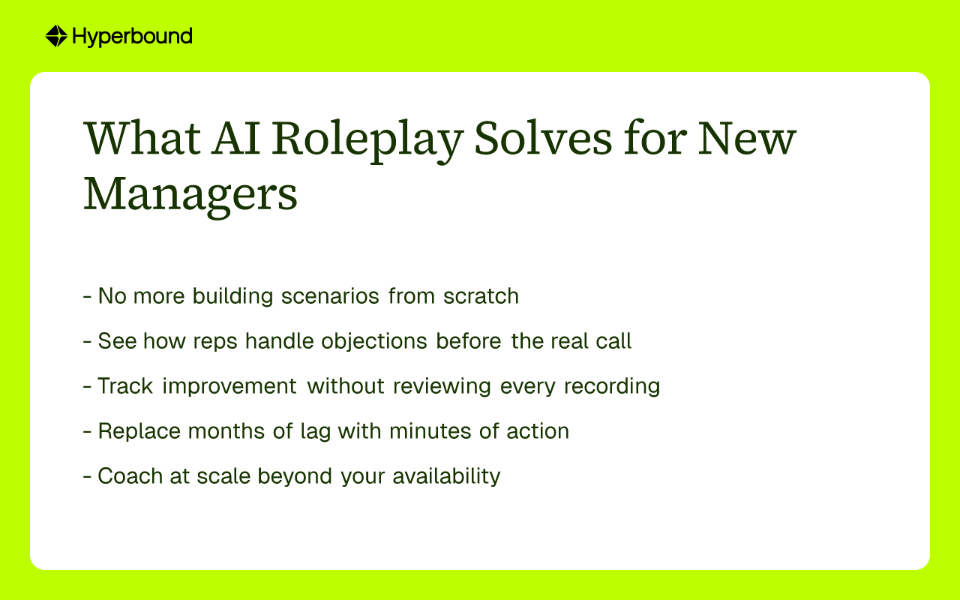
For a first-time manager, the practical upside is enormous:
The shift happening right now in first time sales manager training isn't just about access to better tools — it's about replacing the lag between identifying a problem in the field and doing something about it. With AI roleplay, that lag shrinks from months to minutes.
Before diving in, here's the lens we're using to evaluate each tool — because what matters to a new manager is slightly different than what matters to a seasoned enablement leader with a dedicated team:
.png)
Best for: New managers who want to close the loop between real call data and rep practice — without building training programs from scratch.
If there's one problem every first-time manager hits immediately, it's this: you can see that a rep is struggling with the pricing objection on Gong recordings, but there's no easy path from that insight to making them better before the next call. Hyperbound Practice was built specifically to close that gap.
Hyperbound Practice is the flagship product of Hyperbound's Revenue Activation Platform — the category they coined to describe what happens when teams stop analyzing call data and start using it to change outcomes. The AI buyer personas aren't built from generic scripts. They're trained on 2M+ hours of real B2B sales conversations, which means the objections feel like the objections your reps will actually face — not a watered-down simulation.
Manager Visibility: The AI Scorecards are a standout feature for new managers. Every practice session is automatically scored — talk ratios, key selling moments, methodology adherence, specific coaching areas — so you get a clear picture of where each rep stands without sitting in on every roleplay. The analytics dashboard tracks individual and team progress over time, and certifications let you verify that reps are actually ready before they run a real call.
Rep Engagement: Reps who are skeptical of AI training tools often cite unrealistic interactions as the top reason they disengage. Hyperbound addresses this directly — the AI adapts to unexpected responses, handles objections with the complexity of a real buyer, and even supports emotional states and voice cloning for maximum realism. Bitesized Roleplays (short, targeted practice sessions on a single skill) are particularly effective for tenured reps who won't sit through a 30-minute generic certification but will do a focused 5-minute challenge.
Integration: This is where Hyperbound stands apart from the pack for managers already using call intelligence tools. The Gong and Salesloft integrations create a seamless operational loop: identify a skill gap in a real recorded call → assign a targeted roleplay in Hyperbound → measure improvement in the next real call. It also integrates with HubSpot, Salesforce, Pipedrive, and LMS platforms like Seismic, Highspot, and Showpad via SCORM.
Setup Time: Fast. The white-glove implementation process — Planning Call → Bot Buildout → Scorecard Buildout → Launch Prep → Official Launch — typically wraps up in about two weeks. You don't need to be a curriculum designer to get high-quality, realistic scenarios live.
Proof it works: Vanta used Hyperbound Practice to cut rep ramp time from 210 days to 72 days — a 60% reduction — while scaling their BDR team 4x. Nivoda saw a 150% increase in demo conversion rates and 50% faster ramp. Those aren't abstract metrics; they're the exact outcomes a new manager needs to demonstrate early impact.
.png)
Best for: Understanding what's happening on recorded calls — not practicing future ones.
Gong is the market leader in conversation intelligence, and if you're not already using it (or a similar tool), you should be. It records, transcribes, and analyzes live sales calls with deep analytics on talk tracks, topic coverage, customer sentiment, and deal progression.
But here's the honest assessment for a new manager: Gong tells you what happened. It doesn't help your rep practice what to do next time. There's no safe-fail environment, no objection handling drills, no way to assign a struggling rep a targeted scenario based on what you saw in their last three calls.
Gong is essential. It's just not a practice platform — it's a diagnostic tool. And the best use of it, frankly, is as signal feed for a dedicated roleplay platform like Hyperbound.
.png)
Best for: Post-call analysis and coaching insights within the ZoomInfo ecosystem.
Chorus is a capable conversation intelligence platform with solid analytics on call performance — similar to Gong in its core function. It surfaces coaching moments, tracks deal momentum, and provides visibility into what reps are saying on calls.
Like Gong, the limitation for first time sales manager training is that it's built for analysis, not practice. It helps you identify the gap; it doesn't help your rep close it. If your team is already on ZoomInfo, Chorus is a natural fit for call review. But you'll still need a dedicated practice layer for reps who need repetitions before the real conversation happens.
.png)
Best for: Teams looking for a dedicated AI roleplay tool with a focus on structured scenario building.
Second Nature is a purpose-built AI roleplay platform that offers realistic simulations for sales reps to practice key conversations. It provides a dedicated practice environment and manager dashboards for tracking progress across the team.
The platform is functional and engaging, but the critical question for any roleplay tool is: what is the AI actually trained on? When AI personas are built from generic scripts rather than real-world sales data, reps quickly notice that the objections don't feel authentic — and unrealistic scenarios are the number one reason reps disengage from practice tools. For new managers evaluating any platform, this is the first question worth asking vendors directly.
.png)
Best for: Demo and presentation-specific practice.
PitchMonster fills a specific niche: helping reps sharpen their demo delivery, presentation skills, and pitch structure. It's quick to set up and engaging for reps who need to nail a specific type of conversation.
The limitation is scope. As a new manager, you're coaching reps across the full sales motion — cold calls, discovery, multi-stakeholder negotiations, objection handling, closing. PitchMonster doesn't cover that breadth. It's a useful supplement if your primary coaching need is demo execution, but it won't carry the full weight of a first time sales manager training program.
.png)
Best for: Organizations that need a comprehensive sales readiness platform — onboarding, content management, coaching, and roleplay in one suite.
Mindtickle is a broad enablement platform that bundles onboarding modules, content management, AI roleplay, and coaching analytics into a single system. If your company is trying to consolidate its entire enablement stack, it's worth evaluating.
For a first-time manager specifically, the tradeoff is depth versus breadth. When roleplay is one feature within a larger platform, the simulation fidelity often doesn't match purpose-built tools. Setup can be extensive since you're configuring a full enablement program — not just spinning up targeted roleplay scenarios. And reps can experience "corporate training fatigue" if the tool feels more like an LMS module than a dynamic practice environment.
.png)
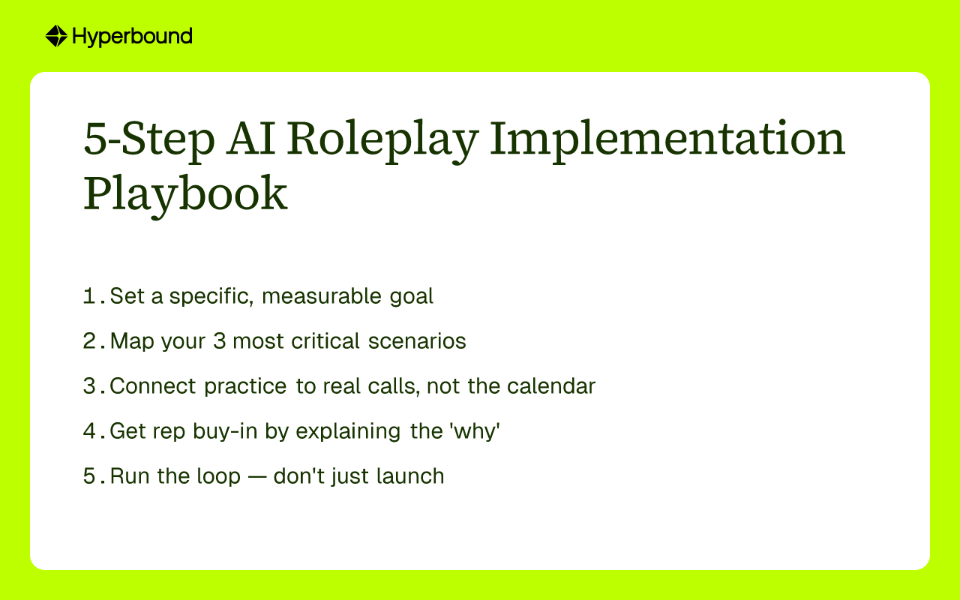
Picking the tool is the easy part. Getting your team to use it — and use it well — is where most implementations stall. Here's a practical playbook:
Step 1: Set a specific, measurable goal. Don't just "add AI training." Define the outcome you're after. Something like: "Improve our cold call-to-meeting conversion rate by 20% in Q2 by certifying all SDRs on our new talk track." This gives you a benchmark to evaluate the tool's actual impact and something concrete to show leadership.
Step 2: Map your three most critical scenarios. Resist the urge to build 15 scenarios immediately. According to Highspot research, starting with focused, high-impact scenarios drives better adoption than comprehensive curriculum rollouts. For most B2B sales teams, that means: cold call opener, handling the top two objections, and discovery-to-demo transition. Customize the AI personas to match your actual ICP — a generic "VP of Marketing" bot won't push back the way your real buyers do.
Step 3: Connect practice to real calls, not just the calendar. The biggest mistake managers make is treating roleplay as a scheduled event rather than a continuous habit. The most effective workflow: use your call intelligence tool (Gong, Salesloft, Chorus) to identify a specific skill gap on a real call → assign a targeted practice scenario immediately → check the scorecard before the rep's next similar call. This is exactly the loop that Hyperbound's Gong integration enables directly.
Step 4: Get buy-in by explaining the "why." Reps who feel uncomfortable or skeptical about AI interactions will disengage quickly. Frame the tool not as surveillance, but as a batting cage — a place to get reps without burning real pipeline. The reps who practice the most will close the most. Make that connection visible through leaderboards, certifications, and by celebrating reps who improve.
Step 5: Run the loop, don't just launch. The real value of AI roleplay compounds over time: Score Real Calls → Identify Skill Gaps → Assign Practice Scenarios → Score Real Calls again. Build this into your weekly rhythm. Use scorecard data to inform 1:1s instead of relying on your gut or anecdotal call reviews.
The three questions every new manager actually cares about:
Can I assign targeted practice to a struggling rep without building it myself? Yes.
Can I see how my rep handles objections before the real call? Yes.
Can I track improvement over time without listening to every recording? Yes.
AI roleplay doesn't replace the judgment and relationship that great managers bring. But it gives you the infrastructure to coach at scale — which is something most experienced managers are still cobbling together manually years into the role. You don't have to.
The tools in this list all offer pieces of the puzzle. For first time sales manager training specifically, the combination of real-data AI personas, seamless Gong/Salesloft integration, and auto-scored practice sessions makes Hyperbound Practice the platform best designed to turn your call data into rep improvement — automatically, repeatably, and with the visibility you need to actually coach your team well.
Ready to build a data-driven coaching habit from your first day on the job? See how Hyperbound Practice works — and start closing the gap between what your reps know and what they need to win.
AI sales roleplay is a training technology that uses artificial intelligence to simulate realistic sales conversations, allowing reps to practice handling objections, pitching products, and navigating different buyer personas in a safe-fail environment. Unlike static scripts, AI buyers can react dynamically to a rep's approach, provide instant feedback, and offer unlimited practice opportunities without needing a manager or peer present.
AI roleplay is more effective than traditional peer roleplay because it is scalable, objective, and consistent. While peer roleplay relies on manager availability and is often awkward and subjective, AI roleplay provides a private, structured environment for reps to practice anytime. The AI provides data-driven feedback based on performance metrics, and the scenarios are built from real-world sales data, making the practice more realistic and impactful.
To get reps to adopt AI roleplay tools, new managers should explain the "why" behind the training, framing it as a performance tool, not a surveillance tool. Start with a few high-impact scenarios that address common challenges, connect practice directly to real-world calls (e.g., assign practice after a tough call), and celebrate improvements publicly. When reps see it as a "batting cage" to improve their skills and earn more commission, adoption rates increase significantly.
Conversation intelligence tools like Gong and Chorus analyze past calls, while AI roleplay tools prepare reps for future calls. A conversation intelligence platform tells you what happened on a call, identifying skill gaps and coaching moments. An AI roleplay platform provides a practice environment to act on those insights and close those gaps before the next real conversation. The two tools work best together, creating a loop of analysis, practice, and improvement.
A new manager can see results from AI roleplay in a matter of weeks, not months. The immediate benefit is having visibility into how reps handle specific scenarios before they talk to a live prospect. Measurable improvements in key metrics, such as call-to-meeting conversion rates or faster rep ramp time, can often be seen within the first quarter of consistent use, as seen in cases where teams have cut ramp time by over 50%.
For a new sales manager, the most important features are fast setup time, clear manager visibility, high rep engagement, and seamless integration with existing tools. Look for a platform that doesn't require a complex IT project, provides at-a-glance performance dashboards and scorecards, uses realistic AI to keep reps engaged, and connects with your call recording software (like Gong or Salesloft) to create a closed loop between analysis and practice.










Use Cases
Legal