You've just finished a team meeting, and your sales manager enthusiastically announces, "Let's pair up for some roleplaying!"
The room goes silent. A few awkward glances are exchanged. Someone whispers, "It's freaking awkward." Another veteran rep rolls their eyes, thinking about the softball objections they're about to receive that bear no resemblance to what happens in real calls.
Sound familiar?
Traditional sales roleplay—that decades-old staple of sales training—is widely considered one of the most uncomfortable and ineffective parts of the job. In fact, a recent informal survey of sales professionals found that the vast majority find it "awkward," "dated," and "a waste of time."
But what if there was a better way to practice? One that didn't involve the vulnerability of stumbling through a mock sales call in front of judgmental peers? One that could actually prepare you for the unpredictable chaos of real customer conversations?
Enter AI-powered sales roleplay tools—a rapidly growing category that promises to transform how sales teams practice their craft. But can artificial intelligence really fix what's broken about sales roleplay? Let's dig in.
Before we explore the AI alternative, let's acknowledge why traditional roleplay often fails:
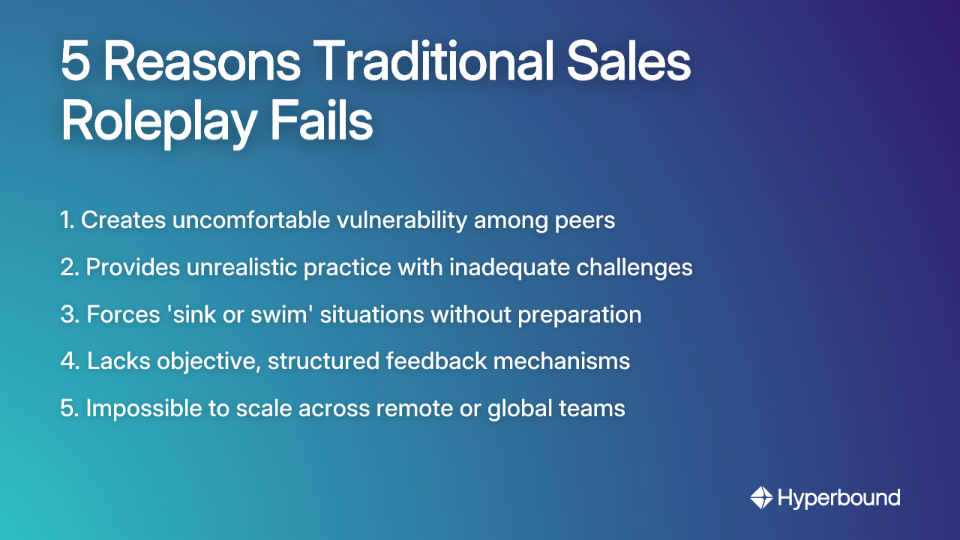
"It makes you vulnerable in front of your peers," explains one sales professional on Reddit. This vulnerability creates anxiety that prevents genuine practice. In fact, research shows 75% of employees experience anxiety over difficult workplace conversations, making roleplay feel more like a performance than a learning opportunity.
Your colleagues aren't professional actors, and they're often terrible at mimicking real prospects. As one SDR puts it: "Most assigned roleplay partners don't do it well. They aren't pushing the 'no' realistically." Instead, they lob softballs that don't challenge you to improve.
Many sales leaders adopt a "baptism by fire" approach, throwing reps into real customer calls with minimal preparation. "The best practice is with clients—sink or swim," argues one sales veteran. While there's truth to learning from real interactions, this high-pressure approach can reinforce bad habits and damage confidence.
Peer feedback is often vague, inconsistent, or overly nice. Without objective measurement of what went well or poorly, reps walk away without actionable insights to improve their discovery calls, objection handling, or value proposition delivery.
Traditional roleplay is time-intensive, pulling multiple team members away from selling activities. For remote or global teams, the logistics become even more challenging.
AI sales roleplay uses artificial intelligence to simulate realistic customer interactions, allowing reps to practice their skills without a human partner. These platforms create virtual buyers who respond dynamically to a rep's pitch, handling objections, asking questions, and even displaying various buyer personalities—from the eager prospect to the skeptical decision-maker.
The technology has evolved rapidly, with specialized tools now offering remarkably human-like conversations, realistic objections, and detailed feedback on everything from talk ratios to buying signals identification.
AI eliminates the social anxiety of traditional roleplay. Reps can make mistakes, experiment with new approaches, and practice difficult scenarios without fear of judgment—creating a psychologically safe space for growth.
Unlike human colleagues who have their own quotas to hit, AI is available 24/7. Sales reps can practice a cold call before an important meeting, rehearse handling customer objections on the weekend, or work through a new pitch deck whenever inspiration strikes.
Rather than subjective peer opinions, AI provides consistent, objective feedback based on predefined criteria. This can include talk-to-listen ratios, filler word usage, question quality, and how well the rep handled specific objections during the sales process.
The best AI platforms allow teams to create highly specific roleplay scenarios that mirror their actual sales process—from initial cold call to discovery, demo, handling objections, and closing. You can even create AI versions of your actual prospects rather than generic pre-built bots.
With 62% of sales enablement teams now adopting AI solutions, the ability to scale consistent training across global teams has become a significant advantage. New product launches, messaging changes, or sales methodology updates can be practiced by everyone simultaneously.
The data doesn't lie: Organizations report significant improvements after implementing AI sales training:
While many platforms are emerging, they generally fall into two camps: comprehensive coaching platforms and niche tools. Here's how to distinguish them:
Overview: Hyperbound is an advanced AI Sales Coaching platform designed to be an all-in-one solution for B2B sales teams. It focuses on driving real-world results with highly customizable AI buyer bots, gamified learning, and simulation of the entire sales cycle.
Standout Features:
User Feedback: "Hyperbound was recently implemented by my company and I love it—gave me more structure in how to approach cold calls as I transitioned out of inbound sales," reports one user on Reddit.
Best For: B2B sales teams looking for a holistic solution that bridges practice with real-world application. It's ideal for reducing new hire ramp time, ensuring message consistency, and scaling effective coaching across the entire team.
While several other tools exist, they often focus on a specific niche, which can create gaps in a complete sales readiness program. When evaluating alternatives, watch for common limitations:
After reviewing the technology and user feedback, here's the unvarnished truth about where AI excels and where it still falls short:
AI definitively fixes the core process problems of traditional roleplay:
Despite impressive advances, AI isn't a perfect solution yet:
AI isn't a replacement for real-world client interactions, but it serves as a powerful "flight simulator" for sales professionals. The best approach combines:
As one sales leader put it, "Practice doesn't make perfect. Perfect practice makes perfect." AI roleplay tools offer that perfect practice environment—realistic enough to be valuable, safe enough to allow experimentation, and data-driven enough to guide improvement.
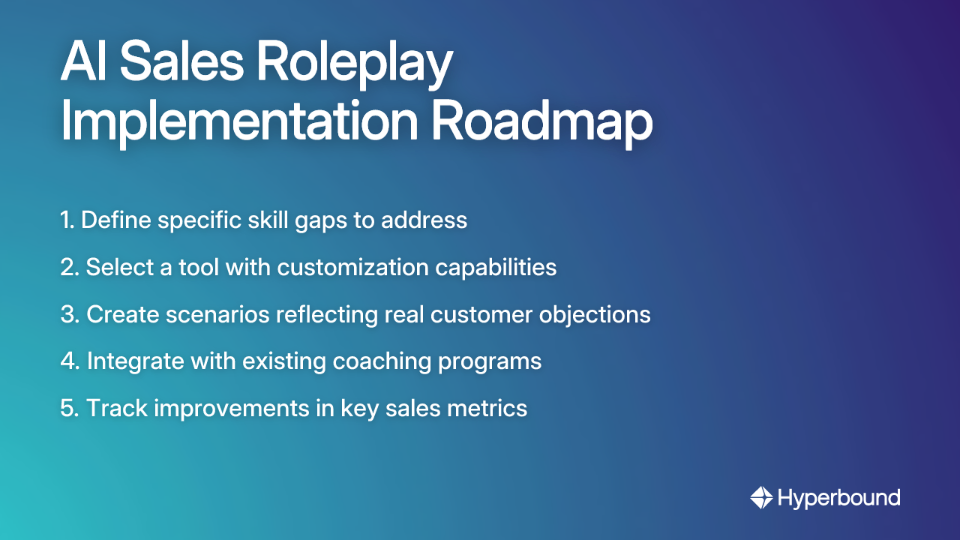
If you're considering introducing AI roleplay tools to your sales team, follow these implementation steps:
Traditional sales roleplay has long been a necessary evil—uncomfortable but unavoidable for skill development. AI-powered alternatives now offer a compelling alternative that addresses the fundamental flaws of the traditional approach.
While the "sink or swim" reality of sales will always exist, AI ensures that when your reps dive into client calls, they've already mastered their strokes in a controlled environment. It transforms the awkward, ineffective practice sessions of the past into valuable learning experiences that directly translate to improved performance.
For sales leaders looking to accelerate ramp times, improve consistency, and boost overall team performance, AI roleplay tools represent one of the most promising innovations in sales enablement technology—not to replace the human element of sales, but to enhance it through better preparation and practice.

The days of cringing when your manager says "Let's roleplay" may finally be coming to an end.
AI sales roleplay is a training technology that uses artificial intelligence to simulate realistic sales conversations. Sales representatives can practice their pitch, objection handling, and discovery skills with a virtual AI buyer instead of a human colleague, providing a safe and repeatable practice environment.
AI roleplay is more effective because it eliminates the peer pressure and awkwardness of traditional roleplay, provides a consistent and challenging practice partner available 24/7, and delivers objective, data-driven feedback. This allows for genuine skill development in a psychologically safe space without taking other reps away from their selling time.
AI sales simulators use advanced language models to create dynamic, interactive conversations. You can load specific scenarios, buyer personas, and common objections. The AI then responds to what the sales rep says in real-time, mimicking the unpredictable nature of a real customer call and providing instant feedback on performance.
All sales professionals can benefit, from new hires to seasoned veterans. New SDRs and AEs can use it to reduce ramp time and build foundational skills safely. Experienced reps can use it to practice new messaging for a product launch, refine their approach for a specific competitive threat, or master advanced sales methodologies.
AI roleplay tools provide specific, measurable feedback that goes beyond subjective opinions. You can expect metrics on your talk-to-listen ratio, use of filler words, pace, the quality of your questions, and whether you successfully identified and addressed key buying signals or objections.
No, AI roleplay is not a replacement for a manager's coaching but rather a powerful supplement to it. The AI acts as a "flight simulator" for building muscle memory and mastering fundamentals. The manager's role then evolves to providing strategic guidance, nuanced feedback on complex deals, and coaching on the emotional intelligence that AI cannot fully replicate.
While general AI tools like ChatGPT can be used for basic practice, they are not specialized enough for effective sales training. They often lack the deep context of your specific products, customers, and competitive landscape, leading to generic and unrealistic objections. Specialized platforms like Hyperbound are designed to create highly customized and relevant training scenarios.
Look for a platform that offers deep customization, allowing you to build scenarios that mirror your actual sales process and buyer personas. The best tools also analyze real customer calls to bridge the gap between practice and performance, provide gamified learning to drive engagement, and offer comprehensive analytics to track improvement.
What's your experience with sales roleplay, traditional or AI-powered? Share your thoughts and experiences in the comments below.








Use Cases
Legal