
You've hired a new SDR. They've sat through the onboarding deck, shadowed a few calls, and can recite the product pitch from memory. Then they're live — on a real cold call, with a real prospect — and they freeze when faced with an objection they've never actually practiced handling.
It's not their fault. It's the system.
Traditional sales training gives reps knowledge, but not reps. Real selling skill comes from repetition — from logging hundreds of at-bats until objection handling feels like muscle memory, not a memorized script. But with the average rep ramp time sitting anywhere between 3 to 9 months, most organizations can't afford to let new hires practice on live prospects. Every fumbled discovery call is a deal at risk. Every cold call that falls apart is pipeline burned.
The promise of AI sales roleplay software is exactly this: give your reps a safe, realistic environment to practice at scale before they ever touch a real opportunity.
But here's the catch — not all AI roleplay tools are built the same. As one sales rep put it on Reddit: "ChatGPT helped us practice responses to basic objections, but it couldn't replicate realistic responses. It just agrees and tells me why I'm right." Another described their experience with early tools as "a bit unrealistic for B2B sales role-playing — prospects ask unexpected questions or take the conversation in different directions, which it doesn't really handle well."
Realistic simulation is the entire point. If the AI doesn't push back like a real buyer, reps aren't building real skills — they're building false confidence.
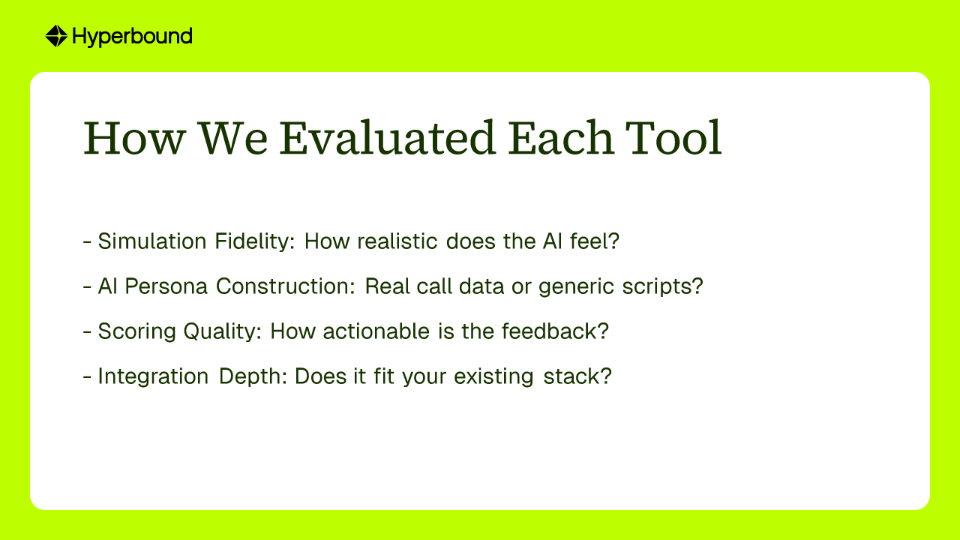
To help you cut through the noise, we evaluated the top AI sales roleplay software on four criteria that actually matter:
Here are the 9 best options on the market today.
Best for: SDR/BDR onboarding, AE discovery and objection handling, multi-stakeholder deal practice, and post-sales teams.
If you want to understand where AI sales roleplay software is headed, look at what Hyperbound's customers are actually experiencing.
These aren't incremental improvements. They're the kind of numbers that make CFOs pay attention.
Simulation Fidelity: High
Hyperbound's AI Roleplays cover the full sales cycle — cold calls, discovery, objection handling, demos, renewals, upsells, and warm calls. But what sets it apart is how the AI behaves during those simulations. The AI buyer personas are dynamically responsive, meaning they don't just follow a script — they push back, go off-topic, ask unexpected questions, and behave the way real buyers do.
Two standout capabilities:
AI Persona Construction: Advanced
This is Hyperbound's core differentiator. Its AI buyer personas are trained on 2M+ hours of real B2B sales conversations — not generic scenarios built by someone guessing what a CFO sounds like. The platform analyzes what your own top-performing reps do on winning calls, then builds practice scenarios from those real patterns. The result: AI personas that simulate real pushback, probe your value proposition, and behave like actual buyers at your ICP.
Scoring Quality: Excellent
After every roleplay, reps receive instant, objective feedback via AI Scorecards that track talk ratios, methodology adherence, handling of key selling moments, and specific coaching areas. AI Coaching surfaces missed opportunities, weak responses, and off-track messaging — all aligned to your sales methodology. Managers get detailed analytics dashboards to track rep progress over time and identify skill gaps before they cost deals.
Integration Depth: Deep
Hyperbound embeds directly into the tools your team already lives in:
Hyperbound also supports 25+ languages, making it a strong fit for global sales teams. With 45,000+ active users across 7,000+ companies and a 4.9/5 rating on G2, it's the category leader in AI sales roleplay software.
Best for: Teams that want to layer in body language and non-verbal communication feedback alongside their sales roleplay training.
Second Nature takes a video-first approach to AI roleplay, allowing reps to practice pitches and conversations on camera. The platform analyzes both what reps say and how they say it — including eye contact, pacing, and filler words.
A strong choice if communication style and executive presence are priorities alongside core sales skills.
Best for: Pharma, financial services, and other highly regulated industries where message control and compliance documentation are non-negotiable.
Quantified is purpose-built for environments where what a rep says and doesn't say carries legal and regulatory weight. Rather than pure sales performance, its primary focus is ensuring reps adhere to approved messaging with precision.
If your sales enablement team is operating in a regulated space where every word matters, Quantified's compliance-first design makes it worth evaluating.
Best for: Individual reps or teams wanting to sharpen foundational communication skills — pacing, clarity, filler words, and executive presence.
Yoodli sits closer to the communication coaching category than pure sales roleplay. It's built around helping people become better speakers, which makes it a useful complement to scenario-based practice — but not a replacement.
Best positioned as a supplemental tool for reps preparing for high-stakes presentations or working on executive communication — not as a primary sales training platform.
Best for: CSMs and AMs who need to practice renewals, upsells, QBRs, and difficult customer conversations before going live.
This is a purpose-built capability within the Hyperbound platform, and it's worth calling out specifically for post-sales teams. Most AI sales roleplay software is built entirely around the acquisition motion — cold calls, discovery, closing. Post-sales conversations carry completely different dynamics: an existing relationship, a history of expectations, and real churn risk.
If your CS or AM team is losing renewals they should be winning, this is the practice environment that bridges the gap.
Best for: Teams that prefer a predictable, script-driven approach over dynamic AI conversation.
PitchMonster is built around scripted conversation trees rather than fully generative AI. Reps move through predefined dialogue paths, which creates consistency — but limits the ability to simulate the unpredictable nature of real buyer conversations.
A reasonable choice for organizations that want to lock in specific messaging or scripts before deploying reps — less suitable as a standalone solution for comprehensive sales skill development.
Best for: Teams struggling with low training adoption who need engagement-first design to get reps practicing consistently.
Luster takes a gamification-first approach to sales practice, using leaderboards, challenges, and rewards to drive rep participation. If the core problem is that reps simply don't practice, this approach can help build the habit.
Best for teams where adoption is the primary blocker — though gamification alone won't replace simulation fidelity when reps need to prepare for complex B2B deals.
Best for: Smaller organizations or early-stage teams needing a straightforward solution to get new reps off the ground quickly.
Brevity offers foundational roleplay capabilities at a lower complexity threshold, making it accessible for teams that don't have a dedicated sales enablement function or complex training infrastructure.
A reasonable starting point for teams new to AI sales roleplay software, with the expectation that they'll likely need to graduate to a more robust platform as the team scales.
Best for: Budget-conscious teams whose primary training priority is getting new SDRs comfortable on cold calls quickly.
FullyRamped is purpose-built around cold calling simulations, making it a focused tool for the top of the funnel. It's not trying to be an all-in-one platform — it's trying to get new reps through their first hundred cold calls faster.
If cold call simulation is the specific and immediate need, FullyRamped is worth evaluating. For teams that need the full motion — onboarding through deal execution — a more comprehensive platform will serve better long-term.
.png)
.png)
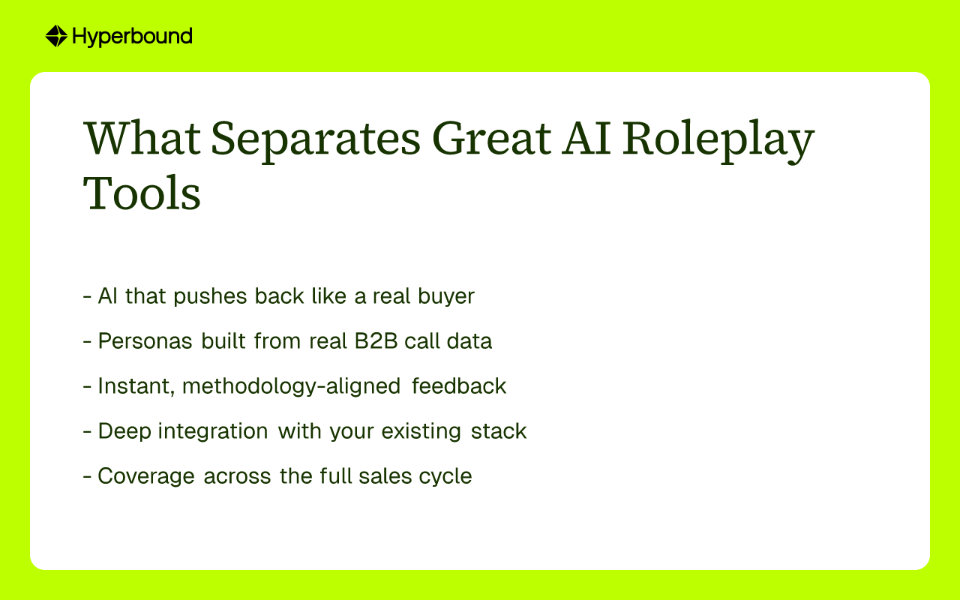
The common thread across every underperforming AI roleplay implementation isn't the technology — it's the gap between what the simulation feels like and what a real B2B sales conversation actually demands. When the AI just agrees with everything the rep says, reps don't build real objection-handling muscle. When personas are built from generic scripts instead of real buyer behavior, reps walk into live calls underprepared.
The tools on this list offer meaningful options across a range of budgets, team sizes, and use cases. But for sales teams where ramp time is a business-critical number — where 210-day onboarding isn't acceptable and win rates need to improve this quarter — the quality of the practice environment makes all the difference.
Platforms built on real B2B call data don't just give reps more at-bats. They give reps the right at-bats — the ones that mirror the conversations they'll actually have.
AI sales roleplay software is a training tool that uses artificial intelligence to simulate realistic sales conversations with virtual buyers. It provides a safe and scalable environment for sales representatives to practice skills like objection handling, discovery calls, and product demos without risking live deals.
Realistic simulation is critical because it prepares reps for the unpredictability of actual buyer interactions. If an AI is too agreeable or follows a rigid script, reps build false confidence. A realistic AI pushes back, asks tough questions, and goes off-topic, mirroring real-world scenarios and ensuring the skills reps develop are directly applicable in the field.
AI sales roleplay software reduces ramp time by allowing new hires to log hundreds of practice "at-bats" in a compressed timeframe. Instead of waiting for live call opportunities, reps can practice specific scenarios on-demand, receive instant AI-driven feedback, and build the muscle memory needed to handle objections and navigate complex conversations effectively from day one.
AI personas trained on real call data are built from analyzing millions of hours of actual B2B sales conversations. This allows them to replicate the nuanced, unpredictable, and challenging behaviors of real buyers. In contrast, personas built from generic scripts follow predictable, predefined conversation paths and are less effective at simulating realistic sales interactions.
While ideal for onboarding new Sales Development Reps (SDRs) and Account Executives (AEs), AI roleplay benefits the entire revenue team. Veteran AEs can use it to practice new messaging or prepare for high-stakes negotiations. Customer Success Managers (CSMs) and Account Managers (AMs) can practice renewal, upsell, and difficult customer conversations.
After each roleplay session, the AI delivers an instant, objective scorecard analyzing the representative's performance. This feedback typically covers adherence to sales methodology, talk-to-listen ratios, handling of key selling moments, and specific areas for improvement. This allows for targeted, consistent coaching at scale without requiring a manager to oversee every practice session.
Yes, the leading AI sales roleplay platforms are designed for deep integration with the modern sales stack. They can connect with your CRM (like Salesforce or HubSpot), conversation intelligence tools (like Gong), and learning management systems (LMS) to create a seamless training workflow that aligns with your team's existing processes.










Use Cases
Legal