
Sales enablement leaders often secure investment in AI roleplay training after a compelling demo. Reps are meant to practice sales calls, sharpen objection handling, and show up to live calls more prepared. But a few weeks later, a familiar complaint surfaces: "The AI just agrees with everything I say."
As one sales rep described in a real conversation about AI roleplay tools: "ChatGPT helped at practicing our responses to basic objections, but it still could not replicate realistic responses. It just agrees and tells me why I am right." Another noted that most tools fail because "prospects often ask unexpected questions or take the conversation in different directions, which it does not really handle well."
This is the realism problem at the heart of AI sales training, and it is why selecting the right platform matters more than simply selecting a platform.
Three names dominate the conversation right now: Hyperbound, Second Nature, and Mindtickle. Each has genuine strengths. But they are built around fundamentally different philosophies about what makes sales training work, and only one connects practice back to real deal outcomes. This article breaks down an honest, structured comparison across the four dimensions that matter most, then shows what sits beyond them.
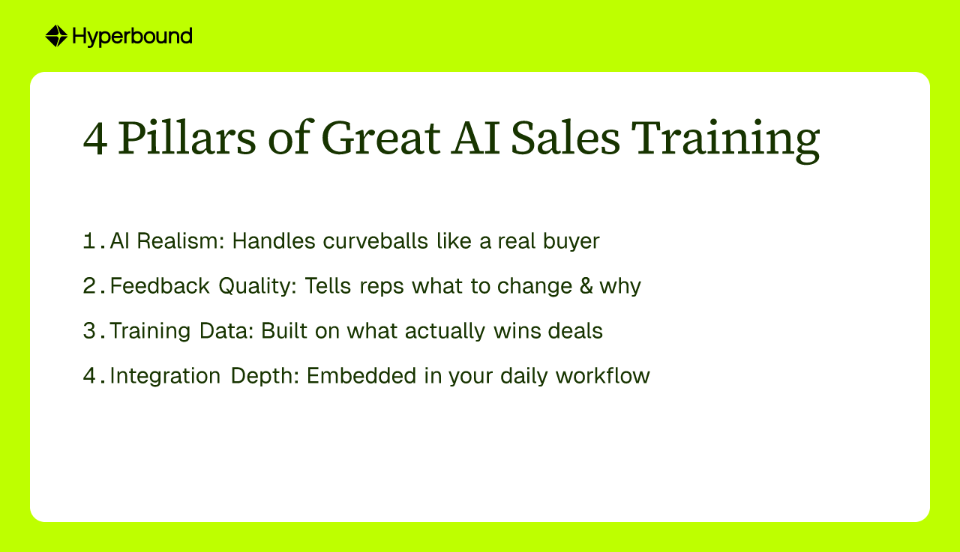
Before diving into the head-to-head, here's why each of these dimensions was chosen:
Second Nature deserves credit for making AI roleplay engaging. Its 3D avatars with realistic movements and emotions create a visually immersive experience that helps reps who freeze up in front of a camera. Assigning a "skeptical CFO" or an "excited champion" persona is useful for presentation practice.
Mindtickle's simulations shine in complex, multi-step enterprise certification scenarios. For organizations certifying 500 reps on a specific product launch script with consistent assessment, the multi-modal format (audio, video, text) is well-suited to the task.
Hyperbound solves the core realism problem: the AI does not feel predictable when reps push it. Hyperbound's AI buyer personas are built from the analysis of real B2B sales patterns, refined across 2M+ hours of simulated calls, which means they do not follow a script. They follow the patterns of how real buyers actually behave, which includes going off-topic, surfacing unexpected objections, and resisting the pitch even when a rep believes they have nailed it.
Hyperbound Practice also supports Multiparty Roleplays, simulating a call with both a champion and an economic buyer simultaneously. That is the kind of complexity that actually maps to enterprise B2B deals, and it is a level of realism the other platforms do not replicate.
Mindtickle's feedback is consistently structured and tied to defined competencies, and its Call AI adds real conversation scoring with coaching recommendations and deal health insights. For large organizations running structured enablement programs, this combination is genuinely valuable: teams can track which competencies are improving across a 1,000-person sales org, see how those competencies show up on real calls, and connect them to broader business outcomes.
Second Nature's gamified approach to scoring and manager dashboards is effective at driving adoption. When reps compete on leaderboards and earn points, participation goes up, and that matters in teams where training completion has historically been low.
Volume of completions and competency scores are inputs. Behavior change is the output. Hyperbound's AI Scorecards go beyond a pass/fail grade: they deliver instant feedback on talk ratio, key selling moments, methodology adherence, and specific coaching areas after every single session. The AI Coaching layer then identifies exactly where the rep went off-message, missed an opportunity to advance the deal, or responded weakly to a specific objection.
Hyperbound also offers Bitesized Roleplays: 3-5 minute practice sessions that target specific skill gaps and fit into a rep's day. This matters in ways a feature comparison does not capture: tenured reps who refuse 30-minute certification roleplays will still do a 5-minute prep session before a big call. And those reps are often the ones whose improvement moves the revenue needle most.
This is the kind of structured guidance that helped one rep describe Hyperbound as the tool that "gave me more structure in how to approach cold calls as I transitioned out of inbound sales." (Source) Specific, behavior-level feedback does not just tell reps they need to improve; it tells them how.
Second Nature lets teams build roleplays from a library of templates or by uploading existing content like pitch decks and sales scripts. This is practical for certifying new messaging quickly, but it means the AI is modeling what an organization says a good call looks like — not necessarily what actually wins deals.
Mindtickle leverages structured learning paths and its broader enablement platform to organize and deliver training content at scale. Importantly, Mindtickle's Call AI captures and analyzes real customer conversations, and the platform increasingly uses insights from real calls to inform AI roleplay scenarios. This is a meaningful evolution from purely script-based training. However, the connection between Call AI insights and dynamically shaping individual roleplay personas remains less direct than building the AI's foundational behavior from a massive corpus of real call data.
Hyperbound is the only platform that starts from what actually works. Its AI is not mimicking a scripted ideal; it is modeling buy-side behavior derived from the analysis of real B2B sales calls. This directly addresses what sales reps themselves identify as the core gap: "I think that can be fixed by training the model with call recording data." (Source) That is exactly what Hyperbound did, at the scale of 2M+ hours of simulated calls informed by real sales patterns.
As a comprehensive sales enablement platform, Mindtickle's deep Salesforce integration is a genuine advantage for enterprise teams already running their revenue operations inside Salesforce. Training assignments, completion tracking, and performance data can all live in one ecosystem.
Second Nature offers robust multi-language support that makes it a viable option for global teams needing a consistent training experience across regions.
Hyperbound is embedded directly in the tools reps already use — calendar, CRM (Salesforce, HubSpot, Dynamics 365), LMS, and Slack. This is not a minor UX detail. As one sales enablement practitioner put it: "The current system takes 7-20 clicks just to find info, engagement is abysmal, and they are already overloaded with emails, Teams messages, CRM tasks." (Source) A great tool that does not fit into the workflow is a tool reps abandon. Hyperbound removes that friction by meeting reps where they are, and unlike integrated suites where roleplay is one module among many, Hyperbound was purpose-built for this.
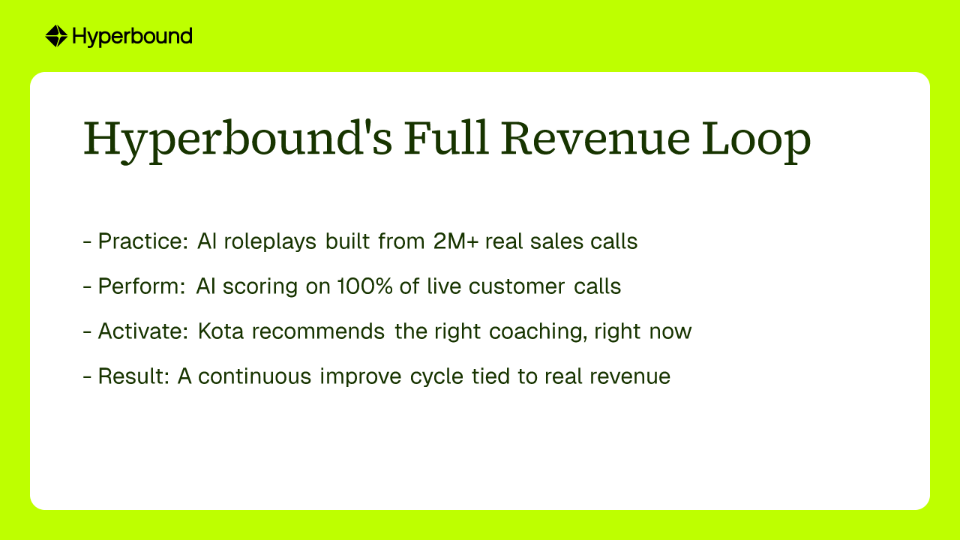
The deeper issue with most AI sales training tools: they stop at the training module. A rep completes a roleplay, gets a score, and the platform's job is done. Whether that practice translated into a better discovery call on Tuesday? Nobody knows.
Hyperbound was built around the idea that practice without a feedback loop tied to real outcomes is incomplete. That is why it coined the Revenue Activation category, and why it is the only platform offering a full Practice -> Perform -> Activate loop.
The operational loop this creates: Score Real Calls → Identify Skill Gaps → Assign Targeted Roleplays → Score Real Calls Again. It is a continuous improvement cycle, and it is the difference between completing training and actually improving on live calls.
Results teams have seen with Hyperbound:
One of the most compelling case studies: Vanta reduced their BDR ramp time from 210 to 75 days — a 60% reduction — while simultaneously growing their BDR team 4x and achieving 5x pipeline growth. Stevie Case, Vanta's CRO, attributes this directly to Hyperbound. LinkedIn deployed the platform across 3,000+ sellers in three business units across NAMER and EMEA. Nivoda saw a 50% ramp reduction, 2x revenue year-over-year, and a 150% increase in demo rates.
These aren't learning completion metrics. They're revenue outcomes.
Each of these platforms has real strengths. Second Nature brings visual polish and gamification that drives adoption. Mindtickle offers an LMS backbone that large enablement organizations trust. But here is the question neither of them can answer: did the practice change what the reps do on live calls?
That is the loop most platforms leave open. The roleplay ends, the score gets logged, and whether it made a difference on Tuesday's discovery call is anyone's guess. Hyperbound closes that loop, with AI roleplays that sound like real buyers, deal-level coaching that catches risk while deals are still winnable, and Kota orchestrating the right intervention at the right time.
Hyperbound is also built for the enterprise. Trusted by teams like LinkedIn (3,000+ sellers), IBM, and Vanta, with SOC 2 Type II, ISO 27001, and HIPAA compliance. Depth and enterprise readiness are not a tradeoff here.
If sales leaders are tired of paying for a training platform that ends at the roleplay and hoping the skills transfer on their own, Hyperbound is where the loop closes.
The main problem with most AI sales roleplay tools is a lack of realism; they often agree too easily with the sales rep and fail to replicate the unpredictable nature of real customer conversations. This "realism problem" means the practice does not prepare reps for the curveballs, unexpected questions, and pushback they will face in live calls. The AI often follows a predictable script, which does not build the adaptive skills needed to handle dynamic sales scenarios.
AI realism is crucial because if the practice environment does not mirror real-world sales calls, the skills and confidence reps build will not transfer effectively to actual customer interactions. Reps need to practice against an AI that can handle curveballs, go off-topic, and raise unexpected objections. This is the only way to build the muscle memory required to navigate complex B2B deals, handle difficult buyers, and close more effectively under pressure.
Hyperbound creates realistic AI buyer personas by building them from analysis of real B2B sales patterns, refined across over 2 million hours of simulated calls. Unlike tools that rely on pre-written scripts or company pitch decks, Hyperbound's AI is informed by the patterns, objections, and behaviors of actual buyers. This data-driven foundation allows the AI to respond dynamically and unpredictably, just like a real prospect would. It also supports multiparty roleplays to simulate calls with multiple stakeholders.
Hyperbound provides instant, behavior-specific feedback that tells reps exactly what to improve and why, going beyond simple pass/fail scores. After each session, AI Scorecards analyze performance on metrics like talk ratio, adherence to sales methodology, and how key moments were handled. The AI Coaching layer pinpoints specific areas for improvement, such as missed opportunities to advance the deal or weak responses to objections, providing actionable guidance for behavior change.
Hyperbound connects practice to performance with its unique "Practice -> Perform -> Activate" loop, which analyzes both simulated and real customer calls to create a continuous improvement cycle. The platform allows reps to Practice with realistic AI. It then uses AI to score 100% of real customer calls to identify skill gaps (Perform). Finally, its AI Revenue Agent, Kota, Activates this data by recommending targeted coaching and roleplays to address those specific gaps, directly linking training efforts to pipeline performance.
The key difference is Hyperbound's foundation in real call data and its focus on the entire revenue cycle, whereas competitors often focus on training completion within a more limited, script-based environment. While Second Nature excels at visual engagement and Mindtickle integrates deeply into enterprise LMS structures, Hyperbound is the only platform built from analysis of real B2B sales patterns, delivered across 2M+ hours of simulated calls. This results in more realistic AI, more actionable feedback, and a unique ability to connect practice drills directly to performance on live deals and revenue growth.










Use Cases
Legal