
The core limitation of most AI sales roleplay bots is not technical capability but domain knowledge. A bot that responds with "I am concerned about the budget" to every objection, regardless of whether the simulated prospect is a CISO evaluating SOC 2 posture or a VP of Engineering assessing API architecture, is not preparing a rep for the conversations that move revenue. It is providing the illusion of practice.
This gap is well documented. Sales professionals across forums and practitioner communities consistently report that generic AI tools produce responses that are overly agreeable, unrealistic, and ultimately poor preparation for live buyer interactions. The root cause is not the underlying model quality. It is the absence of domain context: the specific terminology, regulatory concerns, integration requirements, and stakeholder dynamics that shape how actual buyers evaluate vendors.
Hyperbound addresses this at the infrastructure level. Its AI buyer personas are not scripted from templates. They are built from analysis of real B2B sales patterns across industries, roles, and deal sizes, trained on 2 million+ hours of simulated calls. The result is a practice environment where bots push back with the same specificity a rep will encounter on a live call.
Beyond practice quality, Hyperbound connects roleplay performance to live deal outcomes. The same AI infrastructure that powers practice sessions also scores real calls through Hyperbound Perform and surfaces skill gaps through Kota, Hyperbound's AI revenue agent. Practice is not a standalone activity. It is the first step in a Revenue Activation loop that links preparation to pipeline performance.
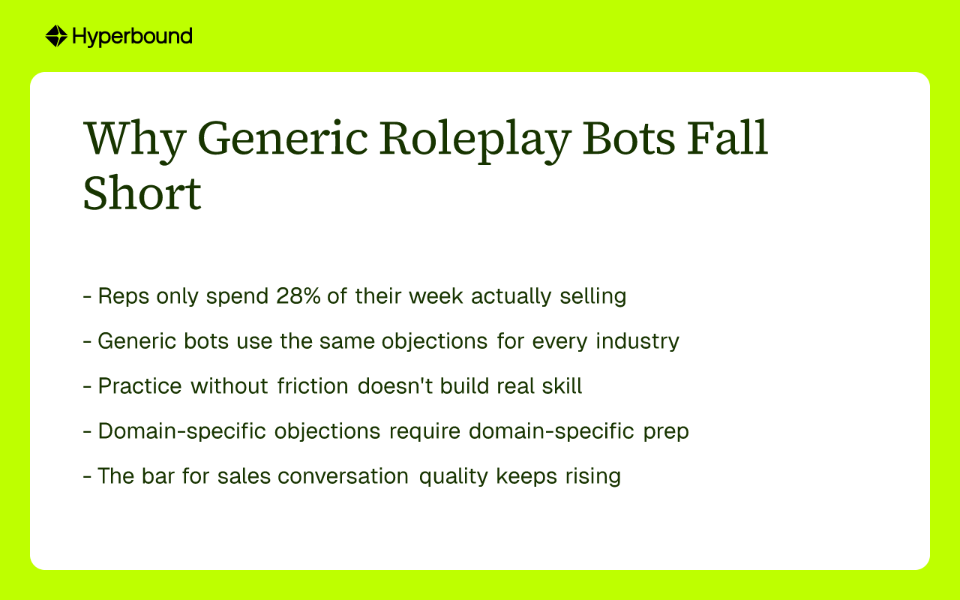
Sales reps spend 28% of their week actually selling. The remainder is consumed by administrative overhead, research, and internal coordination. Every minute of active preparation carries disproportionate weight in determining pipeline outcomes.
When that preparation time is allocated to a bot that returns the same generic budget objection regardless of prospect profile, the organization is not building capability. It is consuming preparation time without producing transferable skill.
Harvard Business Review's research on deliberate practice establishes that skill development requires calibrated challenge. Practice environments that are too generic or too accommodating do not produce meaningful improvement under real-world conditions.
In B2B sales, the required friction is domain-specific. A Chief Information Security Officer at a fast-growing SaaS company will raise SOC 2 compliance, data residency, and infrastructure integration. A Head of Revenue Operations at a mid-market B2B organization will interrogate CRM integration depth, implementation timelines, and whether the vendor has operational experience at comparable scale.
Generic AI lacks the context to replicate these interactions. Sales professionals consistently observe that the standard for conversation quality continues to rise as automated outreach saturates buyer inboxes. The organizations that stand out are those whose reps enter live conversations already fluent in the prospect's operating environment. That fluency requires a practice infrastructure that mirrors the complexity of the conversations it prepares for.
Hyperbound's AI sales roleplay infrastructure is built on 2 million+ hours of simulated calls, with AI buyer personas developed from analysis of real B2B sales patterns across industries, roles, and deal sizes. The personas are not derived from scripts or templates. They are modeled from how actual buyers think, push back, and make procurement decisions.
The outcome is an AI that understands buyer conversation dynamics at a level that prompt engineering alone cannot replicate: how concerns escalate, how objections resolve, and how the quality of a rep's response shapes the direction of the interaction.
The practical difference is material.
A generic bot might say: "I'm not sure this is the right time for us budget-wise."
A Hyperbound bot configured for a B2B SaaS CISO might say: "Before we go further, I need to understand your SOC 2 posture and how you handle data residency. We just completed our annual audit and our security team is going to be all over any new vendor."
A Hyperbound bot built for a FinTech prospect might push back with: "We already have a compliance framework integrated with our transaction monitoring system. Ripping that out is not a small project. Walk me through how your API handles our specific encryption requirements."
These are not hypothetical responses. They reflect the kinds of objections reps actually face when selling into technical B2B environments. Practicing against that level of specificity changes how you prepare, what you learn, and how confident you feel walking into the real thing.
Vanta saw this play out at scale. Their SDR team was selling to highly technical personas, CISOs and security leaders, and ramp times had stretched past 200 days. After implementing Hyperbound, reps practiced daily against bots that understood the security domain. Ramp time dropped 60% (210 days to 75 days), time to first pipeline accelerated 30%, and the team influenced over $125 million in pipeline, all while scaling headcount 4x.
This approach aligns with what McKinsey has consistently found about successful AI implementations: the ones that generate real results take a domain-based approach, embedding deep functional knowledge rather than applying a generic model across all contexts.
The platform's realism is delivered through a set of integrated capabilities, each addressing a distinct dimension of practice quality.
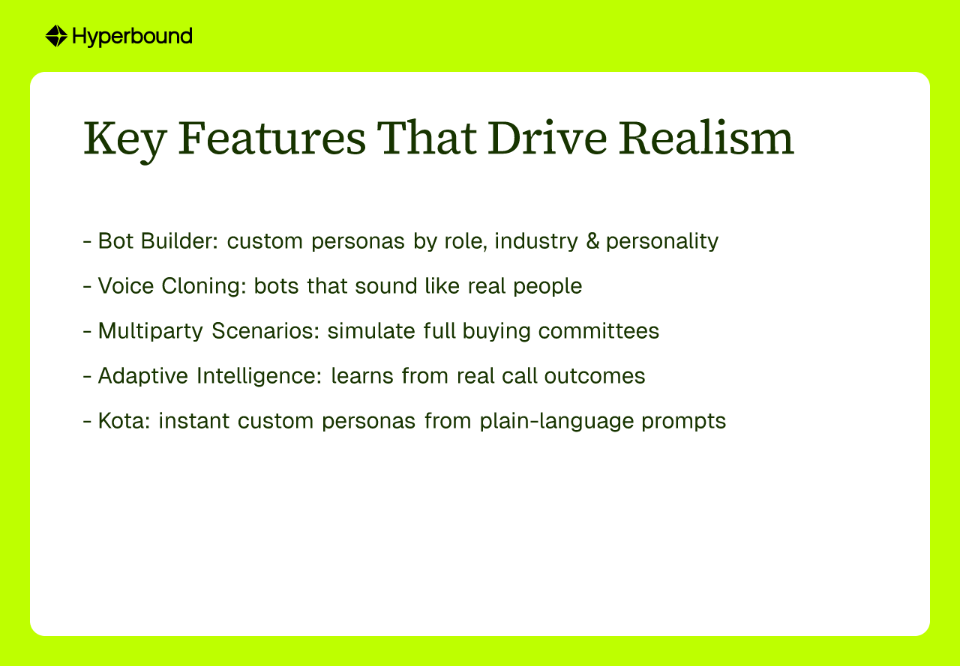
The Bot Builder
Managers are not limited to off-the-shelf personas. The Bot Builder lets teams construct highly specific AI buyers from scratch. You define the industry, the role, the seniority level, the personality type (skeptical, direct, amiable), and the known pain points and goals that would realistically motivate that buyer. This aligns with a core principle of effective sales practice: the more context, the better the experience. Bot Builder is built around exactly that principle.
Voice Cloning
AI roleplay tools are frequently criticized for vocal artificiality. Hyperbound's voice cloning technology addresses this directly: bots produce natural speech that mirrors human cadence and intonation rather than synthetic text-to-speech output. Vocal realism is a significant determinant of practice engagement. The closer the simulation environment to the conditions of a live call, the stronger the transfer to real-world performance.
Multiparty Scenarios
Enterprise B2B purchases rarely involve a single decision-maker. Most complex deals require navigating a buying committee: a champion advocating internally, an economic buyer scrutinizing ROI, and a technical influencer raising integration or security concerns. Hyperbound enables simultaneous multiparty practice sessions where bots representing each stakeholder interact with the rep in real time. This format of practice cannot be replicated through manager-led one-on-one roleplay.
Adaptive Intelligence
Most roleplay tools operate on decision trees, selecting scripted responses based on keyword matching. Hyperbound's AI learns from actual call outcomes and evolves against real-world data rather than a programmer's assumptions about buyer behavior. This adaptive model develops a functional understanding of what approaches work and what approaches fail under live conditions.
Kota: On-Demand Persona Generation
Kota, Hyperbound's AI revenue agent, enables on-demand persona generation from plain-language prompts. A manager can request a custom practice bot targeting a specific rep's weakness, a particular objection pattern, or a deal-specific scenario, and Kota generates a full buyer persona within seconds. No forms, no configuration overhead, no delay between identifying a coaching need and deploying a targeted intervention.
Better practice does not just feel better. It produces measurable outcomes. McKinsey's research on AI adoption in sales-intensive industries shows that well-implemented AI training tools can drive 10 to 20% improvements in sales conversion rates, 10 to 15% premium growth, and 20 to 40% reductions in onboarding costs. Organizations that lead on AI adoption have generated 6.1 times the total shareholder return compared to laggards over five years.
These numbers come from context-aware implementations, the kind where the AI understands the domain well enough to produce useful outputs. A generic bot that gives every rep the same budget objection drill does not move these numbers. A purpose-built AI sales roleplay bot that mirrors the complexity of the deals your reps are actually working does.
Practice is only one component of the Revenue Activation infrastructure. The same AI that powers practice sessions also scores live calls through Hyperbound Perform, identifying skill gaps as they manifest in active deals and routing them into targeted practice interventions. Kota orchestrates the full closed loop: surface a capability gap in a live deal, generate a bite-sized roleplay to remediate it, and measure whether the behavior changed on the subsequent call. Conversation intelligence platforms record outcomes. Revenue Activation changes them.
Sales professionals consistently observe that even as automation saturates buyer inboxes, procurement decisions remain fundamentally human. The organizations that differentiate are those whose reps demonstrate immediate fluency in the prospect's operating environment: their specific pain points, industry pressures, and internal dynamics.
Hyperbound does not replace that human dimension. It ensures the rep enters every conversation with the preparation required to create it. The platform provides the infrastructure for deliberate practice that builds transferable skill: challenging, specific, and grounded in the actual dynamics of active deals. And because practice performance is connected to live deal outcomes, preparation becomes a measurable input to revenue performance.
An AI roleplay bot that cannot challenge pricing logic with an industry-specific concern, cannot simulate the competing priorities of a buying committee, and cannot adapt based on how actual conversations unfold is not a preparation tool. It is a compliance exercise.
The distinction between an effective AI sales roleplay bot and an ineffective one is domain knowledge: the difference between a tool that validates existing behavior and one that improves it.
Hyperbound's infrastructure, built on millions of hours of simulated calls informed by real B2B sales patterns, combines deep persona customization through the Bot Builder with voice cloning, multiparty scenarios, adaptive intelligence, and a closed-loop connection to deal coaching through Perform and Kota. The result is a practice environment that mirrors the complexity of live deals and connects preparation directly to pipeline outcomes.
In a market where execution quality is the primary differentiator, the caliber of practice infrastructure determines the caliber of revenue outcomes.

Most AI sales roleplay bots lack domain knowledge, producing responses that are generic, unrealistic, and overly agreeable. They typically rely on general language models without the industry-specific context required to simulate the objections, concerns, and dynamics that shape actual B2B buyer conversations. The result is practice sessions that fail to prepare reps for the friction of a live call.
Domain knowledge is an AI's deep understanding of a specific industry, including its unique terminology, business challenges, compliance requirements, and buyer motivations. For a sales roleplay bot, this means it can replicate how a real Chief Information Security Officer would discuss SOC 2 compliance and infrastructure integration, or how a VP of Engineering would push back on API limitations and vendor lock-in. Without this knowledge, the AI cannot provide the specific, challenging objections that make practice effective.
A domain-specific AI bot improves sales skills by creating a realistic practice environment where reps can safely face and learn to handle the precise objections and questions they will encounter on actual calls. This type of deliberate practice builds true confidence and fluency. When a rep has already practiced navigating a conversation about SOC 2 compliance or CRM integration depth, they enter the real call better prepared, more credible, and more effective at moving the deal forward.
Generic AI tools can support basic practice but cannot replicate realistic, industry-specific sales conversations because they lack specialized domain context. Sales professionals consistently report that ChatGPT tends toward agreement and produces generic objections. Without the deep context derived from real B2B sales patterns, it cannot simulate the nuanced pushback from a specific buyer persona, making it a poor substitute for purpose-built practice infrastructure.
Hyperbound creates realistic buyer personas by drawing on over 2 million hours of simulated sales calls, with AI buyer personas built from deep analysis of real B2B sales patterns across industries and roles. This data gives the AI a deep understanding of how buyers actually speak, what their true concerns are, and how they object. This is enhanced by features like the Bot Builder, which allows managers to layer in specific company details, pain points, and personality traits for highly customized practice.
Yes, advanced AI sales roleplay platforms like Hyperbound can simulate a full buying committee in a single practice session. The Multiparty Scenarios feature allows a sales rep to engage with multiple AI bots simultaneously, each playing a different role. For example, you can practice navigating the competing priorities of a skeptical CFO, an enthusiastic champion, and a detail-oriented technical buyer all in one call, mirroring the complexity of real B2B deals.
Kota enables custom training scenario creation in seconds from plain-language prompts. A manager can request a specific persona, such as a skeptical CTO at a mid-market SaaS company objecting on infrastructure integration grounds, and Kota generates a tailored AI bot and practice scenario immediately. This removes the configuration overhead that typically separates identified coaching needs from deployed interventions.
Yes. Hyperbound is the entry point to a Revenue Activation platform, not a standalone roleplay tool. Hyperbound Perform scores live calls and surfaces skill gaps as they manifest in active deals. Kota then recommends targeted practice interventions to close those gaps. This closed loop — practice, score real calls, practice what the data identifies as missing — separates Hyperbound from point-solution roleplay tools. Organizations can measure whether practice produced measurable behavior change on the subsequent call.










Use Cases
Legal