Many sales professionals know the moment: about to enter a high-stakes sales call, palms sweating while rehearsing the pitch for the tenth time; or preparing for an interview that demands selling a luxury item on a cold call, unsure where to begin.
Traditional sales roleplay has always been awkward. Reps either practice with a colleague who cannot realistically simulate a skeptical executive decision maker, or they fly solo, rehearsing in front of a mirror and imagining responses. Neither approach prepares them for the unpredictability of actual sales conversations.
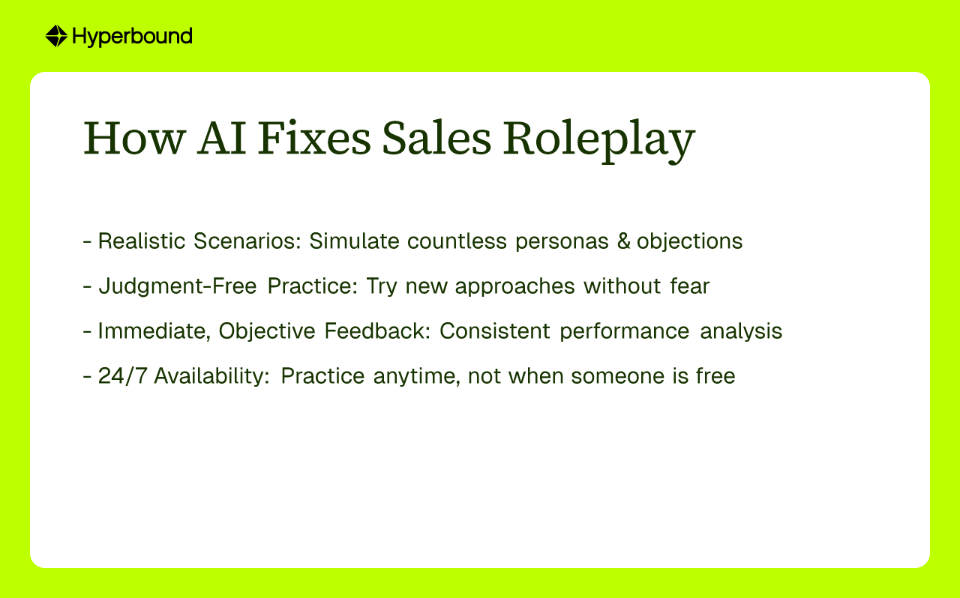
Enter AI: a 24/7, judgment-free practice partner.
As one sales professional put it, "ChatGPT has been a good friend of mine recently that has helped in many different situations." The value of AI for sales roleplay is that it provides a safe space to fail, experiment, and refine an approach before facing a real prospect.
This guide outlines how to use AI tools to create realistic sales simulations, from free options to advanced platforms that transform how teams practice and perform.
Traditional sales roleplay suffers from several fundamental flaws:
AI roleplay solves these problems by providing:
The setup begins with the tools most accessible to individual reps.
The quality of your AI roleplay depends entirely on how well you set up the initial scenario. You need to be the director of this simulation.
Here's a master prompt template you can copy, paste, and customize:
You are an AI sales roleplay partner. I am a sales representative for [My Company Name], and my goal is to practice a [cold call/discovery call/objection handling scenario].

My Product/Service: [Describe your product, its features, and its core value. E.g., 'We provide a B2B SaaS platform that automates accounts receivable to reduce late payments.']

Your Persona: You are 'Sarah,' the CFO of a mid-sized manufacturing company. You are skeptical of new tech vendors due to a poor implementation experience with a previous provider. Your primary pain points are cash flow uncertainty and the high amount of manual work your finance team does. You are focused on ROI and implementation time.

The Scenario: This is a 15-minute simulated cold call. I will initiate the conversation. Please respond realistically as Sarah would. Be challenging but not impossible. Ask tough questions about price and integration. Do not break character unless I type 'PAUSE ROLEPLAY.' After we finish, I will ask for detailed feedback.
Pro Tip: Be specific about the pain points the AI persona should have. This allows reps to practice identifying and addressing them using the SPIN model (Situation, Problem, Implication, Need-Payoff) during the conversation.
Once you've set up your scenario, it's time to begin. For the most realistic practice, use the voice feature in the ChatGPT mobile app. This simulates the pressure of thinking on your feet without the luxury of typing and editing your responses.
Start your conversation naturally, as you would in a real call:
"Hi Sarah, this is [Your Name] from [Your Company]. I know I'm catching you out of the blue, so I'll be brief. We help finance teams like yours automate their accounts receivable processes to improve cash flow predictability. I'm curious what's going on that makes you think you should explore getting a new solution for your AR processes? Why now?"
Notice how this opening uses an open-ended question to uncover needs rather than launching into a pitch—a key technique for engaging executive decision makers.
During your roleplay, you may want to steer the AI to present specific challenges or objections. You can do this without breaking the flow by using square brackets to insert directives:
[Stay in character, but now raise the objection that you're happy with your current vendor.]
This allows you to practice handling common objections like:
When addressing these objections, remember to validate the concern, ask clarifying questions to understand the underlying pain point, and then position your solution accordingly.
After completing your roleplay (by typing "PAUSE ROLEPLAY"), it's time to get feedback. Avoid generic questions like "How did I do?" Instead, ask for specific analysis:
This targeted feedback helps you identify specific areas for improvement in your next practice session.

While basic ChatGPT is powerful, Custom GPTs reduce the setup time required. As one sales professional noted, "I've actually created a custom chat gpt bot specifically for sales role play scenarios."
Custom GPTs are pre‑configured versions of ChatGPT available in the GPT Store that come with built‑in knowledge and instructions for specific tasks. This eliminates extensive prompt engineering each time a rep practices.
Some effective sales-focused GPTs include:
These tools provide a middle ground, more focused than standard ChatGPT, but they still lack the deep analytics, team scalability, and real‑world data integration needed for professional sales organizations. For organizations, a dedicated platform is necessary.
While ChatGPT and Custom GPTs are excellent for individual practice, they have limitations:
This is where specialized platforms built for sales teams come in. Hyperbound is the Revenue Activation Platform, which coined the category to describe what happens when teams stop just analyzing call data and start using it to change outcomes. In practice, it analyzes a team's actual winning calls to generate hyper‑realistic simulations and data‑driven coaching, ensuring the team practices the right things.
AI sales roleplay is Hyperbound's entry point, the avenue that gets teams results fast. But it is part of a larger system. Here is how the full loop works:
This approach is particularly valuable for:
For sales leaders focused on turning call insights into behavior change, platforms like Hyperbound offer a systematic loop that goes beyond what individual AI tools can provide.
Regardless of which AI tool you use, these best practices will maximize the value of your practice sessions:
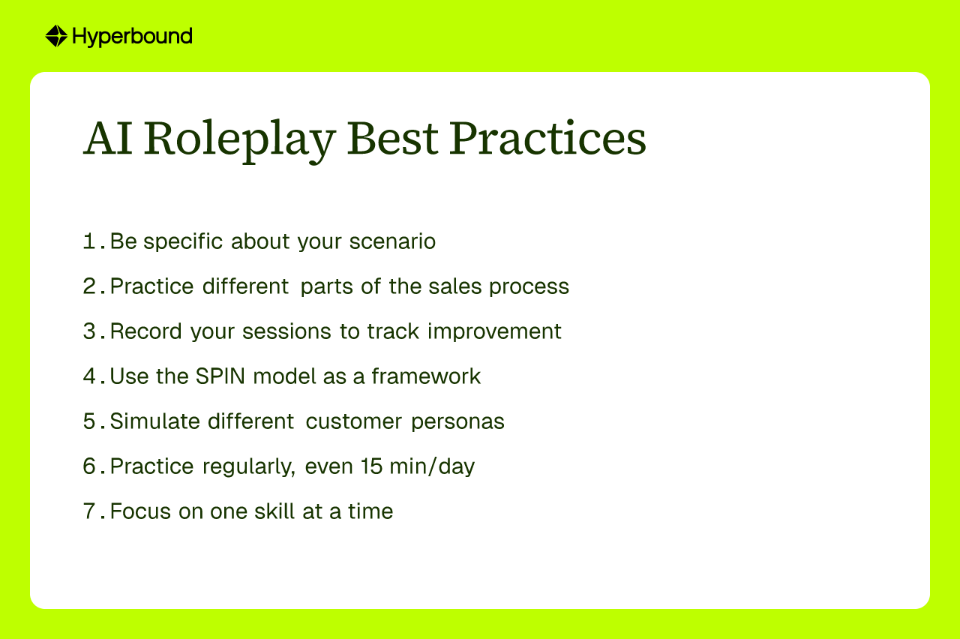
✅ Be specific about your scenario: The more details you provide about your product, customer, and situation, the more realistic the simulation will be.
✅ Practice different parts of the sales process: Do not just rehearse the pitch. Practice discovery questions, handling objections, and closing techniques separately.
✅ Record your sessions: Whether using voice or text, save practice conversations to track improvement over time.
✅ Use the SPIN model as a framework: Structure questions to uncover Situation, Problem, Implication, and Need‑Payoff to create more compelling conversations.
✅ Simulate different customer personas: Practice with various decision‑maker types (technical, financial, operational) to prepare for any conversation.
✅ Practice regularly: Even 15 minutes of AI roleplay practice daily can dramatically improve skills and confidence.
✅ Focus on one skill at a time: Rather than trying to perfect everything at once, use each session to work on a specific skill (like active listening or handling price objections).
The key to effective sales performance is consistent, realistic practice. AI tools have transformed what is possible, making high‑quality practice accessible to everyone, from individual reps preparing for an interview to enterprise sales teams scaling their coaching efforts.
You can start today with free tools like ChatGPT, level up with Custom GPTs for more focused practice, and for organizations serious about sales excellence, platforms like Hyperbound provide data‑driven, scalable coaching that transforms team performance.
Stop practicing on live prospects. Choose the tool that fits your current needs, pick your toughest scenario, fire up your AI coach, and start building the skills that close deals. Your future self, and your quota, will thank you.
Remember, as one sales professional put it, hiring managers are looking for people who are "coachable" and can "take control of the situation." Regular practice with AI tools demonstrates both qualities, building the confidence to excel in any sales conversation.
Whether a sales professional is preparing for a major enterprise pitch or a simulated cold call in a job interview, AI roleplay provides the safe, effective practice environment needed to master the craft. And when teams are ready to move beyond isolated practice, connecting what calls reveal to how the team improves, that is where Revenue Activation enters.

AI sales roleplay is a training method where sales professionals practice conversations with a bot that uses AI to simulate a customer persona. It provides a safe, judgment-free environment to rehearse various sales scenarios, from cold calls to objection handling, without the pressure of practicing with colleagues or live prospects. The AI can be configured to represent specific customer types with unique pain points and objections, offering a realistic and repeatable practice experience.
To start for free, use accessible tools like ChatGPT. Provide a detailed master prompt that describes the product, the customer persona, and the scenario, turning ChatGPT into a 24/7 practice partner. For more realism, the voice feature on the mobile app simulates a real phone call.
AI roleplay is more effective than traditional methods because it overcomes key issues like the authenticity gap, performance anxiety, and inconsistent feedback. Unlike practicing with colleagues who may struggle to realistically simulate a skeptical buyer, AI can embody countless personas and scenarios. It offers a judgment‑free zone for experimentation, provides immediate and objective feedback, and is available 24/7 whenever practice is needed.
Virtually any part of the sales cycle can be practiced with AI. This includes initial cold calls, discovery sessions to uncover customer needs using frameworks like SPIN, product demos, handling specific objections (e.g., price, budget, satisfaction with a current vendor), and even complex negotiation scenarios. Advanced platforms can generate tailored scenarios from real sales data.
ChatGPT is a general‑purpose tool for individual practice, while Hyperbound, the Revenue Activation Platform, is a system that connects practice, coaching, and real deal outcomes in one loop. ChatGPT requires manual scenario creation, disconnected from the team’s live deals. Hyperbound analyzes the team’s real calls, scores them against the sales methodology, identifies skill gaps, and generates targeted roleplays that address the exact behaviors moving deals forward. The result is not just better practice; it is practice informed by what the team needs to work on right now, with coaching tools that scale across the entire organization.
To ensure a realistic simulation, provide a highly specific and detailed initial prompt. The more detail provided about the product, its value proposition, the target customer’s persona (role, goals, specific pain points), and the conversational context, the more accurately the AI can simulate the interaction. This includes telling the AI to be skeptical or to raise certain objections during the roleplay.
Want to learn how Hyperbound, the Revenue Activation Platform, can help your team practice, coach, and close more deals? Request a demo to see how it works.









Use Cases
Legal