
For years, sales role-play was treated as an enablement exercise. Managers played the buyer, reps practiced the pitch, and teams used certification to determine whether sellers were ready for the field.
AI has fundamentally changed the scalability of that model.
Gartner® recently published its Market Overview for B2B Sales AI Role-Play Applications, defining sales AI role-play applications as software that utilizes artificial intelligence (AI) to simulate realistic business conversations, enabling sales organizations to scale communication training, strengthen coaching, and accelerate skill development through personalized, repeatable practice. (1) Hyperbound is included among the Example Vendors identified in the research.
We feel the recognition of a distinct market is important. But what interests us more is where the market appears to be heading.
At Hyperbound, we believe AI role-play is part of a larger transition in how revenue organizations improve seller performance. The first generation of AI made practice scalable. The next connects practice with real-world performance. But identifying a performance gap is only valuable if an organization can act on it.
That is where we believe the market is heading: toward systems that can understand what is happening across revenue interactions, determine where intervention is needed, activate the right response, and measure whether performance changes as a result.
AI role-play isn't developing in isolation. It is emerging as AI changes the broader sales operating environment.
Gartner reported that AI tools are delivering measurable efficiency gains for sales organizations, saving sellers an average of 4.8 hours per week, according to Gartner, Inc., a business and insights technology company. However, 72% of sales organizations report low reinvestment of those time savings back into high-value sales activities, creating a significant “reinvestment gap” that limits AI’s impact on commercial performance. (2)
Gartner noted the divide between sales organizations realizing value from AI and those struggling to capture returns is already emerging: 25% of sales organizations report a 50% or higher return on AI investments, while 20% report a 50% or higher negative return. (2)
A Gartner survey of 210 CSOs and senior sales leaders conducted from January through February 2026 found that sales organizations that achieve moderate to large AI time savings, and then reinvest that time into high-impact sales activities, are 2.2x more likely to exceed customer growth goals and 3.1x more likely to exceed lead-to-opportunity conversion goals, compared with organizations that reinvest less.. (2)
Seller development is approaching a similar inflection point. AI can make practice dramatically more available, but availability alone doesn't tell a revenue leader whether sellers are becoming more effective. The next question is whether organizations can use what they know about seller performance to determine what should happen next, and then measure whether that intervention worked.
There's another reason seller readiness is becoming more important: buyers have AI.
As Robert Blaisdell, VP Analyst, Chief of Research in the Gartner Sales practice, explains:
“B2B buyers are more comfortable using digital channels and GenAI to navigate the purchase process on their own, but that does not eliminate the role of the seller. Buyers still turn to sales reps to validate AI-generated insights, and support decision making at critical moments in the journey.” (4)
Together, those findings suggest a changing division of labor between technology and the seller:
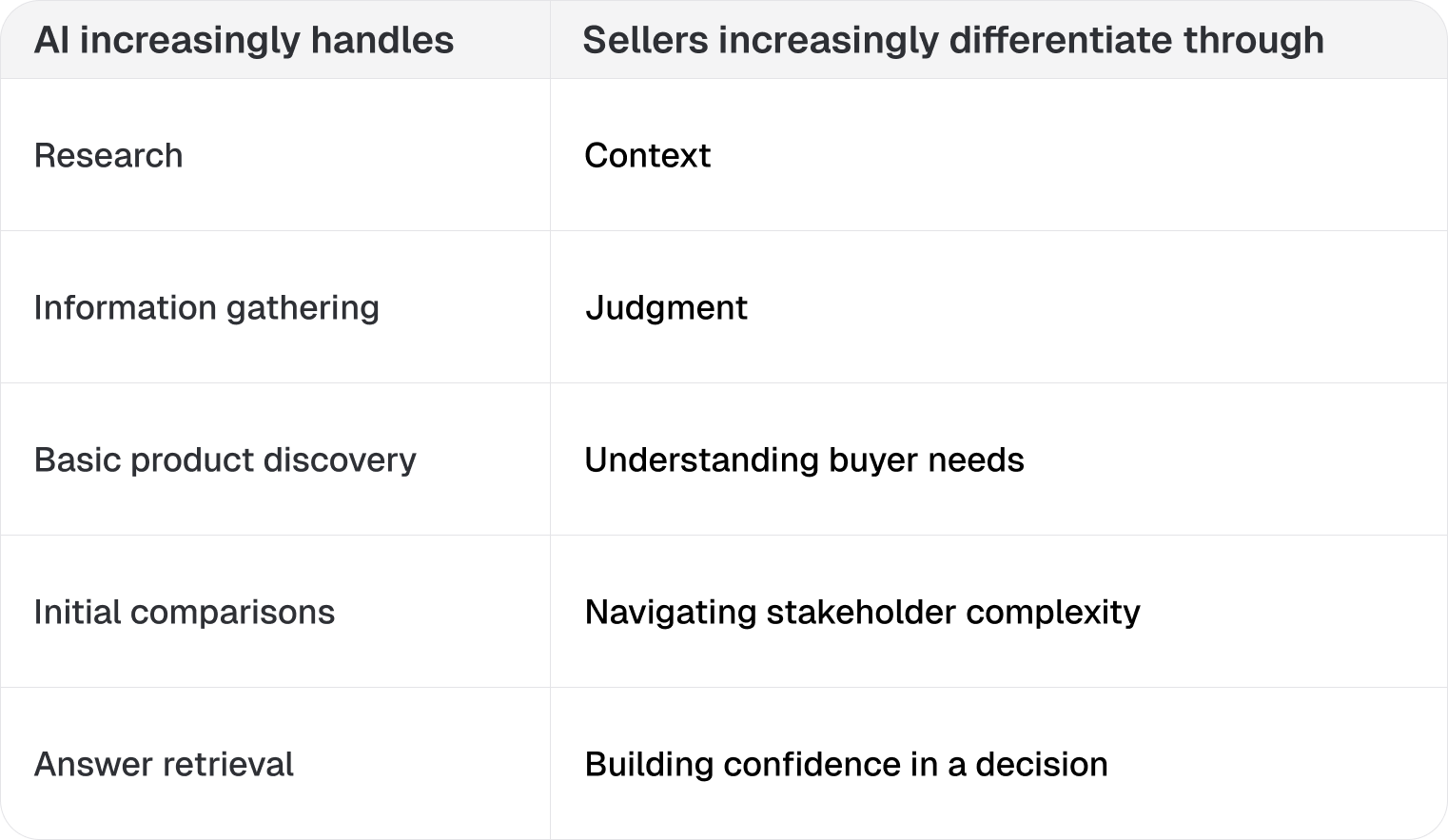
Our interpretation is that AI doesn't make seller readiness less important. It changes what “ready” means.
An informed buyer doesn't need a seller to recite information they could have found themselves. Particularly in complex enterprise sales, sellers need to understand the buyer's situation, navigate different stakeholders, interpret competing priorities and create confidence around a decision.
The evolution of AI role-play isn't only about making simulated conversations sound more realistic. The more meaningful shift is making practice more relevant to the situations sellers actually encounter.
A generic objection-handling simulation may help develop a skill. But if an organization understands which objections are appearing in customer conversations, which sellers struggle with them, and which behaviors correlate with stronger performance, practice can become significantly more targeted.
For us, that changes the question the market needs to answer.
Can we give every seller more opportunities to practice?
becomes:
Can we determine what each seller needs to improve based on what's actually happening in the field?
That shift from generalized practice toward contextual, performance-informed development is where we believe the market becomes much more valuable for enterprise revenue teams.
This is where we believe the market begins to expand beyond standalone role-play.
The traditional model of seller development is relatively linear:
Training > Practice > Certification > Field
What happens in the field may eventually influence future coaching or enablement, but that process often depends on managers and enablement teams identifying patterns and manually determining what to do about them.
AI creates the potential for a different model:
Real Conversations > Identify Gaps > Determine Next Action > Activate Intervention > Measure Change
Practice can be one intervention, but it isn't necessarily the only one.
A performance signal could trigger targeted practice or coaching. It could surface relevant content for a seller preparing for a specific situation. It could recommend a next action based on what's happening in an opportunity. Or it could identify a broader pattern that requires intervention across a team.
The important shift is that intelligence becomes connected to action.
As Greg Hessong, Senior Director Analyst in the Gartner Sales practice, said:
“The most effective sales organizations are not simply layering AI onto existing ways of working. They are redesigning seller workflows so AI can support execution, recommendations and orchestration, while sellers focus their time on the moments where human judgment and customer value matter most.” (3)
We see that same principle becoming increasingly relevant to seller development. Knowing that a seller struggles with discovery, objection handling or executive conversations is useful. The greater opportunity is turning that signal into the appropriate intervention for that seller and situation, and then understanding whether performance improves.
This is where we believe AI can change seller development: connecting performance intelligence with the actions that help sellers improve.
Connecting intelligence to an intervention still leaves one important question: did anything change?
Completed simulations, practice frequency, certifications and coaching recommendations are useful indicators of activity. But for enterprise revenue leaders, the more meaningful measure is whether those activities result in observable changes in field performance.
Did a seller subsequently handle the objection more effectively? Did discovery improve? Is the new messaging showing up consistently in customer conversations? Did a targeted intervention address the performance gap that triggered it?
This creates a different model for measuring seller development.
Rather than treating training data and performance data as separate systems, organizations can begin connecting the two. Real conversations identify a gap, an intervention is activated, and subsequent conversations provide evidence of whether seller behavior changed.
That feedback loop also allows the next intervention to become more informed.
Over time, the system is not simply providing practice. It is continuously learning where sellers need help and whether the actions taken to improve performance are actually working.
As this market evolves, simulation realism will remain important, but we don't believe it will be enough to differentiate enterprise platforms over the long term.
The buying criteria should begin to expand:
As AI becomes more deeply involved in evaluating seller performance and determining what happens next, those enterprise requirements will only become more important.
As AI becomes embedded throughout the seller's workflow, the question for revenue organizations will increasingly move beyond what AI can analyze or automate individually.
The more important question is what the organization can do with the intelligence AI creates.
That is particularly relevant to seller performance. Revenue organizations now have access to enormous amounts of intelligence from customer conversations, CRM activity, coaching, enablement and seller behavior. The challenge is increasingly connecting those signals to the actions that improve what happens next.
Gartner's recognition of B2B sales AI role-play as a distinct market is an important indicator of this shift. AI has made realistic, personalized practice available at a scale that was not previously possible. We believe the next transition will connect that practice more directly with real-world performance, while performance intelligence increasingly determines what intervention should happen next.
A customer conversation can reveal a gap. AI can help determine what needs attention. The appropriate intervention can be activated. The seller returns to the field. Subsequent performance shows whether behavior changed and informs what happens next.
For Hyperbound, this is the larger market direction: from revenue intelligence to revenue activation, where understanding performance and acting on it become increasingly connected.
AI role-play is an important part of that future. The larger opportunity is closing the distance between knowing what needs to improve and actually improving it.
(1) Gartner, Market Overview for B2B Sales AI Role-Play Applications, Bill Yetman, Rachael Buchler, Shayne Jackson, Doug Bushée, August 7, 2026.. Gartner Market Overview(Accessible to Gartner Subscribers only).
(2) Gartner, Gartner Survey Finds AI Saves Sellers Nearly 5 Hours Per Week, Yet 72% of Sales Organizations Fail to Reinvest Time in High-Value Activities, May 19, 2026. Gartner Newsroom source
(3) Gartner, Gartner Survey Finds Sales Organizations That Provide AI-Enabled Next Best Actions Are 2.6x More Likely to Achieve Commercial Growth, May 20, 2026. Gartner Newsroom source
(4) Gartner, Gartner Survey Finds 69% of B2B Buyers Turn to Sales Reps to Validate AI-Generated Insights, May 20, 2026. Gartner Newsroom source
GARTNER is a registered trademark and service mark of Gartner, Inc. and/or its affiliates in the U.S. and internationally and is used herein with permission. All rights reserved.
Gartner does not endorse any company, vendor, product or service depicted in its publications, and does not advise technology users to select only those vendors with the highest ratings or other designation. Gartner publications consist of the opinions of Gartner’s business and technology insights organization and should not be construed as statements of fact. Gartner disclaims all warranties, expressed or implied, with respect to this publication, including any warranties of merchantability or fitness for a particular purpose.










Use Cases
Legal