Have you ever cringed at an AI-generated sales email that used tired clichés like "revolutionize your business" or "game-changing solution"? Or worse—has a prospect ever called you out for sending them an obviously AI-written pitch? One sales leader reported that a "client recognized their 'personalized' outreach email as AI-written before even finishing the first paragraph." Talk about embarrassing.
As AI rapidly transforms sales enablement, two distinct approaches have emerged: AI Sales Pitch Generators that create ready-to-use scripts and AI Sales Roleplay platforms that help reps practice and internalize their pitching skills. While both promise to boost sales performance, they operate on fundamentally different principles.
This article cuts through the hype to answer a critical question: Which approach actually drives more closed deals? We'll compare the short-term convenience of generated scripts against the long-term, compounding value of internalized skills through practice.
An AI sales pitch generator uses artificial intelligence to craft personalized sales messages, scripts, and presentations based on customer data pulled from your CRM and other sources. These tools promise to transform a rep's productivity overnight.
The appeal is obvious:
For sales leaders under pressure to hit this quarter's targets, the promise of instantly arming their team with polished pitches is enticing.
If you're still drawn to pitch generators, consider this refined approach:
AI sales roleplay takes a fundamentally different approach. Instead of generating content for reps to read, it creates an immersive, safe "sales gym" where reps can simulate realistic buyer conversations and internalize winning skills.
Hyperbound's AI Sales Roleplays exemplify this approach by focusing on skill-building over script-reading. The core advantages include:
As Hyperbound's product description states, this approach "provides unlimited, risk-free practice for sales reps on diverse scenarios, scaling coaching beyond manager availability and ensuring consistent message delivery."
According to research from Bain & Company, sales reps spend only about 25% of their time actively selling, and early AI implementations are already showing over 30% improvement in win rates—but which approach delivers the better ROI?
The evidence points toward roleplay as the superior investment:
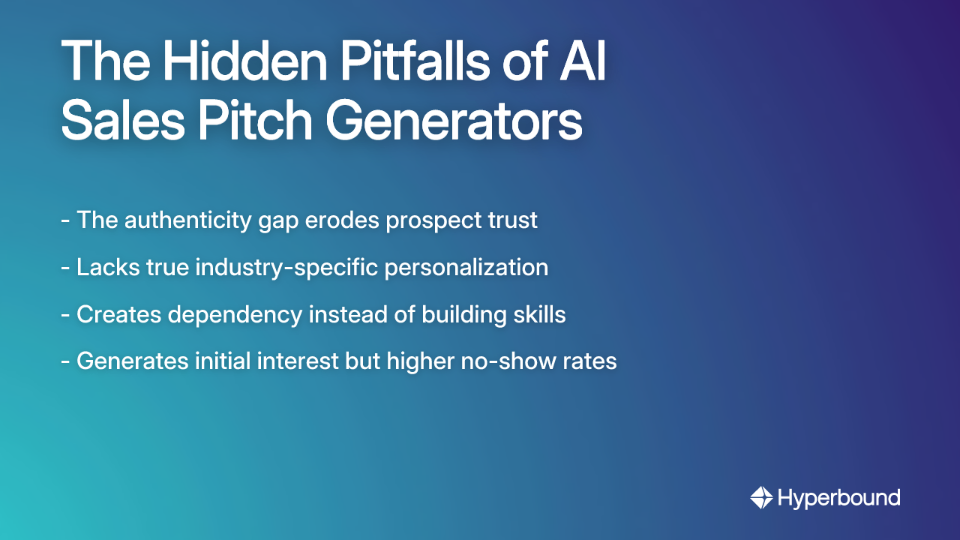
AI pitch generators can show quick wins in initial metrics—more emails sent, more first meetings booked. But as the Reddit A/B test revealed, these engagements often lack quality. The 28% higher no-show rate for AI-generated pitches exposes the fundamental problem: prospects may initially engage but quickly sense the lack of authentic connection.
Conversely, teams using Hyperbound's AI roleplay platform report stronger, more consistent performance improvements:
The superiority of skill development over script reliance comes down to three critical factors:
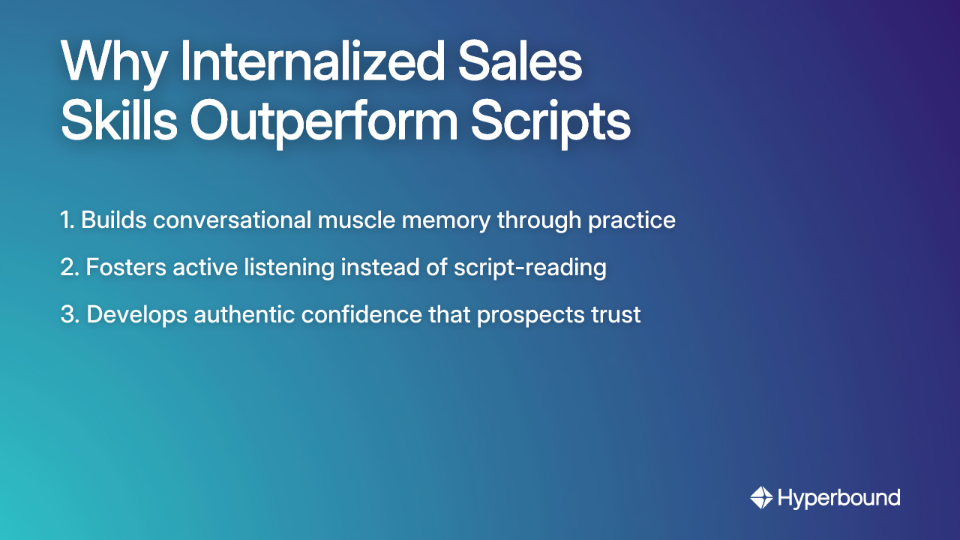
Reps who have practiced handling the top 5 objections 20 times each don't freeze on a live call. They respond calmly and effectively because the right responses have become instinctual through repeated practice.
A rep reading a script is thinking about their next line. A rep who has internalized their playbook is actively listening to the customer's needs and can pivot the conversation accordingly.
One sales leader shared: "Prospects commented 'Finally someone who gets it' rather than 'Nice pitch deck'" when reps truly understood their pain points rather than reciting memorized content.
Practice breeds confidence. Prospects can feel a rep's confidence (or lack thereof), which directly impacts trust and their willingness to buy.
The most effective sales organizations don't view roleplay as a standalone solution but as part of a holistic coaching system.
Hyperbound's approach demonstrates this integration:
This creates a powerful learning cycle: Practice → Perform → Get Feedback → Practice again. Each iteration builds stronger skills and better results.
As Harsha Kapre, Director at Snowflake Ventures, noted in Hyperbound's Series A announcement, "Hyperbound is transforming sales training and making coaching scalable with AI."
Let's examine a real-world example that illustrates why scripts fall short in actual sales situations:
Scenario: Enterprise Software Sale
A rep using an AI-generated pitch approaches the conversation with a polished script highlighting features, benefits, and generic ROI claims. The conversation proceeds smoothly until the prospect asks:
"I've been burned before implementing software that required more IT resources than promised. How would your solution integrate with our legacy CRM system that uses a custom API?"
The script-reliant rep freezes—this specific objection wasn't covered in their generated content. They stumble through a vague response, losing credibility instantly.
Contrast this with a rep who's practiced similar scenarios in Hyperbound:
This dynamic adaptation is impossible with static scripts but becomes second nature through practice.
AI sales pitch generators offer a short-term productivity gain—a "sugar rush"—but at the cost of creating robotic reps who are dependent on scripts and unable to adapt. When the conversation inevitably goes off-script, these reps falter.
AI sales roleplay is a long-term strategic investment. It builds resilient, confident, and adaptable sales professionals who can navigate the complexities of any sales conversation. The result is more closed deals, higher win rates, and sustainable revenue growth.
The future of sales isn't about automating the pitch; it's about scaling the practice that perfects it.
The main difference is that AI pitch generators create content for reps to read, while AI sales roleplay platforms build skills by letting reps practice conversations. Pitch generators focus on short-term productivity by automating script creation, but this can lead to inauthentic interactions. In contrast, AI roleplay is a long-term investment in your team, creating an environment where reps can internalize methodologies, handle objections, and build the conversational muscle memory needed to adapt to any sales situation.
AI-generated sales pitches often fail because they lack genuine personalization and sound inauthentic, which erodes trust with prospects. These tools can insert a name or company, but they struggle to adapt to specific industry nuances or buyer personalities. Prospects can easily spot a generic script, leading to an "authenticity gap." While they might generate initial meetings, data shows these can have higher no-show rates because a real connection was never established.
AI sales roleplay improves skills by providing a safe, repeatable "sales gym" where reps can practice realistic sales scenarios until winning techniques become second nature. Through simulated conversations with AI personas, reps can practice handling specific objections, applying sales methodologies, and navigating difficult conversations without risking a live deal. This process of active practice, combined with instant AI-powered feedback on performance, helps internalize skills far more effectively than simply memorizing lines.
Yes, AI pitch generators can be useful for brainstorming and creating a first draft, but they should never be a substitute for human review and personalization. To use them effectively, feed the AI with real customer conversations to learn their language, forbid the use of clichés, and ensure every output is heavily edited by a human. A good rule of thumb is to use the generator as a starting point, not the final product, to avoid sounding robotic.
Teams using AI sales roleplay can expect higher win rates, better quality deals, and shorter ramp times for new hires. By investing in skill development over script dependency, reps become more confident and adaptable. This leads to more meaningful conversations that build trust and uncover customer needs more effectively. The result is a more consistent, high-performing team that can navigate the entire sales cycle with greater success.
AI roleplay prepares reps for unexpected questions by simulating dynamic conversations where AI personas can deviate from the script, forcing the rep to think on their feet. Unlike a static script, AI roleplay platforms like Hyperbound allow for realistic conversational flows. Reps practice adapting to new information, handling curveball questions, and actively listening to the prospect's needs. This builds the adaptability and confidence needed to manage any real-world sales conversation, no matter where it leads.

Ready to build a team of closers, not script-readers? See how top sales teams at companies like Autodesk, Monday.com, and Bloomberg use Hyperbound's AI Sales Roleplays to drive consistent performance.
Schedule a Demo of Hyperbound Today










Use Cases
Legal