
You're on a sales call that started off well but has now veered completely off-script. You're mentally juggling the conversation while frantically typing notes, knowing you'll struggle to remember the key details later. "My calls feel like improv and then I'm scrambling to remember what actually mattered," as one sales rep put it.
This common struggle highlights why even experienced sales professionals find themselves caught between being fully present in conversations or "typing like a maniac" to capture important details. It's a pain point that creates inconsistency across teams and ultimately impacts revenue.
But top-performing sales organizations have found a solution: AI-powered sales feedback tools that act not as replacements for human reps, but as powerful copilots that drive consistency across teams.
Most sales organizations face a fundamental challenge: they rely heavily on a handful of "rainmakers" who consistently hit their numbers while the rest of the team struggles to keep pace. This performance gap creates several critical problems:
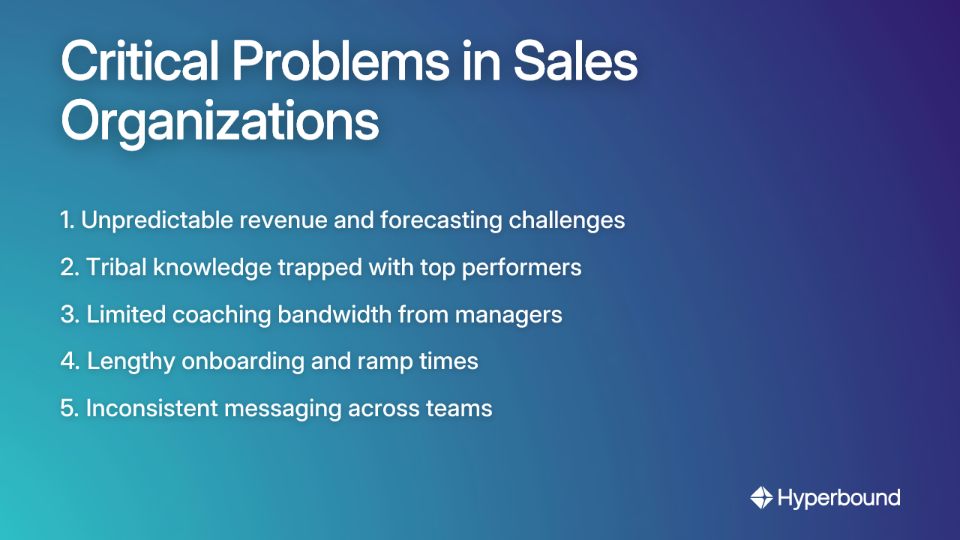
The result? Inconsistent messaging, unpredictable performance, and frustrated sales leaders who know their teams could be performing better.
The best sales organizations have turned to AI not to replace their teams but to systematically clone the skills of their top performers. Here's how they're doing it:
Modern AI tools like Hyperbound, Chorus, Teams Premium, and Fathom use sophisticated NLP to listen to, transcribe, and analyze every sales conversation at scale. This creates a searchable database of sales interactions that reveals patterns human managers could never spot manually.
"We use Teams Premium and love it for capturing full transcription, AI summary, and all follow-ups," shares one sales professional on Reddit.
These tools solve several key challenges:
1. Automated Transcription & Summaries: AI acts as the perfect notetaker, capturing call transcripts and automatically identifying action items, objections, and key moments. This frees reps to focus entirely on the conversation rather than documentation.
"Cluely just kinda runs in the background and spits out decent summaries after each call... like objections, action items, that kinda stuff," explains another user.
2. Call Scoring & Analysis: Platforms like Hyperbound's Real Call Scoring use AI to evaluate calls against your specific sales methodology, providing objective feedback on what worked and what didn't.
3. Theme & Keyword Analysis: AI can identify winning talk patterns across thousands of calls, turning anecdotal evidence into actionable data. Did your top performers mention a specific feature more often? Did they handle pricing objections differently? The AI spots these patterns automatically.
Some reps initially scoff at AI-based practice ("My boss is making us role play cold calls with AI bots LMAO"), but leading organizations have discovered that AI role-playing tools provide a judgment-free zone for practicing difficult scenarios.
Hyperbound's AI Sales Roleplays and similar platforms create realistic practice scenarios that mimic specific customer personas and common objections. This allows reps to:
The result? Reps enter real calls with greater confidence and consistency, having already practiced the most challenging scenarios multiple times.
AI transforms coaching from subjective opinion to data-driven guidance. According to Korn Ferry, AI allows managers to:
This precision approach, delivered by platforms like Hyperbound's AI Coaching, produces dramatically better results than the traditional "listen to a few calls and give feedback" method.
The business case for AI-powered sales feedback is compelling. According to research from Korn Ferry:
Beyond these headline figures, organizations report massive efficiency gains:
These aren't incremental improvements—they represent a step-change in sales performance that can transform an organization's competitive position.
If you're ready to leverage AI to drive sales consistency, follow this proven implementation framework:
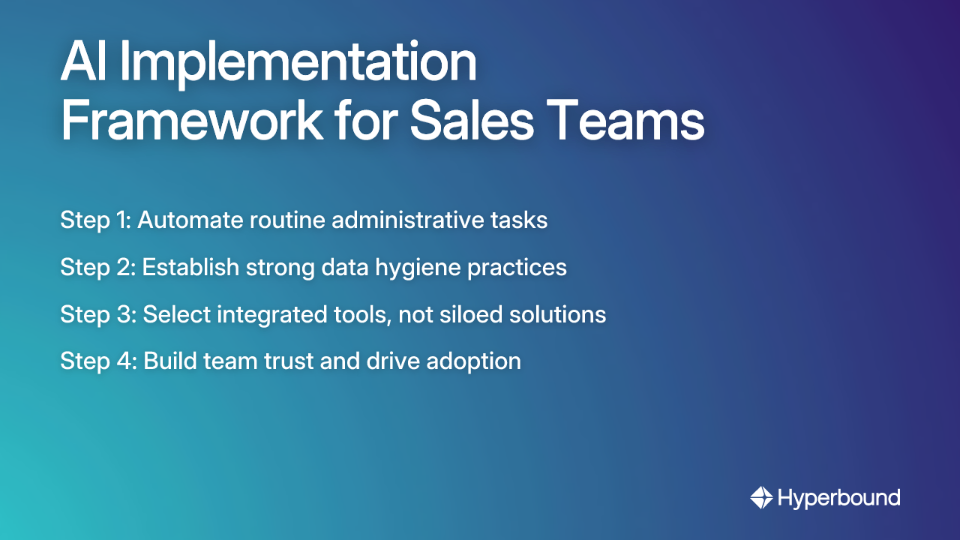
Start with the biggest administrative bottlenecks in your sales process. As Hockeystack advises, "Start small and prove its value before scaling."
For many teams, automated meeting summaries and action item extraction deliver immediate value. Tools like Hyperbound, Otter, read.ai, and Cluely can immediately solve the pain of manual note-taking and follow-up creation.
AI is only as good as the data it learns from. According to Korn Ferry, top sellers engage with their CRM daily, compared to only 31% of their peers.
Use AI tools for automated CRM management to ensure your data is clean and accurate without creating more work for your reps.
Avoid "tool overload" by selecting AI solutions that integrate seamlessly with your existing stack. Look for platforms that connect directly to your CRM, calling tools, and email systems to minimize friction.
Frame AI as a tool for personal and professional growth, not surveillance. Involve your sales team in the selection process to build buy-in, and highlight early wins to create momentum for wider adoption.
The most successful sales organizations understand that AI isn't replacing human sellers—it's empowering them. AI handles the rote tasks of documentation, analysis, and pattern recognition, freeing humans to focus on building relationships, showing empathy, and navigating complex emotions.
This partnership approach creates consistency by codifying success, providing objective coaching at scale, and automating administrative burdens. It gives every rep access to the insights of your top performers while allowing their unique human skills to shine.
Don't wait for your competitors to gain this advantage. Start by identifying one area—meeting summaries, new hire training, or call coaching—where a platform like Hyperbound can begin transforming your team's consistency today.
The sales organizations that learn to partner effectively with AI will be the ones setting records tomorrow.
An AI sales feedback tool is a software platform that uses artificial intelligence to analyze sales conversations, score performance against a set methodology, and provide objective coaching insights at scale. These tools automatically transcribe and summarize calls, identify key moments like objections and competitor mentions, and score reps on specific criteria. This helps sales teams move beyond subjective feedback by delivering data-driven guidance to improve consistency and replicate the behaviors of top performers.
AI improves sales team consistency by codifying what works for top performers and scaling that knowledge across the entire team through objective feedback and personalized training. It analyzes thousands of calls to identify winning talk patterns and provides every rep with data-backed coaching on how to improve. AI-powered role-playing also allows reps to practice handling difficult scenarios in a safe environment, ensuring everyone is aligned on messaging and objection handling before they speak to a customer.
No, AI sales tools are designed to augment, not replace, human sales reps. They act as a copilot to handle administrative tasks and provide data-driven insights. The goal is to free up reps from manual note-taking and analysis so they can focus on high-value human skills like building rapport, showing empathy, and navigating complex negotiations. The most successful sales organizations use AI to empower their teams, not to replace them.
The ROI of implementing AI sales coaching is significant, with studies showing improvements like higher win rates, increased quota attainment, and boosts in overall revenue. For example, research from Korn Ferry indicates organizations using these tools can achieve 41% higher win rates and 29% higher quota attainment. Additionally, they lead to massive efficiency gains, allowing reps to be up to 40% more effective by automating administrative work and uncovering insights they would have otherwise missed.
To ensure team adoption, frame the AI tool as a resource for personal and professional growth, not as a surveillance mechanism. Involve your team in the selection process to build buy-in from the start. Begin by automating a clear pain point, like manual note-taking, to demonstrate immediate value. Finally, highlight and celebrate early wins from reps using the tool to create positive momentum and encourage wider adoption.
Conversational intelligence tools analyze real-world sales calls after they happen, while AI role-playing tools create simulated environments for reps to practice before a call. Think of it as post-game analysis versus pre-game practice. Conversational intelligence (like Chorus or Teams Premium) gives you insights on past performance. AI role-playing (like Hyperbound) provides a safe, repeatable space to master messaging, practice objection handling, and build confidence for future calls. Both are critical components of a modern AI-powered sales enablement strategy.









Use Cases
Legal