
You hired a new rep six weeks ago. They're sharp, motivated, and eager to close. But they're still not ramped — a process that can take 3 to 9 months — and they're still burning pipeline on calls that go nowhere, still fumbling objections you know your top performers handle in their sleep. Every week they stay below quota is a week of real revenue walking out the door.
Here's the uncomfortable truth: most "AI sales coaching tools" aren't solving this. They're analyzing calls after the damage is done. A rep blows a discovery call, the tool flags it, a manager takes note — and then the rep walks into the next call with the exact same gap. Insight without practice doesn't change behavior.
That's the core tension in modern sales enablement. And it's why, when evaluating any AI sales coaching tool, the only metric that truly matters is its direct impact on rep ramp speed.
In this post, we compare 7 leading sales coaching tools against a single, transparent rubric built for one purpose: getting reps to quota faster.
Conversation intelligence tools revolutionized how sales teams understand their conversations. They surface patterns, flag risks, and give managers a window into what's actually happening on calls. That's genuinely valuable.
But there's a gap they don't close.
When a rep watches a recording of themselves and sees the exact moment they lost control of a call, that awareness doesn't automatically translate into a better performance next time. Research consistently shows that sales managers struggle to review every call, leading to inconsistent feedback — and even when they do review, there's no built-in mechanism to convert that review into structured, repeatable practice.
Think of it like a sports team that only watches game tape. Watching film without running drills doesn't build muscle memory. Your reps need at-bats — realistic, pressured, repeatable practice reps where they can fail safely and improve fast.
The knowing-doing gap is real. CI platforms solve the "knowing" part. The question is: what are you doing about the "doing" part?
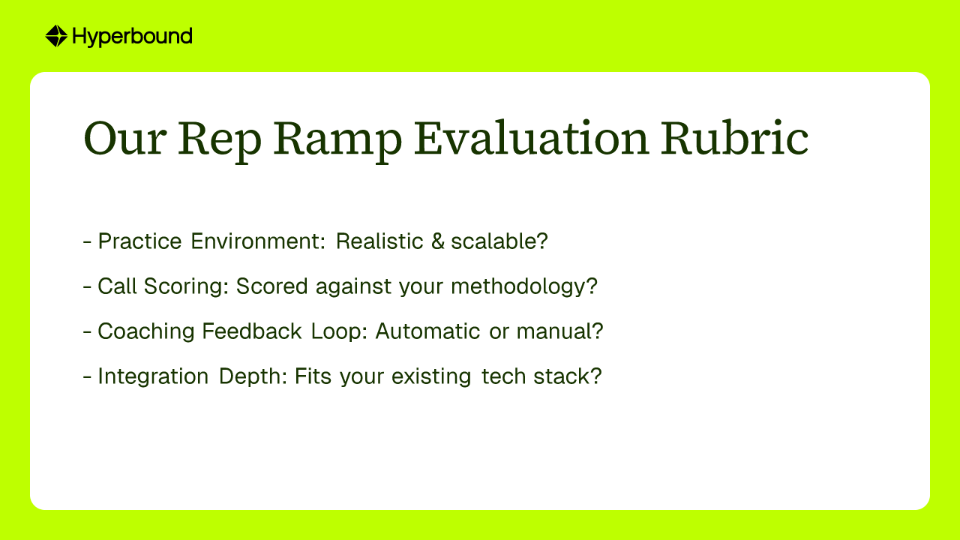
We scored each tool across four criteria tied directly to ramp speed:
.png)
.png)
Best for: Teams that want to close the loop between call analysis and skill practice to drive the fastest possible ramp.
Hyperbound coined the Revenue Activation category for good reason. While most tools stop at analysis, Hyperbound operationalizes a continuous improvement cycle: Score Real Calls → Identify Skill Gaps → Practice Roleplays → Score Real Calls again. It's the only platform purpose-built to make that loop automatic.
Practice Environment: Hyperbound Practice deploys AI buyer personas built from 2M+ hours of real B2B sales conversations — not generic scripts. Reps can practice cold calls, discovery, demos, objection handling, renewals, and even complex multi-party conversations with a champion and an economic buyer simultaneously. Tenured reps get Bitesized Roleplays — short, focused sessions for specific skills — so practice stays relevant without feeling like a homework assignment.
Call Scoring: Hyperbound Perform automatically scores 100% of real customer conversations against custom methodology scorecards. On the practice side, AI Scorecards deliver instant, objective feedback on talk ratios, key selling moments, and methodology adherence — no manager required to trigger a coaching moment.
Coaching Feedback Loop: This is where Hyperbound separates itself. Kota Activate sits above both Practice and Perform, acting as an AI Revenue Analyst that connects roleplay performance to real-call behavior and recommends personalized coaching interventions at the right time. The loop doesn't require a manager to manually play dispatcher — it happens automatically.
Integration Depth: Native integrations with Salesforce, HubSpot, Gong, Outreach, Seismic, Highspot, Zoom, Google Meet, and MS Teams. Enterprise-grade security with SOC 2 Type II, GDPR, ISO 27001, HIPAA, and SSO/SCIM. SCORM-compatible for LMS embedding.
Proof Points:
Best for: Enterprise teams investing in best-in-class conversation intelligence and post-call analysis.
Gong is the market standard for understanding what's happening across your customer-facing conversations at scale. It automatically transcribes, analyzes, and scores calls — surfacing talk patterns, competitive mentions, deal risks, and coaching moments for managers.
Practice Environment: Gong does not offer a native, dynamic AI roleplay environment. It is fundamentally an analysis platform. Reps cannot use Gong to build skills before they walk into a call.
Call Scoring: Best-in-class. Gong's conversation intelligence captures nuanced signals across every recorded call, giving managers visibility into rep behavior at scale.
Coaching Feedback Loop: Gong gives managers the data and key moments to coach from. But the feedback loop is manual — a manager must review the insight, identify a gap, schedule a coaching conversation, and figure out how the rep will actually practice fixing it. That handoff is where ramp time bleeds.
Integration Depth: Excellent. Integrates with virtually every major CRM and sales engagement platform.
Bottom line: Gong tells you exactly what went wrong. It doesn't give reps a safe space to practice getting it right. As one Reddit commenter noted, it's a powerful tool but "easily six figures per year" — and call intelligence alone only solves half the problem.
Best for: Mid-market teams wanting post-call analysis tied tightly to pipeline health and Salesforce.
Chorus takes a deal-centric view of conversation intelligence, connecting call insights directly to CRM data so managers can see how rep behavior is affecting specific opportunities. Its strength is tying what was said on a call to where a deal stands in the pipeline.
Practice Environment: Like Gong, Chorus is an analysis platform — not a practice environment. There's no mechanism for reps to rehearse before high-stakes calls.
Call Scoring: Strong. Chorus tracks keywords, identifies action items, flags deal risks, and scores calls against custom criteria.
Coaching Feedback Loop: Empowers managers with data for 1:1s, but coaching actions are manual and manager-dependent. The gap between "here's what you did wrong" and "here's how you practice doing it right" remains wide.
Integration Depth: Deep Salesforce integration is its headline feature. Solid across major sales tools.
Bottom line: A strong choice for pipeline-focused analysis, but like Gong, Chorus provides the insight — not the practice — that changes rep behavior. The ramp time needle moves when insight leads to deliberate practice.

Best for: Enterprises that want a broad sales readiness platform with training, content, and coaching in one system.
Mindtickle takes a comprehensive approach to sales enablement — combining learning paths, content management, conversation intelligence, and coaching into a single platform. It's a large system designed for large teams running formal certification programs.
Practice Environment: Offers structured roleplay and video practice as part of formal training modules. The practice is tied to certification paths rather than on-demand, AI-driven skill-building triggered by real-call performance.
Call Scoring: Provides performance heatmaps and analytics through its Call AI feature. Connects rep performance in training to manager scorecards and assessments.
Coaching Feedback Loop: The feedback loop exists within the platform but operates through structured learning paths rather than a dynamic, data-driven cycle. The complexity can work against fast ramp when new reps are overwhelmed with features rather than focused on skill-building.
Integration Depth: Good integrations with CRMs and other tools, but the platform is designed to be an all-in-one solution, which can create friction for teams that already have a CI tool like Gong in place.
Bottom line: Mindtickle is a capable platform for mature enablement programs. For teams prioritizing ramp speed with a tight feedback loop between real calls and targeted practice, the breadth can introduce friction.
Best for: Teams that want a dedicated AI simulation tool for practicing pitches and conversations.
Second Nature focuses squarely on AI-powered sales simulations — giving reps an avatar to practice with, score against, and learn from. As a point solution for practice, it's a meaningful step beyond passive call review.
Practice Environment: This is Second Nature's core value. Reps can rehearse pitches and key conversations with an AI persona, receive feedback, and repeat. It's more engaging than reading a playbook or watching a recording.
Call Scoring: Provides feedback and scoring on practice sessions, tracking how well reps hit key talking points and respond to objections.
Coaching Feedback Loop: The loop lives inside the practice tool itself. The significant limitation: there's no connection to what's happening on real customer calls. A rep can practice a scenario endlessly without that practice being informed by their actual performance gaps on live deals.
Integration Depth: As a point solution, integrations are more limited than platform players. This contributes to the fragmented-tool frustration that sales teams consistently cite as a core pain.
Bottom line: Second Nature is a solid practice tool. The key differentiation to keep in mind: Hyperbound's AI buyer personas are built from 2M+ hours of real B2B sales conversations, whereas independent roleplay tools tend to work from more generic scenario frameworks — making Hyperbound's simulations measurably closer to what reps face on real calls.
Best for: Outbound-heavy teams that want real-time guidance and coaching cues during live calls.
Trellus takes a different approach to the ramp problem: instead of analyzing calls after the fact or rehearsing before them, it provides real-time coaching cues during live calls. Think of it as a co-pilot sitting alongside the rep as they navigate the conversation.
Practice Environment: Trellus offers scenario-based practice informed by past call data, but live call assistance is its primary value driver. Practice is secondary to in-call support.
Call Scoring: Provides automated, real-time scoring that evaluates adherence to talk tracks and flags moments where the rep should pivot. Feedback is immediate, which is its core advantage.
Coaching Feedback Loop: The feedback loop is instantaneous — during the call itself. This is genuinely useful for early-stage reps who need guardrails in real time. The limitation is that the loop doesn't extend back into structured practice or forward into deal-level analytics.
Integration Depth: Solid integrations with major CRMs and sales engagement platforms.
Bottom line: Trellus is a strong tool for outbound teams where rep behavior can be guided in real time. For broader ramp acceleration — especially across discovery, demos, and complex deal cycles — a tool that also incorporates pre-call practice and post-call analysis creates a more complete development system.
Best for: Individuals or small teams looking for an accessible, low-cost way to practice specific pitches.
PitchMonster is an emerging tool that lets users build customizable micro-scenarios and personas for focused pitch practice. It's a lightweight entry point for teams that want to start somewhere with AI-assisted practice.
Practice Environment: Allows users to create custom personas and practice scenarios. The practice environment is flexible but less sophisticated than platforms trained on real B2B call data at scale.
Call Scoring: Provides a basic scoring model to evaluate performance within practice sessions, tracking whether key elements of a pitch were covered.
Coaching Feedback Loop: Self-contained within the tool. There's no connection to real-call performance data or CRM pipeline health. It's a useful individual skill-building tool but doesn't scale to team-wide ramp management.
Integration Depth: Limited as a point solution. For teams dealing with fragmented tool sprawl, adding another standalone tool can create overhead without proportional impact.
Bottom line: PitchMonster is a solid starting point for teams with budget constraints looking to introduce practice into their workflow. As scale and accountability requirements grow, the limitations of a standalone tool become the ceiling.
The modern sales floor moves too fast for reactive coaching. By the time a manager reviews a flagged call and schedules a coaching session, the rep has already had three more opportunities to repeat the same mistake.
The fastest path to ramp isn't more data. It's a tighter loop between data and action: score real calls, identify skill gaps, practice those exact scenarios, score again. Repeat. That's how behavior changes. That's how ramp time shrinks from months to weeks.
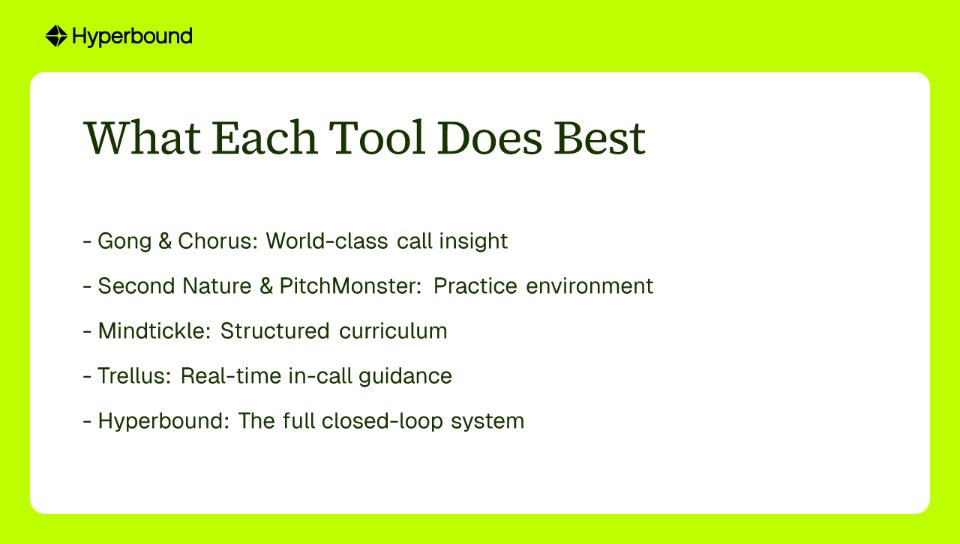
Most of the sales coaching tools on this list do one or two parts of that loop exceptionally well. Gong and Chorus give you world-class insight. Second Nature and PitchMonster give you a practice environment. Mindtickle gives you a structured curriculum. Trellus gives you real-time guidance.
But Hyperbound is the only platform that closes the full loop — built from the ground up to connect what's happening on real calls to what reps need to practice, with AI that orchestrates those coaching interventions automatically.
Nivoda used it to achieve 50% faster ramp and double their revenue year-over-year. Vanta cut BDR ramp time from 210 to 72 days.
An AI sales coaching tool is a software platform that uses artificial intelligence to analyze sales conversations, identify skill gaps, and provide targeted practice and feedback to help reps improve their performance. Unlike traditional methods that rely on managers reviewing a small fraction of calls, these tools can analyze 100% of conversations. The best platforms, like Hyperbound, go beyond analysis by offering realistic AI-powered roleplays, allowing reps to practice specific scenarios and close the "knowing-doing gap" before they engage with real prospects.
Reducing sales ramp time is crucial because it directly accelerates revenue generation. Every week a new sales representative is not fully productive represents lost sales opportunities and revenue. A shorter ramp period means reps start hitting their quota faster, which improves team morale, reduces costly turnover, and maximizes the return on your hiring investment. Tools that focus on targeted practice, not just analysis, have been shown to cut ramp time by over 60%.
Conversation intelligence (CI) tools like Gong and Chorus are primarily focused on analyzing past calls to provide insights, while a complete AI sales coaching platform also includes a practice environment to proactively build skills. CI tells you what went wrong on a call; a complete coaching platform takes that insight and automatically creates targeted AI roleplay scenarios for the rep to practice how to get it right next time. This closes the loop between knowing and doing.
AI-powered roleplays provide a safe, scalable, and realistic environment for sales reps to practice handling objections, navigating discovery calls, and mastering their pitch without risking live deals. These simulations offer instant, objective feedback, allowing reps to get the "at-bats" they need to build muscle memory and confidence. Platforms like Hyperbound build their AI buyer personas from millions of hours of real sales calls, ensuring the practice is highly relevant.
No, AI sales coaching tools are designed to augment, not replace, human sales managers. They act as a force multiplier, handling the repetitive tasks of call analysis and practice so managers can focus on high-impact strategic coaching. By automating the identification of skill gaps and assigning practice, AI frees up managers to spend their time on deal strategy, career development, and motivation.
The most critical features are a realistic practice environment, objective scoring for both real and practice calls, an automated coaching feedback loop that connects analysis to practice, and deep integration with your existing CRM and tech stack. Look for a tool that creates a "closed-loop" system where performance data from real calls automatically informs personalized practice assignments, creating a continuous cycle of improvement.
If rep ramp time is your lever, book a personalized Hyperbound demo and see what closing the loop actually looks like.










Use Cases
Legal