
You've spent hours preparing for that sales interview. You've researched the company, practiced your pitch, and polished your resume. Then they hit you with it: "Please complete this online assessment before we proceed."
Your heart sinks. "I feel like they are already pre-programming me to be a sales robot before the interview even starts," you think. And that six-round interview process? It "definitely puts a sour taste in my mouth from the jump."
If this resonates with you, you're not alone. But what if the real problem isn't the assessment itself, but rather the human biases lurking beneath traditional interview processes?
So how do AI sales assessments actually work? Instead of relying on subjective impressions, platforms like Hyperbound use AI to create standardized scenarios that measure actual selling skills. This process often looks like this:
.png)
This isn't just theoretical. Candidates rate these AI processes highly for fairness (4.3/5) and job relevance (4.5/5). One company saved over 1,500 collective hours in just three months.
What makes AI assessments particularly powerful is how they directly counter specific biases:
.png)
As one Reddit user candidly put it: "I don't mind the personality assessment, it's the criteria assessment that bothers me and I think it's unfair." The key difference with AI assessments is that they're designed to be consistently fair to everyone, not just candidates who match the interviewer's unconscious preferences.
Let's address the critical counterargument: AI is not inherently fair. In fact, poorly designed AI can inherit and amplify human biases if not carefully managed.
According to Harvard Business Review, AI can "reshape fairness definitions, locking in one interpretation" if not thoughtfully implemented. With approximately 88% of companies already using some form of AI in hiring, this is a pressing issue.
Before implementing AI assessments, leaders must ask:
For companies looking to implement AI assessments while avoiding potential pitfalls, here are actionable guidelines:
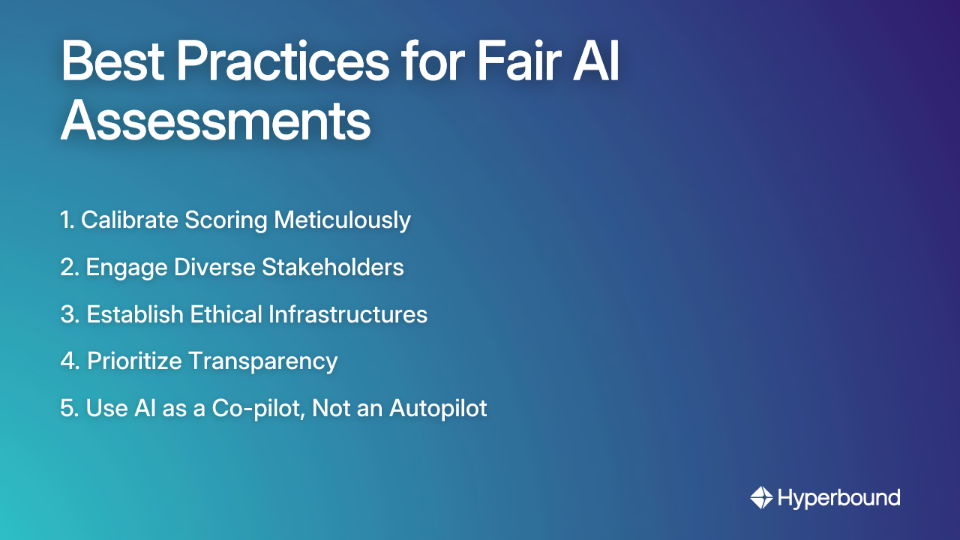
The frustration expressed by candidates—"What the fuck is up with these assessments and 6 rounds of interviews"—often stems from processes that feel both dehumanizing AND biased. That's the worst of both worlds.
But there's a powerful reframe: AI assessments, when properly designed, handle the repetitive and bias-prone task of initial screening. This actually frees up human interviewers to have more substantive, strategic, and ultimately more human conversations with a pool of candidates who have already proven they can do the job.
Instead of six rounds of inconsistent interviews where each person asks the same basic questions, imagine a process where:
This approach respects candidates' time by ensuring they're only asked to invest in further interviews if they have a real chance at the job. And it respects their humanity by ensuring they're evaluated on their actual skills rather than arbitrary factors like which interviewer they happened to be assigned to.
The goal is not to turn candidates into "sales robots" but to ensure everyone gets a fair shot at showing what they can do. In a world where research shows that diversity in the candidate pool dramatically increases hiring diversity, AI assessments can help create that diverse pool by removing initial screening biases.
Done right, AI doesn't make hiring less human—it makes the human parts of hiring more meaningful, fair, and focused on what really matters: finding the right person for the job, regardless of who they are or who they know.
And that's something both candidates and companies can get behind.
An AI sales assessment is a tool that uses artificial intelligence to evaluate a sales candidate's skills through standardized, simulated scenarios. Instead of relying on resume keywords or subjective interviews, these platforms measure practical abilities like cold calling, objection handling, and communication in a controlled, unbiased environment.
Companies use AI assessments primarily to reduce costly hiring mistakes and combat unconscious bias in the traditional interview process. By standardizing the initial screening, organizations can objectively identify top performers based on actual skills, leading to a fairer process, a more diverse talent pool, and significant time savings for hiring managers.
AI assessments reduce hiring bias by standardizing the evaluation process for all candidates. They use a consistent, pre-defined scoring rubric to evaluate performance in simulations, which eliminates subjective "gut feelings" and first impression bias. Furthermore, by focusing on skills demonstrated in anonymized scenarios, they counter biases like the "similar-to-me" effect and stereotyping based on a candidate's background.
Yes, AI hiring tools can inherit and even amplify human biases if they are not designed and managed carefully. An AI is only as fair as the data and criteria it's trained on. To prevent this, it's critical to meticulously calibrate the AI's scoring system, involve diverse stakeholders in its implementation, and maintain human oversight to ensure the definitions of "fairness" and "success" are appropriate and equitable.
AI sales assessments are designed to measure core, on-the-job selling competencies. This often includes a candidate's ability to handle realistic sales simulations such as making a cold call to an AI agent, navigating common customer objections, demonstrating product knowledge, asking effective discovery questions, and drafting clear, persuasive prospecting emails.
No, the goal of AI assessments is not to replace human involvement but to make it more meaningful and strategic. AI acts as a co-pilot, handling the initial, repetitive screening to identify a shortlist of highly qualified candidates. This frees up human interviewers to focus on deeper conversations about strategy, cultural fit, and team dynamics, ensuring the final decision remains in human hands.
To implement a fair AI assessment process, companies should calibrate the scoring system against the skills of current top performers, ensure transparency by explaining the process to candidates, and establish ethical review protocols. Most importantly, AI should be used as a tool to augment human judgment, not replace it, with humans making the final hiring decision based on a combination of AI-driven data and in-person interviews.









Use Cases
Legal
.png)