
Every sales leader knows the painful truth: objection handling can make or break your deals, yet it's one of the hardest skills to coach effectively at scale. While you might catch glimpses of improvement (or struggles) on individual calls, traditional coaching methods leave massive blind spots in understanding your reps' true objection handling capabilities.
"I need better tools to assess and improve my reps' skill gaps beyond random call samples," a sales manager recently shared on Reddit. This sentiment echoes across sales organizations everywhere—coaching objection handling effectively is critical but incredibly difficult to scale.
Traditional approaches have clear limitations:

Enter AI-powered roleplays: a modern, scalable solution providing a safe, repeatable, and data-driven environment for reps to master this crucial skill. This article provides a practical framework for using AI roleplays to coach reps through objection handling, including common scenarios, a progressive training structure, and key metrics to track improvement.
The stakes of poor objection handling are enormous. Beyond lost revenue, mishandled objections damage prospect relationships and erode trust. Conversely, effective objection handling builds credibility and often uncovers deeper needs that expand deal size.
According to research from Revnew.com, role-playing can improve sales performance by up to 20%. Yet traditional coaching approaches have significant limitations:
As one sales leader put it, "We need tools that analyze patterns across multiple calls for effective coaching, not just individual feedback."
Before diving into AI-powered practice, establish a consistent objection handling framework. A simple, memorable approach is the three-step "Empathize, Isolate, and Solve" method:
For more comprehensive situations, expand to the 7-step process based on Salesforce's guide:
Now that we've established a framework, let's explore how to implement AI-powered roleplays to systematically coach and improve your reps' objection handling skills.
Hyperbound's AI Sales Roleplays lead the way in creating hyper-realistic AI simulations where reps can practice critical conversations in a safe environment. The platform allows you to build a comprehensive library of objection scenarios customized to your specific ICPs, products, and competitive landscape.
Based on research from Revnew.com, here are five essential objection scenarios to include in your training program:
Scenario 1: The Brush-Off ("We're Not Interested Right Now")
Coach reps to uncover hidden pain points with questions like, "Understood. Just so I'm aware, what are your team's main priorities for the next quarter?"
Scenario 2: The Incumbent ("We Already Have a Solution in Place")
Train reps to highlight unique differentiation: "That's great you're already tackling that area. Many of our customers use us to complement their existing setup to enhance X. Would you be open to seeing how?"
Scenario 3: The Budget Block ("It's Not in Our Budget")
Focus reps on ROI and long-term value: "I hear that. Many of our clients found that our service actually led to significant cost savings in other areas. I can show you a few case studies if you'd like."
Scenario 4: The Gatekeeper ("I Need to Speak with My Decision-Maker First")
Equip reps to gather intel and enable their champion: "That makes sense. To make that conversation as productive as possible, could you help me understand what their key priorities are right now?"
Scenario 5: The Stall ("Can You Send Me More Information?")
Teach reps to maintain control and secure a next step: "Absolutely. To make sure I send the most relevant one-pager, could you tell me what aspect is most interesting to you? We can then schedule a brief 15-minute call for Thursday to discuss any questions."
Effective objection handling coaching should progressively challenge reps as they build confidence and competence:
Level 1 (Foundational):
Reps practice handling single, common objections against a standard AI buyer persona. The goal is to master the 7-step framework without pressure. The AI responds predictably, giving reps space to implement the structure correctly.
Level 2 (Intermediate):
The AI introduces follow-up objections or combines two objections at once. The AI persona becomes more skeptical, forcing the rep to think on their feet. This reflects the unscripted nature of real calls—a key feature of Hyperbound's AI, which responds dynamically rather than following rigid scripts.
Level 3 (Advanced):
Introduce complex simulations like Multi-Party Roleplays where reps must convince multiple stakeholders with different concerns simultaneously. For example, a skeptical CFO (focused on budget) and a supportive Director (focused on features) in the same call. Also include scenarios for handling aggressive or emotionally charged objections.
One of the biggest challenges in objection handling coaching is the "difficulty in getting actionable feedback from call transcripts," as noted by sales professionals on Reddit. Unlike waiting for a manager's availability, AI provides immediate, objective feedback.
Hyperbound's AI Coaching analyzes every roleplay and provides:
To demonstrate the impact of your AI-powered objection handling coaching program, you need to measure improvement systematically. A great way to do this is by using sales call scorecards to create a baseline and track improvement over time.
To maximize practice frequency and effectiveness, leverage gamification elements like leaderboards and scoring systems. Hyperbound's AI Sales Roleplays include these features to foster friendly competition and motivate reps to practice more frequently, accelerating skill development across your entire team.
One sales enablement leader reported that after implementing gamified AI roleplays, their team's practice sessions increased by 300%, with corresponding improvements in live call performance.
Objection handling is a skill that can be systematically coached and mastered with the right tools. The framework is straightforward:
The benefits of this approach address the core challenges sales teams face:
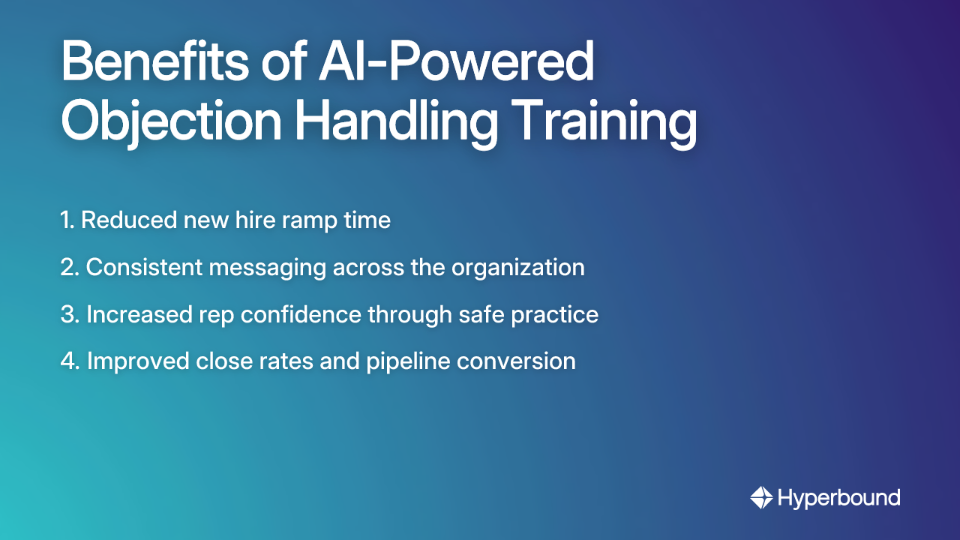
AI roleplays reduce new hire ramp time, drive consistent messaging across the organization, and build rep confidence through safe practice, ultimately improving close rates and pipeline conversion.
As sales conversations grow increasingly complex, the old ways of coaching objection handling—sporadic manager roleplays and post-mortem call reviews—simply can't scale. AI-powered roleplays provide the systematic practice environment reps need to master this critical skill.
AI-powered objection handling coaching uses artificial intelligence to create realistic, simulated sales conversations where reps can practice responding to customer objections in a safe, repeatable environment. Unlike traditional methods, AI provides instant, data-driven feedback and allows for scalable practice without requiring a manager to be present for every session.
AI is better than traditional roleplays because it offers scalability, consistency, and objective, data-driven feedback that isn't dependent on a manager's limited time or subjective opinion. It solves the core limitations of traditional practice, where feedback can be inconsistent, peer roleplays lack realism, and there's not enough time for every rep to get personalized coaching.
To start using AI for sales coaching, first establish a consistent objection handling framework for your team to follow. Then, use an AI platform like Hyperbound to build a library of realistic scenarios, structure training with progressive difficulty levels, and leverage AI-driven feedback and scorecards to track measurable improvement over time.
The most common sales objections to practice include brush-offs ("We're not interested"), incumbent-related objections ("We already have a solution"), budget constraints ("It's not in the budget"), gatekeeper blocks ("I need to talk to my boss"), and stalls ("Can you send me more information?"). A robust AI training platform allows you to customize these scenarios to your specific industry, product, and competitive landscape.
You can measure the effectiveness of AI sales coaching by tracking key performance indicators (KPIs) before and after training. Key metrics include objection resolution rates in simulations, improvements in AI-generated scorecard results, response confidence and fluency, and ultimately, observing increases in live call performance and conversion rates.
Both new hires and experienced sales reps benefit from AI objection handling training. New reps can quickly ramp up and build foundational skills in a safe environment without risking live deals. Veteran reps can refine their techniques, practice handling new market objections, and get objective feedback to eliminate long-standing bad habits.
Ready to see how AI can coach your team to handle any objection? See a demo of Hyperbound's AI Sales Roleplays and transform how your reps respond to even the toughest customer pushback.










Use Cases
Legal