
You've done the outreach, survived the follow-ups, and finally landed the meeting. It's T-minus 15 minutes. You open your CRM, skim the notes from the last call, scroll through the prospect's LinkedIn, and re-read the email thread. You feel... prepared? Kind of.
But here's the thing: knowing your prospect and being ready for the conversation are two very different things. And in B2B sales today, the gap between those two things is where deals are won and lost.
Sales reps know this pain acutely. On forums like Reddit's r/sales, you'll find threads filled with frustrations: high no-show rates after painstaking outreach, difficulty maintaining consistency on calls, and the quiet dread of facing an objection you haven't prepared for. One rep put it plainly: "I bombed my first day." Another asked: "How are you ensuring your reps follow a checklist on sales calls?"
The underlying question in all of it is the same: What does good pre-call preparation actually look like?
There are two competing philosophies here. The traditional approach—passive, research-based review—and the modern alternative: active, AI roleplay tailored to the specific prospect and scenario. This article breaks down both, honestly, and shows you the data on what actually moves the needle.
Traditional pre-call prep follows a familiar pattern. You review prior conversations in the CRM. You check the prospect's company news. You re-read their job title and try to infer their priorities. You maybe glance at a recorded call from a similar deal.
This research-based preparation isn't worthless—far from it. Salesforce notes that tailoring your approach to the prospect's specific needs is table stakes for a successful call. And Saleshood rightly points out that "every call teaches buyers about your understanding of their world"—so doing your homework does build trust.
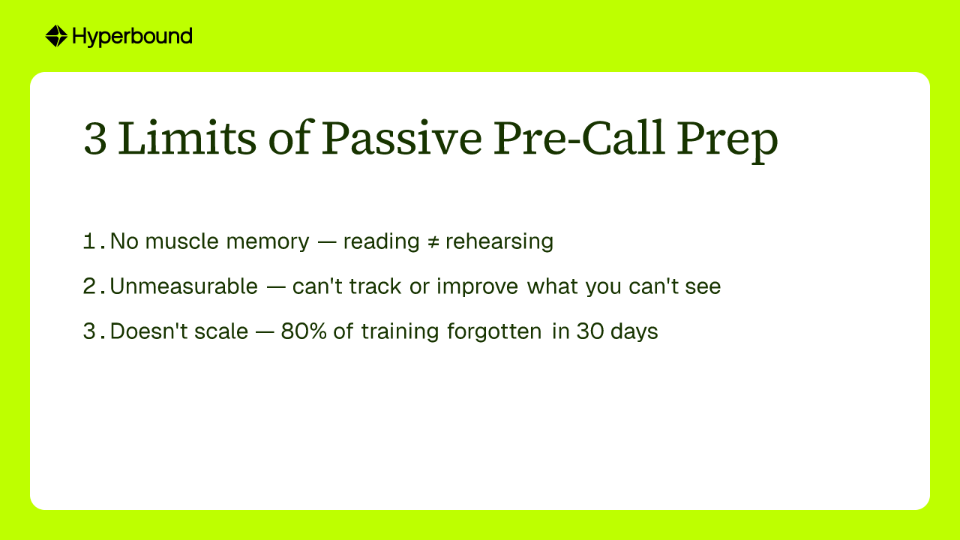
But here's the ceiling: reading is not rehearsing.
Knowing that a CFO is likely to raise a budget objection is not the same as having practiced your response out loud, under simulated pressure, five times this week. You can intellectually understand every objection in the playbook and still stumble when it lands in a live conversation. Knowledge builds competence; practice builds reflexes.
There are three core limitations to passive review:
AI roleplay before sales calls flips the preparation model from passive consumption to active practice. Instead of reading about the buyer, reps talk to a simulated version of the buyer—one that pushes back, raises realistic objections, and forces the rep to think on their feet.
Think of it as a flight simulator for sales calls. Pilots don't learn to handle turbulence by reviewing weather reports. They practice in simulators until the response is automatic.
AI roleplay tools simulate real-life scenarios, allowing reps to practice and receive instant feedback—enabling quick adjustments before they matter in a live deal. This creates the kind of continuous, adaptive learning that static content simply can't replicate.
Hyperbound Practice is built exactly on this philosophy. Its AI buyer personas are trained on over 2 million hours of real B2B sales conversations—not generic scripts. Reps can practice cold calls, discovery, demos, objection handling, renewals, and more. After every session, AI Scorecards deliver objective metrics: talk ratio, methodology adherence, how effectively objections were handled. AI Coaching surfaces specific missed moments so reps improve on the exact behaviors that win deals—without waiting for a manager to find time to listen to a recording.
Here's how the two preparation philosophies stack up across the five dimensions that sales leaders actually care about:
.png)
80% of traditional training is forgotten within 30 days.
Theoretical comparisons are useful. Real-world outcomes are better.
Take Nivoda, a global diamond marketplace. After implementing contextual AI roleplay, they saw a 150% increase in their decision-maker-to-demo conversion rate and a 50% reduction in ramp time for new hires—according to Rob Rangel, their Director of Sales Performance. The driver wasn't generic sales training refreshers. It was practice that mirrored actual deal scenarios, building the reflexes that passive review never could.
Vanta, the trust management platform, went even further. Their CRO Stevie Case reported a 60% reduction in ramp time—from 210 days down to just 72—alongside 4x BDR team growth and a 5x pipeline increase. That's not incremental improvement. That's a structural shift in how quickly revenue starts flowing.
Why does ramp time matter so much? Because it's one of the most expensive hidden costs in sales. According to Revgenius, the average ramp time is typically the length of your sales cycle plus 90 days. During that window, a new hire can cost a company up to three times their base salary while generating negative ROI. Shaving weeks—or months—off that curve isn't a nice-to-have. It directly accelerates revenue realization and drops your cost of acquisition.
The common thread in Nivoda and Vanta's results? Practice wasn't generic. It was contextual—built around the actual scenarios, objections, and buyer types those reps were going to face. That specificity is what separates meaningful skill development from box-ticking training compliance.
Here's a pain point most sales leaders recognize but rarely solve: senior reps won't do generic training.
And honestly? They shouldn't have to. A tenured AE with five years of deal experience doesn't need to practice a basic discovery call framework. But they absolutely will—and should—practice handling the specific procurement objection their CFO prospect raised on last quarter's similar deal. The distinction matters enormously for adoption.
The real-world data backs this up. Sales reps consistently cite the need for feedback mechanisms that are tied to their actual performance gaps—not generic best-practice exercises. When training feels disconnected from the live deal in front of them, it gets deprioritized. When it's directly relevant to winning the deal they're working on right now, it becomes a competitive advantage.
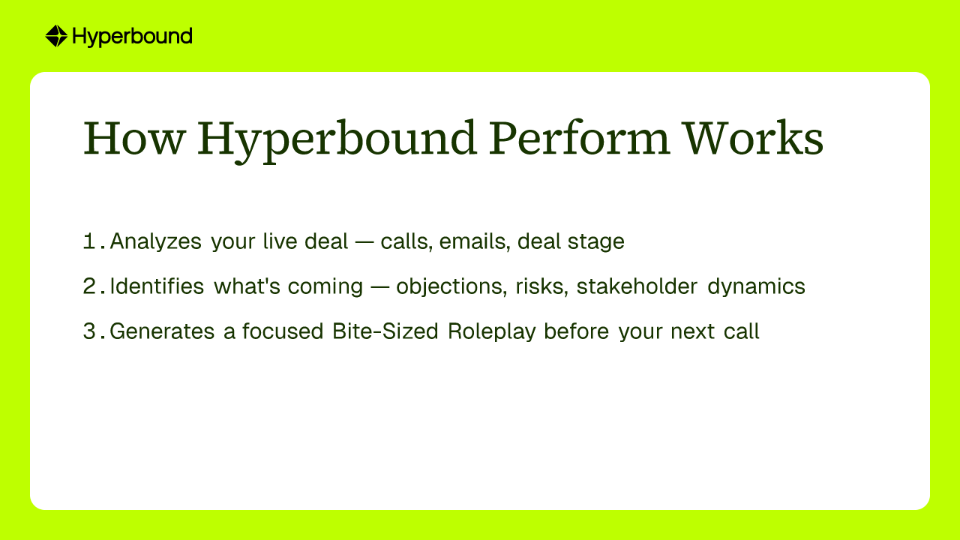
This is where Hyperbound Perform bridges the gap between knowing and doing. Rather than asking reps to practice in a vacuum, Perform analyzes real call activity across a rep's active deals and historical data from similar closed-won (and closed-lost) opportunities. From that analysis, it automatically generates Bite-Sized Roleplays: short, targeted practice sessions built around the exact skill gaps, objections, and stakeholder dynamics relevant to that specific deal.
The workflow is surgical:
What this means in practice: the rep who's about to get on a call with a skeptical VP of Finance can spend 10 minutes practicing exactly that conversation—not reviewing notes, not watching a generic objection-handling video, but actually rehearsing the moment that will determine whether the deal advances or stalls.
This is ai roleplay before sales calls done right: not a training module to complete, but a precision tool deployed exactly when it matters.
The evidence is in. AI roleplay outperforms passive review across every dimension that matters: confidence, objection preparedness, ramp speed, measurability, and long-term skill retention. Nivoda's 150% lift in demo conversions and Vanta's 60% ramp reduction aren't statistical anomalies—they're the result of a fundamentally better preparation philosophy.
But technology doesn't close deals. Reps do. And the uncomfortable truth for sales leaders is that the most sophisticated AI roleplay platform in the world generates zero ROI if reps aren't actually using it.
That's why the adoption question matters more than the capability question. Skepticism about AI tools is real and legitimate—reps have seen enough "game-changing" enablement tools collect dust to be wary. The answer isn't better mandates. It's better relevance.
When practice is directly tied to the deal a rep is working on right now—when a Bite-Sized Roleplay lands in their workflow and mirrors the exact conversation they're about to have—it stops feeling like training. It starts feeling like preparation that actually helps them win. That shift, from obligation to competitive edge, is what drives real adoption.
Stop asking your reps to review CRM notes and hope they're ready. Start giving them the at-bats that build the reflexes they actually need—deal-specific, data-informed, and delivered before it matters most.
That's the difference between a rep who knows what to say and a rep who says it when it counts.
AI roleplay for sales is a training method where sales representatives practice conversations with an AI simulated buyer. This technology acts like a flight simulator for sales calls, allowing reps to rehearse scenarios like cold calls, discovery, and objection handling in a safe environment. The AI provides instant feedback and performance metrics, helping reps build conversational muscle memory and reflexes before a real deal is on the line.
AI roleplay improves sales call preparation by shifting from passive review to active practice, which builds conversational reflexes and confidence. Unlike simply reading CRM notes, active practice through AI roleplay helps reps internalize responses to objections and key talking points. This method is measurable through AI scorecards, scalable, and helps reps retain training far more effectively than traditional methods.
Deal-specific roleplay is more effective because it is directly relevant to a salesperson's active opportunities, which significantly increases adoption and impact. Senior reps often skip generic training, but they will engage with practice sessions tailored to the specific objections and stakeholders of a deal they are trying to win. This turns training from a chore into a competitive advantage.
AI sales training reduces ramp time by providing new hires with consistent, on-demand practice and immediate, objective feedback, accelerating their path to productivity. Instead of waiting for managers to review calls, new reps can use AI roleplay to practice continuously and learn from mistakes quickly. Companies using this approach have cut ramp time by as much as 60%, directly impacting how quickly new hires begin generating revenue.
The key benefits of using AI for pre-call preparation are increased rep confidence, better objection handling, quantifiable skill measurement, and faster new hire ramp times. AI roleplay provides a safe environment to build reflexive responses to tough questions. AI scorecards offer objective metrics to track improvement, leading to tangible business outcomes like increased conversion rates.
Yes, experienced sales reps are highly likely to use AI roleplay when it is made directly relevant to the deals they are actively working on. While senior reps often resist generic training, they embrace tools that give them a competitive edge. Deal-specific roleplays, which focus on the exact challenges of a live opportunity, provide immediate value and drive high adoption.










Use Cases
Legal