
You've invested in the playbooks. You've built the onboarding program. You've even got Gong recordings of your best reps handling tough objections. But when your new AE finally gets a real enterprise prospect on a call, they freeze the moment a CFO starts pushing back on pricing — or worse, they default to a memorized script that lands flat.
This is the enterprise objection handling gap. And it's not a knowledge problem. It's a reps problem.
Enterprise sales isn't about memorizing the right answer. It's about navigating complex, multi-stakeholder conversations where objections are nuanced, deal-specific, and rarely follow the script. As one sales practitioner put it on Reddit: "The simulated buyer feels flat enough that reps learn to perform against a script, not against human objection patterns."
That sentiment explains why most generic AI roleplay tools fall short for enterprise teams. The AI feels robotic. The scenarios don't match your actual deals. And tenured reps — the ones who need the sharpest objection handling skills — refuse to sit through certification modules built for SDRs.
The good news: a new generation of AI sales roleplay tools is purpose-built to close that gap. Trained on real B2B conversations, connected to live deal data, and built for the complexity of enterprise buying committees.
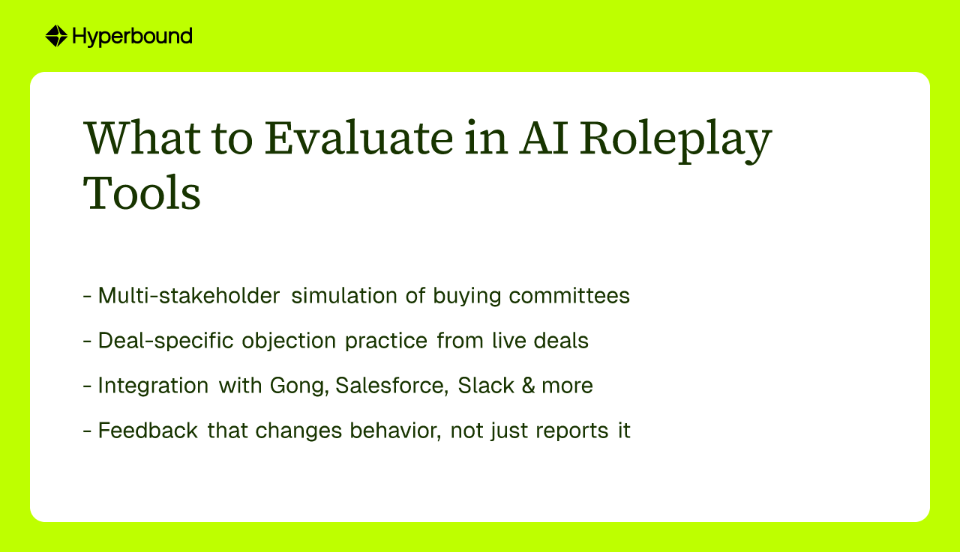
This buyer's guide evaluates seven of the best against the criteria that actually matter for enterprise sales objection handling practice:
.png)
.png)
Hyperbound Practice is purpose-built for the problem this guide is trying to solve: giving enterprise sales reps realistic, repeatable practice against the actual objections they'll face in real deals — not generic scripts.
Multi-stakeholder simulation: Hyperbound's Multiparty Roleplays let reps practice complex calls with multiple AI buyer personas simultaneously. A rep can navigate a champion who loves the product while an economic buyer is pushing back on ROI — all in the same conversation. For enterprise teams managing large buying committees, this is the only way to build genuine muscle memory.
Deal-specific objection practice: This is where Hyperbound creates the largest gap between itself and every other tool on this list. Its AI buyer personas are trained on 2M+ hours of real B2B sales conversations — which is why users describe it as feeling like a real buyer, not a customer service bot. More importantly, Kota Activate can analyze data from your CRM and call intelligence tools (like Gong) to auto-generate objection scenarios from your team's real, active deals. A rep prepping for a renewal call with a skeptical CFO can practice the exact objections that CFO is likely to raise — before ever dialing in.
For tenured reps who won't sit through generic certification programs, Bitesized Roleplays solve the adoption problem. Short, focused, deal-contextual practice that senior reps will actually do.
Integration: Hyperbound connects directly with the enterprise stack — Gong, Salesforce, HubSpot, Salesloft, Seismic, Highspot, Showpad, Slack, and Microsoft Teams. Roleplay assignments can be triggered from Slack, embedded in your LMS via SCORM, or launched from inside a CRM record.
Feedback quality: AI Scorecards provide instant, objective feedback after every roleplay — tracking talk ratios, methodology adherence (including MEDDIC/MEDDPICC), key selling moments, and specific coaching observations. No waiting for a manager to review a recording. No lag between field problem and training intervention.
Proof points: Vanta reduced ramp time by 60% — from 210 to 72 days — while scaling their BDR team 4x. Nivoda saw a 150% increase in demo conversion rates after implementing Hyperbound's AI roleplays. These aren't abstract claims — they're the result of reps practicing the right objections before the right calls.
Gong is the dominant conversation intelligence platform in enterprise sales, and for good reason. It captures, transcribes, and analyzes every sales call — giving managers visibility into talk ratios, topic coverage, and competitive mentions that previously required listening to every recording manually.
For objection handling analysis, Gong is excellent. Managers can build playlists of best-practice calls, tag objection moments, and flag patterns across the team. If you want to know what objections your reps are facing most often, Gong will tell you.
The limitation is fundamental: Gong is built to review the past, not practice for the future. It doesn't have a roleplay layer. When a manager identifies a rep struggling with pricing objections in Gong, the coaching intervention is still human-dependent and asynchronous. There's no mechanism for the rep to practice that specific objection ten times at 11pm before their next call.
As Hyperbound's own competitive positioning puts it: Gong is "a giant library of data" — the question is what you do with it. For enterprise teams that already use Gong, the highest-leverage move is pairing it with a dedicated practice platform that can ingest call data and convert identified gaps directly into targeted roleplays.
Chorus.ai operates in the same category as Gong: conversation intelligence that records, transcribes, and analyzes sales calls. It offers deal intelligence, relationship analytics, and coaching workflows that help managers identify patterns across their team's calls.
Like Gong, Chorus excels at surfacing what happened — which objections came up, how reps responded, where deals got stuck. Its strength is in the analysis layer, not the practice layer. It doesn't offer AI roleplay or simulated objection practice, which means identified skill gaps still rely on human-led coaching to address.
For enterprise teams already embedded in ZoomInfo's data ecosystem, Chorus integrates naturally. But for enterprise sales objection handling practice — the ability for reps to simulate, repeat, and refine specific responses — it's not the right tool. It's the diagnostic; you still need the training room.
Second Nature takes a distinctive approach to AI sales roleplay: 3D animated avatars designed to create a more visually engaging simulation experience. Reps interact with lifelike AI characters that respond conversationally to their pitch and objection handling.
Multi-stakeholder simulation: Second Nature does support multi-persona conversations, which puts it ahead of call intelligence tools for actual practice. A rep can navigate a conversation that involves more than one buyer archetype.
Deal-specific objections: This is where Second Nature shows its limits for enterprise teams. Scenarios are built from uploaded content — slide decks, playbooks, product documentation — rather than dynamically generated from live deal data or CRM activity. For a standardized onboarding program, this works well. For a tenured AE who needs to prep for the specific objections a $500K prospect has been raising across four calls, it falls short.
Feedback quality: Manager dashboards track rep progress and performance trends over time, providing useful visibility for enablement teams. The feedback is competency-based rather than deal-specific.
Second Nature is a strong option for organizations that want an immersive, avatar-driven experience for new hire onboarding and product certification — particularly if the team responds better to visual interfaces than voice-only simulations.
PitchMonster is a sales roleplay platform built around gamification mechanics — leaderboards, scoring, and team challenges designed to make practice something reps actually want to do. For organizations struggling with rep adoption of training programs, this is a meaningful differentiator.
Multi-stakeholder simulation: PitchMonster is primarily designed around 1:1 interactions. It's not built for the complexity of enterprise buying committee simulations.
Deal-specific objections: Practice scenarios are built from pre-configured content rather than dynamically generated from live deal and CRM data. Teams can customize what they build, but there's no automated pipeline from Gong or Salesforce into personalized objection scenarios.
Feedback quality: PitchMonster provides feedback on vocal delivery — tone, pace, and vocabulary. This approach can be genuinely useful for building foundational communication habits and driving engagement with training.
For mid-market teams or SDR organizations where adoption is the primary challenge and scenarios are relatively standardized, PitchMonster's gamification model can create strong training momentum. For enterprise AEs practicing deal-specific, multi-stakeholder objection scenarios, it's less suited.
Mindtickle is one of the most comprehensive sales readiness platforms on the market. It combines content management, onboarding workflows, skills assessments, coaching tools, and AI-powered roleplay into a single suite — making it an attractive option for large enterprise enablement teams that want to centralize their training infrastructure.
Multi-stakeholder simulation: Mindtickle's AI roleplay feature supports multi-persona scenarios and includes multilingual support for global sales teams, which is a real advantage for enterprises with distributed international reps.
Deal-specific objections: Mindtickle's roleplay is well-suited for standardized certifications, product launches, and onboarding programs. It's less designed for the kind of dynamic, deal-level practice that enterprise objection handling requires — where the scenario changes based on what a specific prospect said on the last call. It functions best as a readiness gate, not a deal-execution tool.
Integration: Mindtickle integrates extensively with CRMs, LMS platforms, and enterprise tech stacks — one of the strongest integration footprints in the category.
Feedback quality: The platform's AI provides performance analysis and coaching feedback, with manager dashboards that track readiness scores and skill development over time.
For enterprise enablement leaders managing complex, global training programs and looking for a centralized platform, Mindtickle is a serious option. Where it trades off versus a purpose-built tool like Hyperbound is in simulation fidelity — particularly for the deal-specific, multi-stakeholder scenario complexity that characterizes enterprise objection handling practice.
Highspot is the leading sales content enablement platform — and in recent years, it has built out coaching and training capabilities alongside its core content management functionality. For organizations that already use Highspot as their content hub, the ability to run certifications and collect rep practice submissions from within the same platform reduces friction.
Multi-stakeholder simulation: Highspot's coaching features are oriented around rep submissions — reps record themselves delivering a pitch or handling a scenario and submit it for manager review. It's less designed for dynamic back-and-forth objection practice and more for pitch certification.
Deal-specific objections: Highspot's training is tightly coupled to its content library, which is its core strength. Practice scenarios are aligned to the playbooks and messaging assets your team already uses. The limitation is that practice remains content-driven and standardized rather than dynamically generated from live deal activity.
Integration: Highspot integrates deeply with CRMs, particularly Salesforce and Microsoft Dynamics, and serves as a natural integration point for calling tools and conversation intelligence platforms.
Feedback quality: AI-powered feedback is available on rep submissions, providing coaching guidance that aligns with the messaging standards established in Highspot's content library.
For enterprise enablement programs where content adoption and messaging consistency are the primary training goals, Highspot is a strong choice. For teams whose primary need is enterprise sales objection handling practice — particularly multi-stakeholder simulation and deal-specific scenario generation — it's best paired with a dedicated roleplay platform rather than used as a standalone.
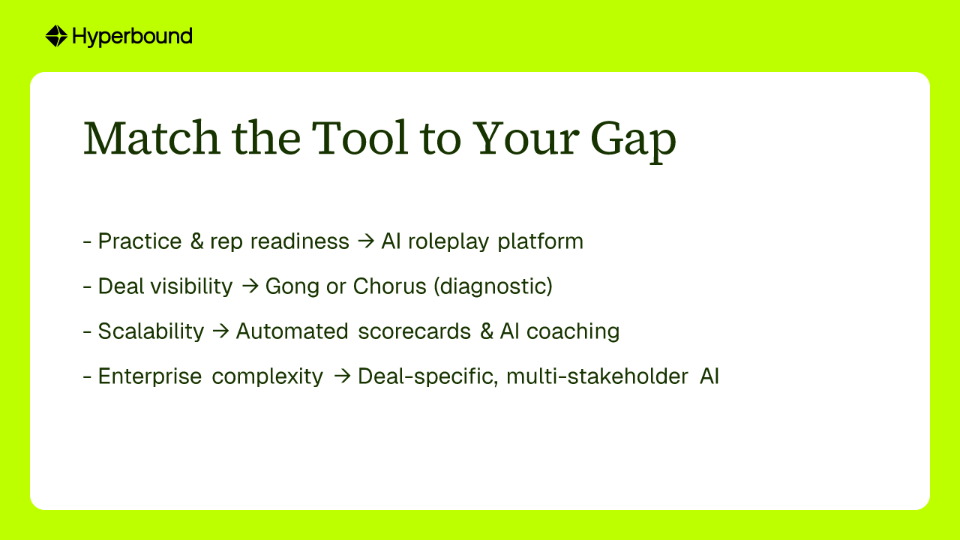
Not every tool on this list is trying to solve the same problem. Before you evaluate, it helps to be honest about where your gap actually is.
If your gap is practice and rep readiness — reps aren't prepared for the conversations they're about to have — you need a purpose-built AI roleplay platform. Hyperbound, Second Nature, and Mindtickle (for broader programs) are the primary options here. The critical differentiator is whether the AI is trained on real B2B call data or generic scripts. As users repeatedly point out, robotic AI that can't counter objections realistically leads to reps building muscle memory against the wrong patterns.
If your gap is analysis and deal visibility — managers can't tell why deals are stalling — Gong and Chorus are excellent starting points. But they're diagnostic tools, not training tools. The insight they surface still requires a separate mechanism to translate into rep skill improvement.
If your gap is scalability — one enablement manager supporting 50-100 reps across multiple products and segments — the tools that matter most are the ones that can run without constant human intervention. Automated AI Scorecards, Kota-orchestrated coaching interventions, and Bitesized Roleplays triggered by real deal activity let a lean enablement team run a high-quality practice program at scale.
The realism test is non-negotiable. For enterprise sales objection handling practice specifically, the quality of the AI buyer persona determines whether reps are building real skills or gaming a script. Ask every vendor: what data is your AI trained on? How does it generate objections? Can it simulate a skeptical CFO who has already read your competitor's case study? The answers will tell you a lot.
Enterprise sales teams have never had more data about what's happening in their deals. What most still lack is a scalable, realistic way to translate that data into rep behavior change — before the rep gets on the call.
The tools reviewed here represent the state of the art in enterprise sales objection handling practice. The right choice depends on your team's specific gaps, existing tech stack, and the complexity of the buying cycles you navigate.
For teams where objection handling practice needs to match the full complexity of enterprise deals — multi-stakeholder dynamics, deal-specific scenarios, and feedback that ties directly to methodology — Hyperbound Practice is built for exactly that problem. The results from teams like Vanta (60% ramp reduction) and Nivoda (150% demo rate increase) reflect what's possible when practice is grounded in real data rather than generic scripts.
Ready to see it in action? Book a demo of Hyperbound Practice and find out how your team can start practicing the conversations that actually close deals.
AI sales roleplay tools are software platforms that allow sales representatives to practice conversations with AI buyer personas. These tools simulate realistic sales scenarios, such as handling objections or delivering a pitch, providing a safe and repeatable environment for reps to build skills and receive instant feedback without risking a live deal.
Realistic practice is crucial because enterprise sales conversations are complex, involve multiple stakeholders with different priorities, and rarely follow a script. Generic scripts fail in these dynamic situations. Reps need to build muscle memory against nuanced, deal-specific objections to navigate conversations effectively with senior buyers like CFOs and CTOs.
The key difference is practice versus analysis. Conversation intelligence tools like Gong and Chorus are designed to record, transcribe, and analyze past sales calls to provide insights and identify skill gaps. AI roleplay tools like Hyperbound are built for active practice, allowing reps to use those insights to rehearse and improve their responses to specific objections before they get on a live call.
For enterprise teams, the most important features are multi-stakeholder simulation, deal-specific objection practice, deep integration with your tech stack (CRM, Gong, etc.), and high-quality, actionable feedback. These features ensure the practice is relevant to the complex, high-stakes deals your team is actually working on.
Advanced AI roleplay platforms like Hyperbound can run "Multiparty Roleplays" where a sales rep interacts with multiple AI buyer personas simultaneously in the same conversation. For example, a rep can practice navigating a scenario with an enthusiastic champion and a skeptical economic buyer at the same time, mirroring the real dynamics of an enterprise buying committee.
Yes, the most advanced tools can. Platforms like Hyperbound integrate with CRM (e.g., Salesforce) and call intelligence tools (e.g., Gong) to analyze data from your team's active deals. This data is then used to automatically generate highly relevant and personalized objection scenarios for reps to practice, ensuring they are preparing for the exact challenges they will face.
To drive adoption with senior reps, the training must be directly relevant to their deals and respectful of their time. Avoid generic, one-size-fits-all certifications. Instead, use tools that offer short, focused, deal-specific practice sessions ("Bitesized Roleplays") that help them prepare for an upcoming call. When training directly helps them close a deal, adoption follows.








Use Cases
Legal