
You've spent a week building rapport with your champion. You know their pain, their internal politics, their budget cycle. Then the calendar invite updates — and suddenly the CFO, the Head of IT, and a skeptical VP are all joining the call.
Sound familiar? Sales professionals on Reddit describe it bluntly: "New stakeholders constantly disrupt the flow of deals and require significant adaptations." The presence of multiple stakeholders doesn't just complicate the call — it can completely derail the deal if you're not ready.
The problem is that most sales reps practice for the call they expect, not the one they actually get. Traditional roleplay — running through a script with a single colleague or a basic chatbot — doesn't replicate the chaos of a real group call where a CFO talks over the champion, the IT director raises a technical blocker, and the end user asks something completely off-script.
This is where AI roleplay tools promise to help. But here's the catch: not all of them are built equal, and most fall dangerously short when it comes to multi-stakeholder practice. Users note that "AI lacks the ability to counter objections realistically, resulting in unchallenging role-plays" — which means you can go through the motions and still get blindsided on the real call.
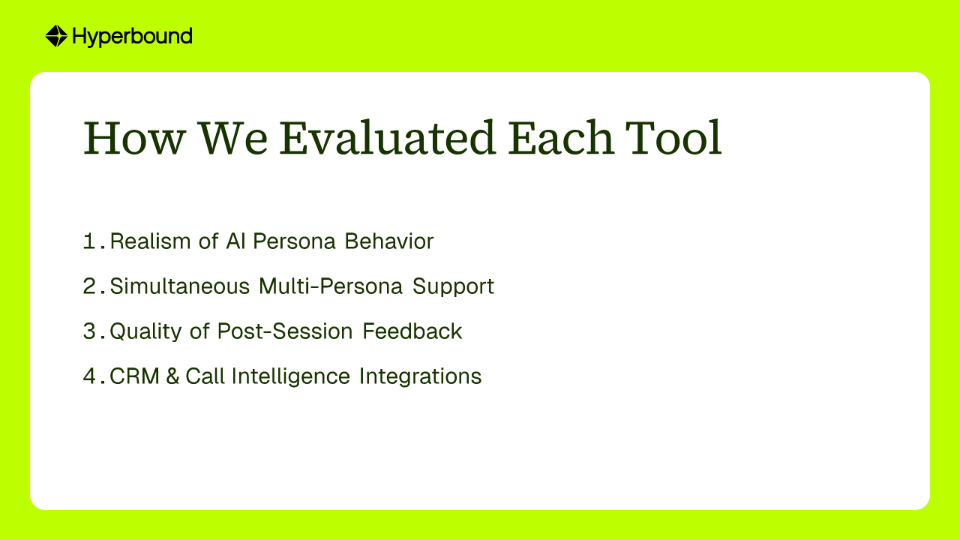
So we evaluated the top platforms on the market across four criteria that actually matter for complex, multi-stakeholder calls:
Hyperbound Practice is purpose-built for complex B2B sales training and is the strongest option available today for reps who need to practice multi-stakeholder sales calls — not just solo buyer interactions.
Realism of AI Persona Behavior: Hyperbound's AI isn't running off a generic language model with scripted buyer responses. It's trained on 2M+ hours of real B2B sales conversations, which means the personas don't just respond — they push back the way real buyers actually do, raise unexpected objections, and adapt to how you steer the conversation. This directly addresses the core complaint from sales reps that AI tools feel robotic and fail to adapt to unexpected inquiries. You can build digital twins of specific buyers from LinkedIn profiles, clone voices, and set emotional states — giving you a much closer simulation of a real prospect.
Simultaneous Multi-Persona Support: This is where Hyperbound stands alone. The Multiparty Roleplays feature lets you practice with multiple AI buyer personas simultaneously — not one after another, but all in the room at once. Your champion, the economic buyer, and a skeptical IT lead can all be active in the same session, each responding with their own agenda and communication style. No other platform reviewed here offers this level of group dynamic simulation, which makes it the only tool built to genuinely prepare you for the multi-stakeholder calls where deals are won or lost.
Quality of Post-Session Feedback: AI Scorecards deliver instant, objective feedback after every session — tracking talk ratios, key selling moments, methodology adherence (MEDDIC, BANT, SPICED), and specific coaching areas. The Screen Comprehension feature means the AI can actually "see" and react to what you're presenting on screen, making demo practice significantly more realistic. For tenured reps who won't sit through generic certifications, Bitesized Roleplays offer short, targeted practice tied to active deals — so even experienced AEs stay sharp.
CRM & Call Intelligence Integrations: Hyperbound integrates with Salesforce, HubSpot, and Pipedrive on the CRM side, Gong, Chorus, Salesloft, Outreach, and Aircall for call intelligence, and Seismic, Highspot, and Showpad via SCORM for LMS deployment. It also lives inside Slack and Microsoft Teams.
Proof Points: The numbers are hard to argue with. Hyperbound has delivered 250,000+ simulations to 45,000+ active users across 7,000+ companies and holds a 4.9/5 rating on G2.
Second Nature takes a visual-first approach, using 3D AI avatars to create engaging roleplay experiences. It's particularly strong for reps who benefit from visual feedback on body language and presentation delivery, and it allows teams to repurpose existing content — decks, videos, and scripts — into interactive scenarios.
Realism of AI Persona Behavior: The avatars create a more immersive experience than text-only tools, and Second Nature does allow for scenario customization. However, some users note that the AI can struggle with accents and sometimes drifts off-topic mid-conversation, which breaks the flow and can undermine the realism that makes practice stick.
Simultaneous Multi-Persona Support: Second Nature is designed around single-avatar interactions. You practice against one AI persona at a time. There is no native capability for simultaneous multi-persona sessions, which means it doesn't replicate the dynamics of a group discovery call or multi-stakeholder demo.
Quality of Post-Session Feedback: Feedback is primarily focused on video communication analysis — confidence, pacing, filler words, and presentation delivery. This is valuable for pitch polish, but falls short of the methodology-aligned, deal-level coaching that sales managers typically need to see before approving a tool purchase. As one rep put it, "management will not buy a tool like this on its own — they see feedback as being the most important element."
Best for: SDRs and AEs who need to sharpen presentation delivery and want a visually engaging practice format, but aren't yet dealing with complex multi-stakeholder scenarios.
Allego is a well-established sales enablement platform, and Rehearsal is its practice module built for video-based self-assessment and peer review. Its strength is in connecting practice to a broader learning ecosystem — content libraries, training modules, and manager workflows all live within one platform.
Realism of AI Persona Behavior: Allego recently added "Live Dialog Simulators" to create AI roleplay experiences, but some reviewers note these tools "may lack maturity compared to other vendors." The AI persona capabilities are newer additions rather than core differentiators.
Simultaneous Multi-Persona Support: Rehearsal is focused on 1-on-1 practice scenarios. It is limited in simultaneous persona interactions and does not offer a multi-persona group dynamic. If practicing for a complex call with a buying committee is the goal, this isn't the right fit.
Quality of Post-Session Feedback: Feedback leans heavily on peer reviews and manager observation rather than automated, AI-driven scoring. This works well within organizations that have strong coaching cultures and time-available managers, but doesn't scale easily for teams where managers are already stretched thin.
Best for: Teams already invested in the Allego ecosystem that want to add a structured practice layer and peer review workflow inside an existing platform.
PitchMonster is built around the insight that reps will practice more when there's a competitive element involved. Leaderboards, team challenges, and scoring mechanisms drive engagement and create a culture of friendly competition around skill development.
Realism of AI Persona Behavior: The primary draw is the gamification layer rather than the depth of AI persona simulation. PitchMonster can be effective for high-volume, repetitive scenario work — like drilling a cold call opener — but some find it "may lack depth for serious training needs." The AI personas are not built to handle the kind of nuanced, adaptive objection handling that complex multi-stakeholder sales calls demand.
Simultaneous Multi-Persona Support: PitchMonster does not support simultaneous multi-persona roleplays. Practice sessions are structured around individual interactions.
Quality of Post-Session Feedback: Feedback and scoring are geared toward the gamification experience — leaderboard positioning, completion streaks, competitive rankings. This drives adoption, but doesn't produce the granular, methodology-aligned coaching insights that sales managers and enablement leaders need to tie training to business outcomes.
Best for: Early-stage teams or organizations that struggle with training completion rates and want to drive engagement through competition before investing in deeper simulation capabilities.
Mindtickle is an enterprise-grade platform where AI roleplay is one component of a comprehensive revenue enablement stack that spans content management, readiness tracking, coaching, and analytics. It's a strong choice for large organizations that want a single platform to manage the full enablement lifecycle.
Realism of AI Persona Behavior: Mindtickle offers "holistic roleplays" combining audio, video, and text with realistic AI avatars, and its analytics provide competency-based reporting that ties practice performance to business outcomes. The depth of its analytics layer is a genuine strength.
Simultaneous Multi-Persona Support: While Mindtickle offers strong roleplay capabilities, it is not purpose-built for simultaneous multi-stakeholder dynamics. The platform's breadth means the roleplay feature is one of many, and some users find it can feel "overwhelming for roleplay-specific training." If multi-stakeholder preparation is your primary use case, the specialization isn't there.
Quality of Post-Session Feedback: Feedback and analytics are among the strongest in the market, particularly for enterprise teams that need granular performance data tied to readiness benchmarks. The reporting infrastructure is built for scale.
Best for: Large enterprises that need a unified enablement platform and are comfortable with roleplay being one capability within a broader ecosystem rather than a specialized, deep simulation environment.
.png)
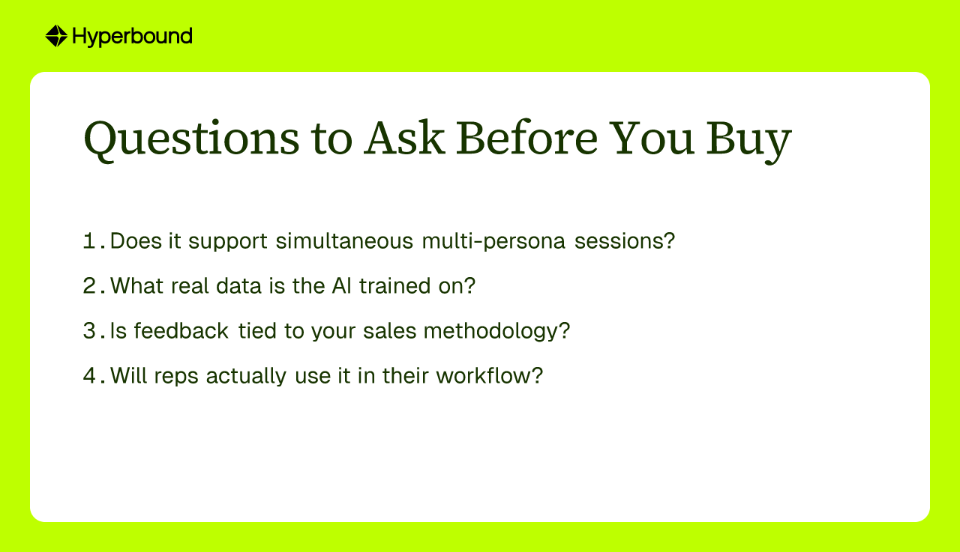
Before booking demos, ask these questions to cut through the noise:
1. Does it actually support simultaneous multi-persona? Ask vendors directly — not "does it support multiple personas?" but "can multiple AI buyers be active in the same session, interacting with me at the same time?" Most tools support sequential persona practice. Only Hyperbound supports true simultaneous group dynamics.
2. What is the AI trained on? Generic AI personas trained on internet text feel generic. Look for platforms trained on real, domain-specific B2B sales conversations. The difference in realism is significant — and real-world data is what makes the training stick.
3. Is the feedback tied to your sales methodology? Talk/listen ratios are table stakes. What you need is coaching that tells you where you missed a discovery question, deviated from your MEDDIC framework, or failed to quantify pain — before it costs you a real deal.
4. Will reps actually use it? A tool only works if it lives where reps work. Prioritize platforms that integrate with Slack, Teams, your CRM, and your call intelligence stack — so practice is embedded in the workflow, not an extra tab to ignore.

The reality of B2B sales in 2026 is that the single-threaded deal is a liability. Committees are bigger, buying cycles are longer, and the CFO you've never spoken to can derail a deal that felt like a sure close. The ability to navigate a room full of competing agendas isn't just a nice-to-have — it's a core competency.
Most AI roleplay tools are built for a simpler problem. They help reps rehearse one conversation, against one persona, in isolation. That's useful. But it doesn't prepare you for the real call.
Hyperbound's Multiparty Roleplays — built on an AI engine trained on 2M+ hours of real sales conversations and proven across 250,000+ simulations — is the only platform architected to simulate the full complexity of a multi-stakeholder meeting. The results speak for themselves: Vanta cut ramp time by 60%, Nivoda doubled revenue year-over-year, and LinkedIn scaled practice to 3,000+ sellers across multiple regions.
Ready to see it in action? Book a demo of Hyperbound's Multiparty Roleplays today.
An AI roleplay tool for sales is a software platform that uses artificial intelligence to simulate realistic sales conversations, allowing reps to practice their pitch, handle objections, and refine their skills in a safe environment. Unlike traditional roleplay with colleagues, these tools provide on-demand, scalable practice with AI-driven "buyers" who can replicate various customer personas and scenarios, helping reps build confidence for real-world interactions.
Practicing for multi-stakeholder sales calls is crucial because these meetings involve multiple decision-makers with different priorities, objections, and communication styles. A single unexpected question from a CFO or a technical objection from an IT director can stall momentum. Practice helps reps learn to manage the room, navigate competing agendas, and address diverse concerns simultaneously, which is a key competency for closing complex B2B deals.
The best AI roleplay tools help reps prepare for group calls by simulating the dynamic of a real multi-stakeholder meeting, allowing them to practice against several AI personas at the same time. Platforms like Hyperbound offer "Multiparty Roleplays" where a rep can interact with a champion, an economic buyer, and a technical evaluator all in the same session. This replicates the chaos of a real group call and trains reps to handle interruptions and pivot between different stakeholder concerns.
Based on our evaluation, Hyperbound is the best AI roleplay tool for multi-stakeholder sales calls because it is the only platform that offers true simultaneous multi-persona simulations. While other tools are designed for one-on-one practice, Hyperbound's Multiparty Roleplays feature allows reps to engage with an entire buying committee at once, providing the most realistic preparation for the complex group meetings where major deals are won or lost.
A multi-persona feature typically means you can practice against different buyer types one at a time, whereas a true multi-stakeholder simulation allows you to interact with multiple AI buyer personas simultaneously in the same session. Most platforms let you practice sequentially—first with a CFO persona, then with an IT Director persona. A true simulation places all personas in the "room" at once, forcing you to manage group dynamics in real-time.
When choosing an AI sales roleplay platform, you should look for four key features: realistic AI persona behavior, support for simultaneous multi-persona sessions, detailed feedback aligned with your sales methodology, and integrations with your existing CRM and sales tools. Ensure the AI is trained on real sales data, the tool can run true group simulations, and the feedback provides actionable coaching.
The ROI of an AI roleplay tool can be measured through key sales metrics like reduced ramp time for new hires, increased demo-to-close conversion rates, higher quota attainment, and improved pipeline generation. For example, companies using these tools report tangible results like a 60% reduction in ramp time and a 150% increase in demo conversion rates, building a strong business case for the investment.









Use Cases
Legal