
You know you need more practice. But your only real practice ground is live prospects — and every fumbled opener, every "uh..." after a brush-off objection, every awkward gatekeeper interaction costs you a real opportunity.
That's the SDR dilemma. You can't get better without at-bats, but every at-bat you're still figuring things out is a meeting you didn't book.
Here's the uncomfortable truth that most reps already know: top-performing sales organizations are 51% more likely to have a regular coaching cadence, yet the average sales manager spends only around 8% of their time actually coaching. If you're waiting for your manager to clear calendar space for roleplay sessions, you're going to be waiting a long time.
The reps who level up fastest aren't waiting. They're creating their own practice reps — and increasingly, they're using AI sales roleplay to do it.
Now, if your first reaction is "AI roleplay sounds robotic and unrealistic" — that's fair. Early tools were exactly that. But the category has changed dramatically. Modern platforms like Hyperbound Practice are trained on 2M+ hours of real B2B sales conversations, not generic scripts. The AI personas push back the way real prospects do, go off-script, and give you instant AI scorecard feedback on what actually worked and what didn't.
This article breaks down four of the highest-leverage SDR scenarios you can drill in under 10 minutes each — cold call opens, the "send me an email" brush-off, gatekeeper navigation, and the multi-thread follow-up call. Master these, and you'll book more meetings. Simple as that.
The Challenge
Your prospect has been trained by a thousand bad cold calls to hang up within the first 10 seconds. The moment you sound like every other rep — "Hi, is this a good time?" — their brain switches to autopilot and you're done. Your opening line is everything.
What "Good" Looks Like
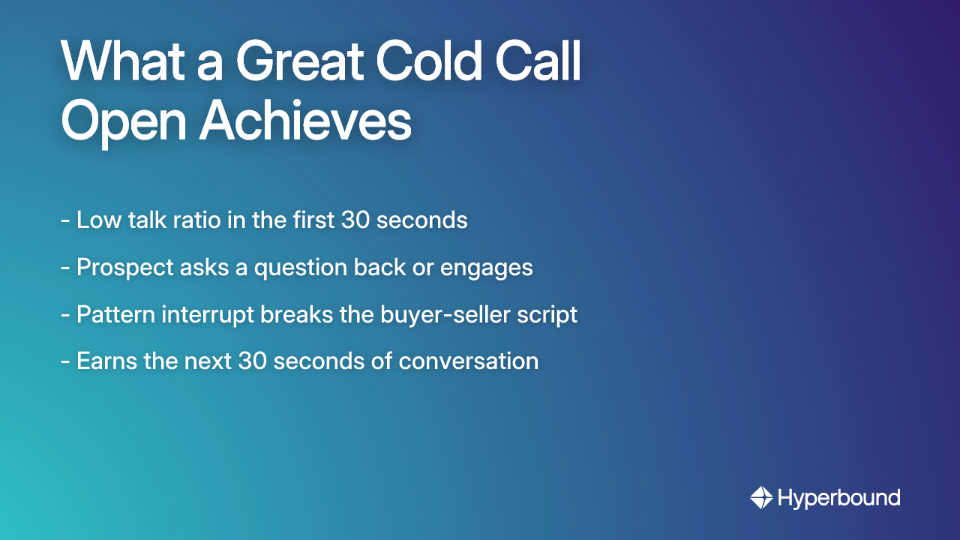
On a well-executed cold call open, the AI scorecard will show:
A strong pattern interrupt doesn't need to be gimmicky. Sandler's approach frames it simply: acknowledge their reality and ask for permission. Something like "You probably get a lot of calls like this — can I take 20 seconds to explain why I reached out?" works because it's honest and unexpected. Negative reverse selling is another option: "It sounds like you may already have this handled — should we even bother exploring it?" This lowers resistance by inviting them to say no, which paradoxically keeps them on the call.
The 10-Minute Drill with Hyperbound Practice
The goal here isn't to memorize a perfect line. It's to build the muscle memory of starting a conversation instead of launching a pitch — until it feels completely natural.
The Challenge
"Send me an email" is one of the most common cold call objections — and it's a polite way of saying "go away." Most reps say "sure!" and hang up. The meeting never gets booked. The email never gets opened.
What makes this objection tricky is that it can mean two very different things: genuine interest but bad timing, or a total blow-off. Treat both the same way and you're leaving meetings on the table.
And here's the thing SDRs in the r/sales community are right about: canned responses to this objection are immediately obvious and immediately off-putting. You need responses that feel like natural conversation, not a script you memorized.
What "Good" Looks Like
The AI scorecard for this scenario checks for:
The 10-Minute Drill with Hyperbound Practice
The reps who consistently book meetings from cold calls aren't the ones with the best email templates. They're the ones who don't let the call die at the first sign of resistance.
The Challenge
You had a great first call. Your champion was engaged, there was clear pain, and they said "let me loop in my manager for the next one." Now the stakes are higher. You need to re-establish context for one person, introduce yourself credibly to another, and keep the momentum going — all in the first two minutes.
This is where deals quietly die. Not because the opportunity isn't there, but because the rep didn't control the room.
What "Good" Looks Like
The AI scorecard for multi-thread calls looks for:
The 10-Minute Drill with Hyperbound Practice
This is exactly where Hyperbound's Multiparty Roleplays feature pays off. You can run a simulation with two AI personas simultaneously — your Champion and an Economic Buyer — each with different priorities and different questions.
Most SDRs never practice multi-stakeholder calls before they're on them. The ones who do walk into those calls with a completely different level of composure.
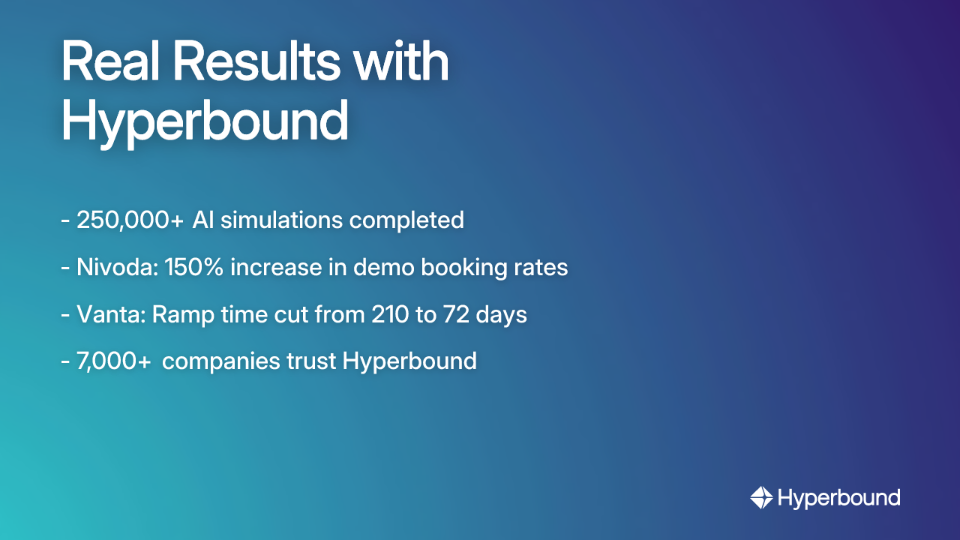
This isn't theory. Thousands of reps across 7,000+ companies are using this exact approach to build real skills and get measurable results. Hyperbound Practice has delivered over 250,000+ AI simulations — and the outcomes are showing up in pipelines.
At Nivoda, a B2B diamond marketplace, reps used Hyperbound's AI sales roleplay to rehearse their conversations before going live. The result: a 150% increase in demo booking rates. Rob Rangel, their Director of Sales Performance, attributes it directly to reps being more prepared and more confident in the moments that matter — exactly the four scenarios we covered above.
At Vanta, the security compliance company, their BDR team cut ramp time by 60% — from 210 days down to 72 — while scaling the team 4x. That's what happens when reps aren't waiting for manager-led training sessions to get practice reps in.
The common thread isn't talent. It's intentional, repeatable practice before the real call.
Waiting on your manager's calendar is a losing strategy. The market doesn't wait, your quota doesn't wait, and the reps at competing companies aren't waiting either.
AI sales roleplay gives you a personal practice partner that's available any time — 6am before a dial block, 10pm the night before a big follow-up call, right after you hear a new objection you didn't handle well. You can run your cold call opener five times until it stops feeling like a script. You can drill the "send me an email" response until you stop flinching when you hear it.
That kind of deliberate, low-stakes repetition is what builds the confidence that translates into booked meetings.
Stop practicing on live prospects. Try a free Hyperbound AI roleplay simulation and see what it feels like to walk into your next call having already run it three times.
AI sales roleplay is a training tool that uses artificial intelligence to simulate realistic sales conversations, allowing reps to practice scenarios like cold calls and objection handling in a risk-free environment. It works by having an AI-powered persona act as a prospect. The SDR interacts with this persona via voice, and the AI responds dynamically, mimicking real-world pushback and questions. After the session, the AI provides instant feedback and a scorecard on performance.
AI roleplay should be used to supplement manager coaching because it provides unlimited, on-demand practice that doesn't depend on a manager's limited availability. While manager coaching is invaluable for strategy and human insight, AI provides a 24/7 practice partner, allowing reps to drill scenarios hundreds of times to build muscle memory and confidence at their own pace, right when they need it most.
Modern AI sales roleplay platforms are highly realistic because they are trained on millions of hours of real B2B sales conversations, not generic scripts. Today's AI personas understand context, go off-script, raise unexpected objections, and react based on your tone and word choice, ensuring the practice is directly applicable to live calls.
Both new and experienced Sales Development Representatives (SDRs) and Account Executives (AEs) benefit significantly from AI sales roleplay. For new reps, it dramatically shortens ramp time by providing a safe space to master core skills. For experienced reps, it's a tool for refining techniques, practicing new messaging, or preparing for high-stakes calls with multiple stakeholders.
You can improve a wide range of critical sales skills, including cold call openings, objection handling, gatekeeper navigation, discovery questioning, and managing multi-stakeholder calls. The focused drills allow you to isolate and master each part of the sales conversation, from breaking the script with a pattern interrupt to ensuring every call ends with a confirmed next step.
The AI provides instant, data-driven feedback through an automated scorecard and qualitative coaching notes after every roleplay session. This scorecard analyzes metrics like your talk-to-listen ratio, use of filler words, and pace, while also providing notes on what you did well and where you could improve, such as suggesting alternative phrasing for handling an objection.
Reps can see improvements in their confidence and call performance in as little as a few 10-minute practice sessions, with significant results in booking rates often appearing within weeks. The key is consistent, focused practice on the specific scenarios where you feel weakest. This repeatable practice leads to rapid and measurable improvements.











Use Cases
Legal