
You've just onboarded three new BDRs. Onboarding week is done, product training is complete, and now they're staring at a blank Salesforce dashboard with a quota that starts ticking on day one. You check your calendar — back-to-back deal reviews, a forecast call, skip-levels, and a pipeline review with the VP. The one thing you don't have time for? Coaching them.
This isn't a you problem. It's a structural one. Research shows frontline sales managers spend only 5–8% of their time on coaching. In a 40-hour week, that's a maximum of three hours. Spread across a team of five reps, new hires get less than 40 minutes of coaching per week during the most critical window of their career — the ramp period.
The result? New hires learn on the job. They burn real leads, develop bad habits on live calls, and churn before they ever become productive. Average ramp time runs 3 to 9 months, and every week of slow ramp is a week of lost revenue generation that you'll never recover.
But the problem isn't your managers. The problem is that the entire onboarding model was designed for a time when one-on-one coaching was the only option. Today, it isn't.
AI roleplay has fundamentally changed what's possible. Instead of waiting for a manager to run a practice session, new hires can now get hundreds of at-bats — cold calls, discovery conversations, objection handling, multi-stakeholder demos — before they ever touch a real prospect. The best part? Every one of those reps can practice simultaneously, at any hour, without pulling a single manager into a room.
This article breaks down how AI roleplay delivers new hire sales ramp acceleration at a scale the old model could never match — and why the data proves it works.
Ask any sales rep what they remember from their first week and you'll hear some version of the same story: product decks, compliance videos, a shadowed call or two, and then — sink or swim.
As one rep put it on r/sales: "Most onboarding is product-focused. The ICP, problems the solution solves, and practical examples are left to the field." Another highlighted the structural mismatch: "If onboarding takes 4 weeks and the company's usual sales cycle is 4–6 months, the new hire is disadvantaged from the start."
This captures the core failure of traditional onboarding. There's a massive gap between knowing the product and knowing how to sell it — and the old model fills that gap with passive learning that doesn't translate to live conversations.
Here's where the legacy approaches break down:
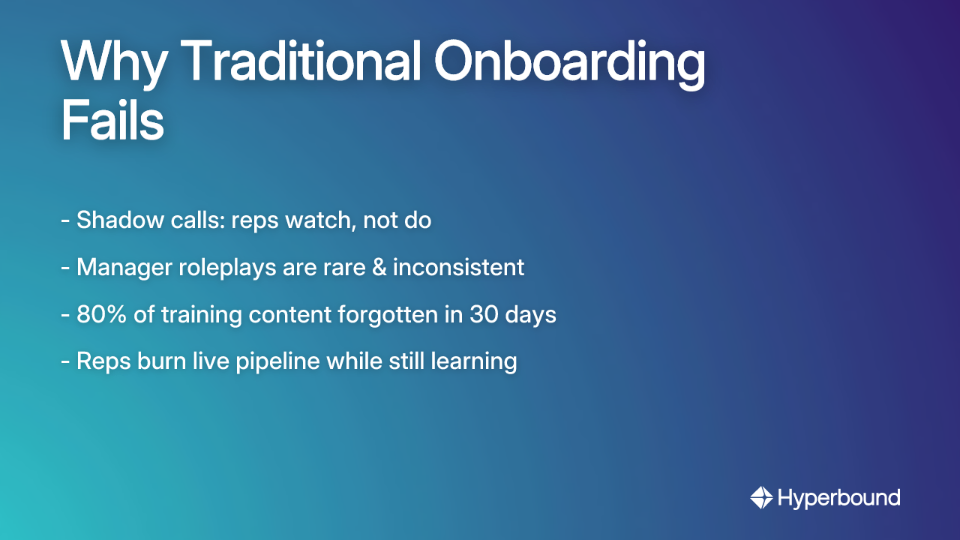
The downstream consequence is predictable: reps burn pipeline while they're learning. Their first calls set the trajectory of the relationship — and those calls happen before they're ready.
The criticism of AI roleplay is fair — when it's applied generically. As one rep noted on Reddit: "ChatGPT just agrees and tells me why I'm right." Another added: "No, they are awful at context-based coaching." These are real limitations of generic AI tools that weren't designed for sales training.
But purpose-built AI roleplay is a different category entirely.
Hyperbound Practice doesn't run on generic scripts. Its AI buyer personas are built from analysis of over 2 million hours of real B2B sales conversations — which means the AI pushes back the way real buyers do, introduces unexpected objections, goes cold when reps pitch too early, and demands specifics when answers are vague. It's not a chatbot playing along. It's a simulation built from how actual deals are won and lost.
And that distinction matters enormously when you're trying to build real sales muscle.
Here's what this infrastructure gives new hires that the old model never could:

Practice alone isn't enough. The real engine of new hire sales ramp acceleration is a closed-loop system that connects practice to performance — and performance back to practice. Here's how it works:
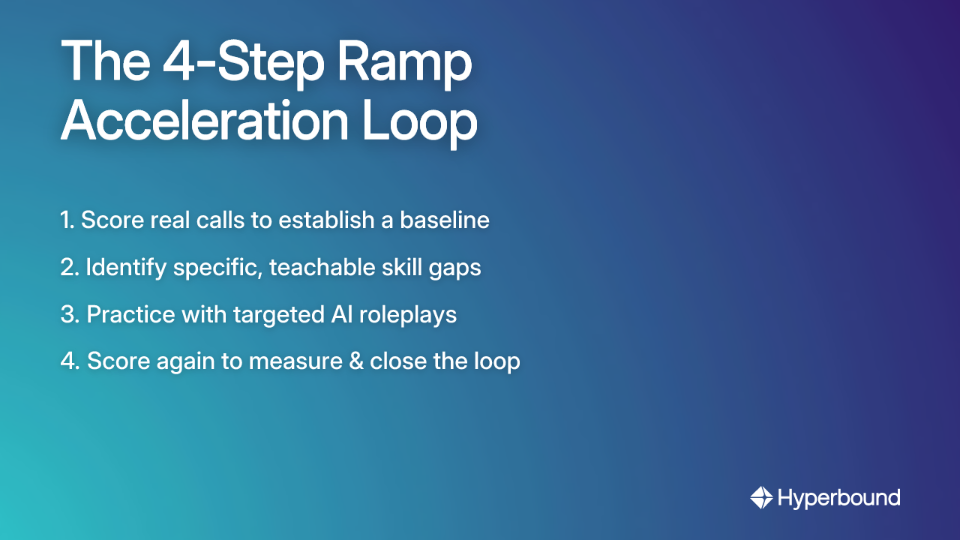
Step 1: Score Real Calls to Establish a Baseline
Before you can close skill gaps, you need to identify them. Hyperbound Perform automatically scores 100% of real conversations against your sales methodology. This surfaces exactly where new hires are underperforming versus your top reps, with data to back it up, not manager intuition.
Step 2: Identify Specific, Teachable Skill Gaps
With a scored baseline, you move from "this rep needs to improve" to "this rep fails to uncover budget before pitching" or "drops energy after the first objection." That specificity changes everything about how you train.
Step 3: Practice with Targeted AI Roleplays
Now you assign specific scenarios based on real gaps. A rep who fumbles pricing objections runs a series of sessions with an AI persona laser-focused on budget pushback. A rep who talks too much during discovery gets a persona that goes cold the moment they stop asking questions. For tenured reps who don't need full-length sessions, Bitesized Roleplays target one specific skill in under five minutes — removing the friction that kills adoption.
Step 4: Score Again to Close the Loop
As reps take their practice back into the field, their real calls get scored again. Improvement is tracked. New gaps surface. The cycle repeats: Score Real Calls → Identify Gaps → Practice Roleplays → Score Again. This is the mechanism that turns onboarding from a one-time event into a continuous performance system.
The operational loop above isn't theoretical. Two proof points illustrate the scale of what's possible.
Nivoda — a B2B jewelry marketplace — used AI roleplay to drill their reps on top-of-funnel conversations. The outcome: a 150% increase in their demo conversion rate, directly connecting practice repetition to pipeline generation. Rob Rangel, Director of Sales Performance, also reported a 50% reduction in ramp time and 2x revenue growth year-over-year.
Vanta faced a different challenge: scaling a BDR team rapidly without proportionally scaling manager hours. By implementing AI roleplay-driven onboarding, they cut ramp time by 60% — from 210 days down to 72. That compression allowed them to grow the BDR team 4x and generate 5x more pipeline. As Stevie Case, CRO at Vanta, noted, the ability to onboard at that speed without sacrificing quality changed the economics of their entire go-to-market motion.
Across the broader Hyperbound customer base, the aggregate results follow the same pattern: 50% faster ramp on average, 2x faster time to first won deal, and 3.5 workweeks of manager coaching time saved per team, per year. That last number matters — it's not just reps who benefit. Managers get time back to focus on deals, strategy, and the coaching conversations that actually require a human in the room.
The contrast between traditional onboarding and an AI roleplay-driven approach isn't subtle. Here's how the two models stack up across the dimensions that matter most:
.png)
The traditional model was never designed to scale. It was designed for a world where you had one manager, five reps, and enough time to run proper ride-alongs. That world is gone. Sales teams are bigger, sales cycles are more complex, and the cost of slow ramp has never been higher.
The AI roleplay model doesn't just fix what's broken — it builds infrastructure that compounds over time. As your library of scenarios grows, as your scorecards get more refined, as your AI personas get trained on more of your actual top-rep conversations, the entire system gets better. Every new hire who goes through it benefits from everything every previous hire has taught the system.
The manager coaching gap isn't going to be solved by asking managers to work more hours. It's going to be solved by building systems that don't depend on manager time to deliver the practice volume new hires actually need.
AI roleplay — deployed through the Score → Identify → Practice → Score loop — is that system. It turns onboarding from a passive, inconsistent, largely forgettable experience into a continuous, measurable, performance-driving engine. It gives reps hundreds of at-bats before their first real call. It gives managers back their time. And it gives revenue leadership something they've never had before: a clear, data-backed line between training and pipeline outcomes.
The companies seeing 50% ramp reductions and 4x team growth aren't relying on luck or heroic manager effort. They're running better infrastructure.
If you're still onboarding new hires the old way, you're not just leaving performance on the table — you're paying for it every day in burned leads, missed quota, and rep turnover.
Ready to change that? See how Hyperbound Practice can cut your ramp time in half.
AI sales roleplay is a training technology that allows sales representatives to practice real-world conversations with an AI-powered buyer persona. Unlike traditional methods, it provides a safe, scalable environment where reps can get hundreds of "at-bats" across scenarios like cold calls and objection handling, receiving instant feedback without burning live leads.
AI roleplay accelerates sales ramp time by giving new hires unlimited, on-demand practice and immediate feedback, allowing them to master skills much faster than waiting for manager-led sessions. This compressed learning cycle lets reps build confidence and competence before ever speaking to a real prospect. Companies using this approach have cut ramp time by as much as 60%.
AI roleplay is more scalable, consistent, and measurable than traditional training methods like shadow calls or manager roleplays. While traditional methods are capped by manager availability, AI allows an entire team to practice simultaneously, 24/7. It provides standardized, data-driven feedback, making it possible to track skill progression and connect training directly to performance.
No, AI roleplay is a powerful tool for both new and tenured sales representatives. While it's invaluable for accelerating new hire onboarding, experienced reps can use it to refine specific skills, prepare for high-stakes negotiations, or master new product messaging. Bitesized roleplays allow tenured reps to target a single skill in under five minutes.
Purpose-built AI for sales training is designed to simulate realistic buyer behavior and provide context-aware coaching, whereas generic AI often agrees with the user and lacks sales-specific context. Platforms like Hyperbound train their AI on millions of hours of real B2B sales calls, so the AI pushes back, raises relevant objections, and reacts like a real buyer, creating a far more effective training simulation.
Teams implementing AI roleplay can expect significant reductions in ramp time, increased pipeline generation, and more efficient use of manager coaching time. On average, Hyperbound customers see 50% faster ramp, a 2x faster time to the first won deal, and save 3.5 workweeks of manager coaching time per year.
No, AI roleplay does not replace sales managers; it empowers them by automating repetitive practice so they can focus on high-impact coaching. The system handles the high volume of foundational practice that managers lack the bandwidth to provide. This frees managers to focus on strategic deal reviews, complex scenarios, and personalized coaching that requires human expertise.








Use Cases
Legal