
Your team has more data than ever. Call recordings piling up, deal stages rotting in Salesforce, dashboards nobody opens after the first week. Yet for too many RevOps and Sales leaders, win rates are stubbornly flat and ramp times are still painfully long.
Sound familiar? You're not alone. Sales leaders across the industry are wrestling with the same paradox: more data, but no clear path to changing outcomes. The tools collect beautifully. They just don't activate.
That's the gap the next generation of AI revenue analyst tools is designed to close. They don't just diagnose what went wrong on a call last Tuesday — they prescribe what to do differently on the call tomorrow, and make sure your reps can actually do it.
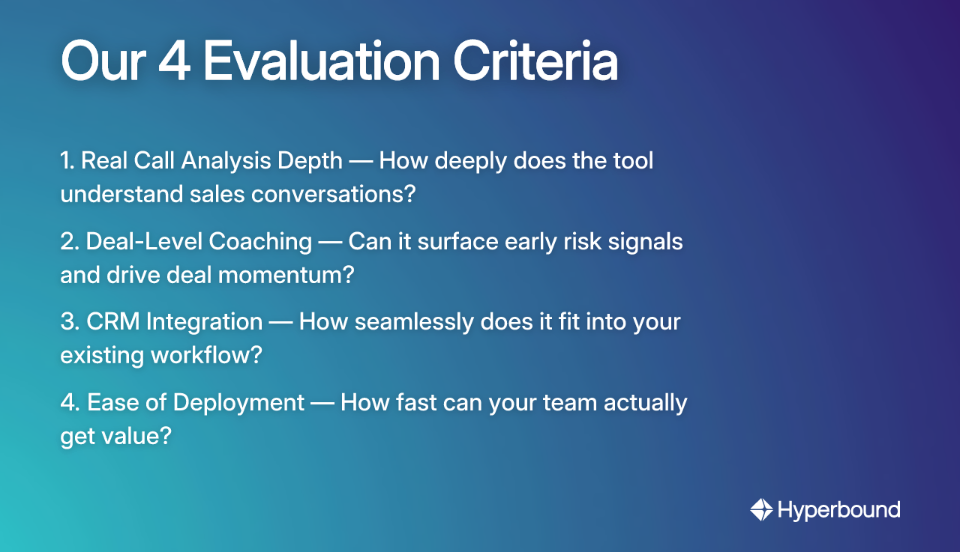
In this guide, we evaluate the 7 best AI revenue analyst platforms for sales teams in 2026 across four criteria that matter most for RevOps and Sales leaders making a buying decision:
Let's get into it.
Scores: Real Call Analysis Depth: ⭐⭐⭐⭐⭐ | Deal-Level Coaching: ⭐⭐⭐⭐⭐ | CRM Integration: ⭐⭐⭐⭐⭐ | Ease of Deployment: ⭐⭐⭐⭐
Hyperbound coined the Revenue Activation category for a reason: it's the only platform that closes the full loop from analyzing real sales conversations to actually changing rep behavior through hyper-realistic practice — and then orchestrating the whole cycle through an AI revenue analyst layer called Kota Activate.
Founded by ex-Salesforce Einstein lead Sriharsha "Sai" Guduguntla and ex-Meta Ads ML engineer Atul Raghunathan, and backed by Y Combinator, Hyperbound's three-product system works as a continuous improvement engine:
What makes Hyperbound genuinely different is the operational loop: Score Real Calls → Identify Skill Gaps → Practice Roleplays → Score Real Calls again. It's not a dashboard you check. It's a flywheel that compounds.
Customers at Vanta cut ramp time by 60% — from 210 to 72 days — while growing their BDR team 4x. LinkedIn deployed it to 3,000+ sellers across three business units. Nivoda saw a 150% increase in demo conversion and 2x revenue year-over-year.
With a 4.9/5 rating on G2, 45,000+ active users across companies like Autodesk, Monday.com, IBM, and Klaviyo, and enterprise-grade security (SOC 2 Type II, GDPR, ISO 27001, HIPAA), Hyperbound is built for teams that are serious about turning enablement into revenue.
Best For: Revenue teams ready to move past passive analytics and build a system that actively improves rep skills, execution consistency, and deal outcomes. Especially valuable for teams where ramp time and coaching scale are the top bottlenecks.
Scores: Real Call Analysis Depth: ⭐⭐⭐⭐ | Deal-Level Coaching: ⭐⭐⭐ | CRM Integration: ⭐⭐⭐⭐ | Ease of Deployment: ⭐⭐⭐⭐
Gong is the established market leader in conversation intelligence and remains one of the most powerful tools for capturing and analyzing customer-facing interactions. Its AI is trained on billions of interactions, making it highly effective at surfacing what winning talk tracks look like and flagging deal risk from conversation signals.
Where Gong falls short is the activation layer. It excels at helping managers identify coachable moments and build clip libraries — but it doesn't give reps a scalable, repeatable way to practice and apply that feedback. Diligent increased close rates by 7.4% after integrating Gong, which speaks to its real impact — and also to the ceiling teams hit when the tool stops at analysis.
Gong is also a native integration partner for Hyperbound, meaning teams often run both: Gong for deep call intelligence, Hyperbound to activate those insights through targeted coaching and practice.
Best For: Enterprise and high-growth teams that need best-in-class call analytics and deal risk identification. A strong foundation that pairs well with an activation layer.
Scores: Real Call Analysis Depth: ⭐⭐⭐ | Deal-Level Coaching: ⭐⭐⭐⭐ | CRM Integration: ⭐⭐⭐⭐⭐ | Ease of Deployment: ⭐⭐⭐
Clari is the go-to choice for revenue operations teams that need to nail forecast accuracy and pipeline visibility at an executive level. Its AI pulls from CRM data, email activity, and calendar signals to build high-fidelity forecasts and flag pipeline risk before it becomes a miss.
The limitation is that Clari is a strategic layer, not a coaching layer. It's excellent at telling managers which deals need attention. It's less equipped to help reps understand how to execute the conversations that save those deals. Implementation is also known to be resource-intensive, requiring significant RevOps bandwidth to configure and maintain.
Best For: Mature RevOps teams in enterprises with complex sales cycles who need accurate forecasting and pipeline inspection for leadership stakeholders.
Scores: Real Call Analysis Depth: ⭐⭐⭐⭐ | Deal-Level Coaching: ⭐⭐ | CRM Integration: ⭐⭐⭐⭐⭐ | Ease of Deployment: ⭐⭐⭐⭐
Salesforce Einstein is the AI layer baked into Sales Cloud — which means it benefits from being native to the world's most widely adopted CRM. It provides solid opportunity scoring, activity capture, and conversation insights (Einstein Conversation Insights) without requiring a separate tool for teams already invested in Salesforce.
The tradeoff is depth of coaching. Einstein is an analytics and productivity engine, not a coaching development platform. It's excellent at surfacing signals (lead scores, deal risk flags, task automation) but provides limited capability to develop the specific rep skills needed to act on those signals. As one sales rep noted in a discussion on CRM tools, Salesforce often feels "more for the employer's metrics and record keeping" than for helping reps actually sell better. Einstein improves on this, but the coaching gap remains. Crexi famously saved reps 5 hours a day in admin tasks using Salesforce AI — a real efficiency win, even if it doesn't directly build selling skills.
Best For: Sales teams deeply embedded in the Salesforce ecosystem who want to maximize the intelligence already inside their CRM without adding another platform.
Scores: Real Call Analysis Depth: ⭐⭐⭐⭐ | Deal-Level Coaching: ⭐⭐⭐ | CRM Integration: ⭐⭐⭐⭐ | Ease of Deployment: ⭐⭐⭐⭐
Chorus.ai, now part of ZoomInfo, offers solid conversation intelligence with one meaningful differentiator: the ability to layer ZoomInfo's market and contact data directly onto call analysis. This gives teams a richer context on who they're talking to and how market trends are showing up across conversations.
It's a strong tool for teams already invested in the ZoomInfo ecosystem, though its coaching capabilities are largely limited to flag-and-review workflows similar to Gong. The activation layer — the practice mechanisms that drive actual behavior change — isn't part of the offering.
Best For: Sales teams that are heavy ZoomInfo users and want to enrich call analysis with third-party prospect and market intelligence.
Scores: Real Call Analysis Depth: ⭐⭐⭐ | Deal-Level Coaching: ⭐⭐⭐ | CRM Integration: ⭐⭐⭐⭐ | Ease of Deployment: ⭐⭐⭐⭐⭐
Salesloft is a comprehensive sales engagement platform that manages the full workflow — cadences, dialer, email, meetings, and conversation intelligence — in a single place. If your primary challenge is orchestrating multi-channel outreach and you want one vendor to cover it all, Salesloft's breadth is hard to beat.
As a dedicated AI revenue analyst tool, though, it's more generalist than specialist. The conversation intelligence and coaching features are functional but not the deepest in the market. Teams with specific coaching or call analysis needs will likely find they're hitting ceilings.
Best For: Teams looking for a single platform to manage the entire sales engagement workflow, who value simplicity of stack over depth of any individual capability.
Scores: Real Call Analysis Depth: ⭐⭐⭐ | Deal-Level Coaching: ⭐⭐⭐ | CRM Integration: ⭐⭐⭐⭐ | Ease of Deployment: ⭐⭐⭐⭐
Revenue.io stands out in the market for its focus on real-time coaching — surfacing prompts, talk tracks, and content suggestions during a live call. For inside sales teams with complex products, this can meaningfully improve conversation quality in the moment.
The risk is dependency. Real-time prompts are powerful, but they can become a crutch that limits long-term skill development. Without a practice layer to build foundational competency, reps may improve on coached calls but struggle the moment the guardrails come off. Historical analysis capabilities are also less developed compared to purpose-built platforms like Gong or Hyperbound.
Best For: Inside sales teams with complex products who want to reduce variance in live conversations through in-the-moment guidance.
.png)
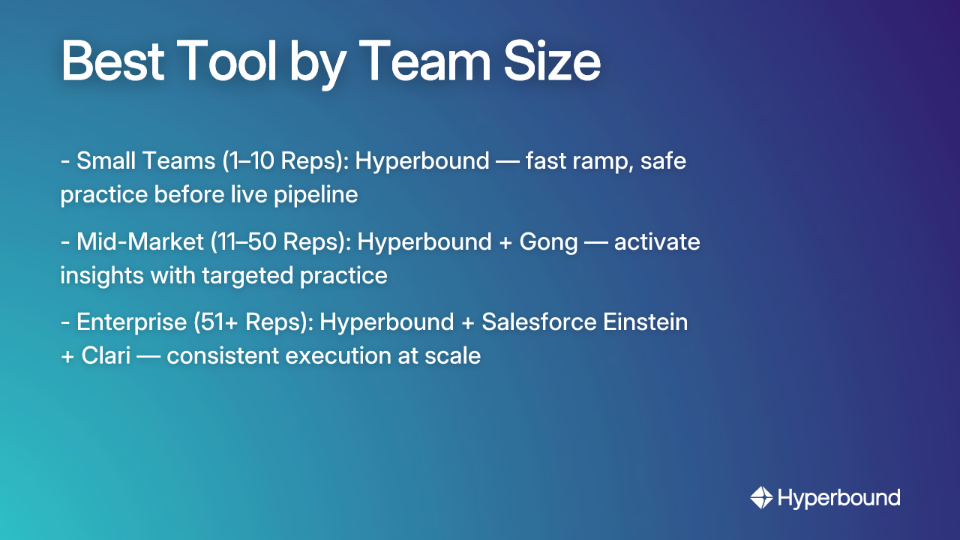
🏢 Small Teams (1–10 Reps)If every rep you hire has to get productive fast, ramp time is your most expensive variable. Hyperbound is the ideal starting point — its structured practice environment means new hires build real skills before they touch live pipeline. You're not burning deals while reps learn. Start with Hyperbound Practice, and layer in Perform as your call volume grows.
📈 Mid-Market Teams (11–50 Reps)This is where the Hyperbound + Gong combination shines. Use Gong to identify patterns across your call library — what's working, what's not, where deal momentum is stalling. Use Hyperbound to activate those insights: turn the coachable moments Gong surfaces into targeted practice reps actually complete. If forecasting accuracy and pipeline discipline are your top priority, Clari also becomes a strong contender at this stage.
🏭 Enterprise Teams (51+ Reps)The enterprise challenge isn't finding insights — it's scaling consistent execution across hundreds or thousands of reps across regions, segments, and business units. Hyperbound + Salesforce Einstein + Clari is a natural enterprise stack: Einstein for native CRM intelligence, Clari for executive-level forecasting, and Hyperbound to ensure every rep is applying the right methodology, every time. Hyperbound's enterprise-grade integrations (Seismic, Highspot, SSO/SCIM) and 25+ language support make it built for global teams at scale.
In 2026, the question is no longer whether you have call data — it's what you're doing with it.
The tools that generate the most value aren't the ones with the biggest dashboards. They're the ones that close the loop between insight and behavior change: identifying where deals are at risk, recommending what to do about it, and ensuring reps have actually practiced the skills to execute.
That's the difference between Revenue Intelligence and Revenue Activation — and it's the difference between a tool that tells you what happened and one that changes what happens next.
If you're ready to stop watching your call data collect dust and start turning it into coaching that compounds, see what Hyperbound can do for your team.
An AI revenue analyst is a tool that automatically analyzes sales data from calls, CRM entries, and other interactions to identify risks, surface opportunities, and prescribe specific coaching actions. It goes beyond simple dashboards to actively guide sales execution and improve rep performance.
Conversation intelligence tools primarily focus on analyzing past conversations to provide insights. An AI revenue analyst takes the next step by using those insights to create a full feedback loop. For example, a platform like Hyperbound uses call analysis to identify skill gaps and then automatically assigns targeted AI-powered practice roleplays to reps, ensuring insights lead to actual behavior change.
Revenue Activation is the process of turning sales data and insights into concrete actions that change rep behavior and improve deal outcomes. It's the difference between a dashboard that tells you what happened and a system that changes what happens next, creating a continuous cycle of analysis, targeted practice, and performance improvement.
Sales leaders, RevOps professionals, and enablement teams see the most significant benefits. Sales leaders can scale coaching and reduce ramp time. RevOps can ensure consistent process execution and gain deeper pipeline visibility. Enablement teams can directly link training to on-the-job performance. Individual reps also benefit from personalized, on-demand coaching.
While deployment times vary, modern platforms can be set up in days or weeks, not months. Tangible results can be seen quickly as reps begin to practice and apply new skills. For instance, Hyperbound customers have reported seeing a 60% reduction in ramp time within the first few quarters of implementation.
Yes, seamless CRM integration is a critical feature for leading AI revenue analyst platforms. Deep integrations allow these tools to pull deal data for context, automatically log activities to reduce admin work, and push coaching insights directly into the systems your team already uses every day.










Use Cases
Legal