You've just hired a promising new sales rep. Their resume looks great, they aced the interview, and they're eager to start closing deals. There's just one problem: they're green. How do you transform this new hire into a revenue-generating machine without letting them practice on your actual customers?
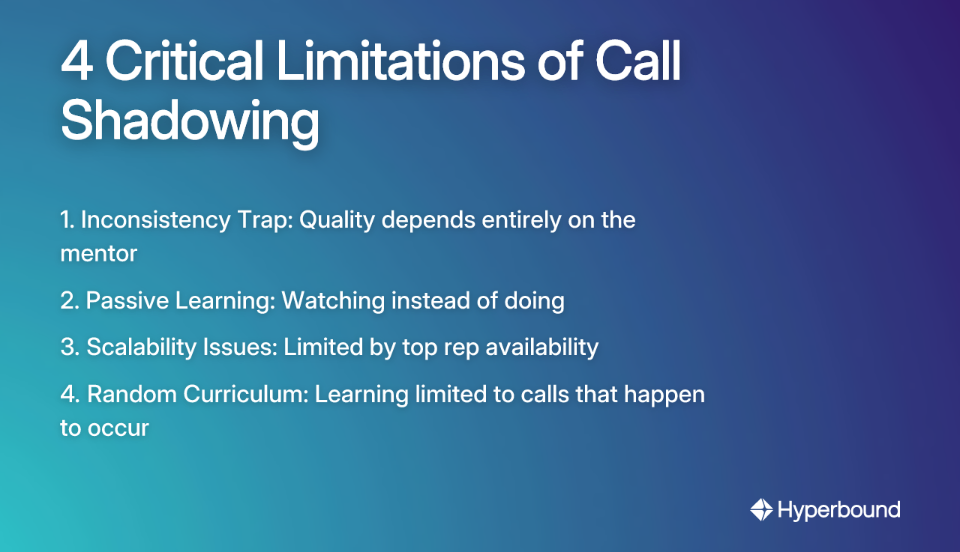
For decades, the answer has been call shadowing—having new reps silently observe experienced team members on live calls. It's been the default training method for generations of sales leaders. But in today's high-pressure sales environment, where ramp time is measured in weeks, not months, is passive observation really the best we can do?
The truth is that while shadowing provides some context, it's an inconsistent, unscalable, and fundamentally passive learning experience. The modern alternative—AI mock calls—offers a controlled, repeatable, and data-driven environment that accelerates skill development, builds confidence, and drives better sales outcomes.
Before we dismiss call shadowing entirely, let's acknowledge why it became the go-to training method in the first place.
Shadowing does provide new reps with a higher level of context than simply reading a training manual. They get to experience the natural flow of customer conversations, complete with unexpected twists and turns. In theory, trainees can observe multiple mentors to learn diverse selling styles, and with structured pre-call preparation and post-call debriefs, shadowing can encourage some degree of active learning and reflection.
AI-powered mock calls address each of these fundamental flaws while offering additional benefits that traditional shadowing simply cannot match.
Unlike shadowing, AI mock calls shift learning from passive to active. New reps aren't just observers—they're participants, actively practicing their pitch, handling objections, and navigating conversations in real-time. It's like having a flight simulator for sales.
This creates a controlled environment where reps can make mistakes, test different approaches, and build genuine confidence without the pressure of a live deal on the line. This type of safe-to-fail practice is proven to accelerate skill acquisition and retention far more effectively than passive observation.
Perhaps most importantly, AI is available 24/7. A rep can run through a discovery call scenario ten times in a row before their first real customer meeting, cementing the talk track in their mind. This solves the scalability problem entirely—your entire sales team can practice simultaneously without depending on the limited time of your top performers.
One of the biggest challenges in sales onboarding is ensuring every rep delivers your company's value proposition and follows your sales methodology consistently. AI mock calls excel here by guaranteeing that:
Every Rep Masters the Same Playbook: AI ensures each rep is trained on the exact same, approved sales methodology and messaging. This eliminates the "rogue" techniques often learned during inconsistent shadowing sessions with different mentors who may have their own styles and shortcuts.
Quality at Scale: Whether you're onboarding one rep or one hundred, the quality and content of the training remain consistently high. The AI doesn't have "off days" or get distracted by its own pipeline.
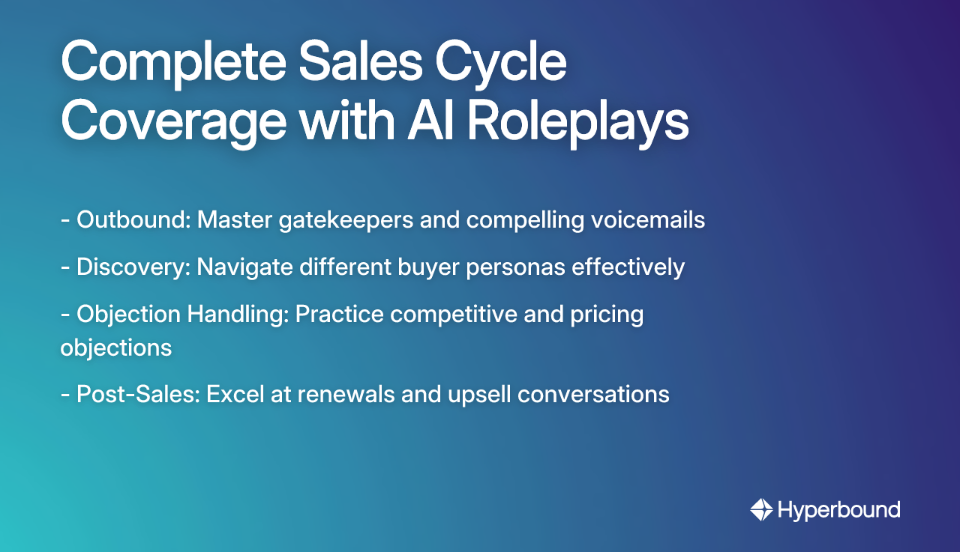
With traditional shadowing, a new rep might never hear how to handle a specific objection or buyer persona if it doesn't come up during their limited observation period. AI mock calls solve this problem completely:
Simulate the Unpredictable: AI can be programmed to simulate any buyer persona or sales scenario on demand, filling the gaps left by random shadowing experiences.
Comprehensive Coverage: Platforms like Hyperbound allow you to create roleplays for every stage of the sales cycle:
This comprehensive coverage ensures no rep enters a real sales conversation unprepared for what they might encounter.
After a traditional shadowing session, feedback is often subjective ("I think that went well") and delayed. AI mock calls transform this experience:
Objective Call Coaching: AI provides instant, unbiased feedback based on data rather than opinion. There's no waiting for a manager to have time for a debrief.
Actionable Performance Metrics: Advanced AI tools analyze calls and provide concrete metrics. Hyperbound's AI Real Call Scoring tracks factors like talk-to-listen ratio, how effectively objections were handled, and whether key value propositions were mentioned.
Targeted Improvement: This data empowers managers to provide highly specific, context-based coaching, addressing the exact areas where a rep is struggling, rather than offering generic advice based on limited observation.
Despite the clear advantages, some sales professionals remain skeptical about AI's ability to effectively coach sales skills. Let's address these concerns directly:
This is a valid concern for simplistic, generic AI tools. However, advanced platforms like Hyperbound's AI Coaching excel at context because they are highly customizable. The platform can be tailored to your specific Ideal Customer Profiles (ICPs), products, and sales methodology. The AI is coached on your playbook, making its feedback deeply contextual to your specific sales environment.
Absolutely true. But we should question what "the job" really means. Is it fumbling through a live call with a real prospect who might take their business elsewhere after a poor experience? Or is it practicing that exact scenario 15 times in a simulator until you're flawless? AI mock calls are the closest you can get to "on-the-job" learning without risking revenue or customer relationships.
The value of AI mock calls isn't magic; it's math. More practice leads to higher confidence. Consistent messaging leads to better qualification. Data-driven feedback leads to faster skill acquisition. These factors directly contribute to measurable business outcomes:
Platforms like Hyperbound are built by analyzing thousands of real winning sales calls to identify what actually works, grounding the training in proven success patterns rather than theory.
Rather than viewing this as an either/or decision, the most effective sales organizations are adopting a blended approach that leverages the strengths of both AI mock calls and traditional shadowing:
New reps spend their first weeks in the AI "gym." They build foundational skills and confidence by mastering the pitch, core discovery questions, and common objections in a safe environment. This ensures they have the basic mechanics down before being exposed to live customer interactions.
After building a strong foundation, reps shadow senior team members. Now, the shadowing is far more valuable because they have a framework to understand what they're observing. They can recognize the techniques they've practiced, understand the nuances, and ask much more intelligent questions in the post-call debrief.
Reps begin taking live calls, but with a manager listening in to provide support and real-time feedback, bridging the gap between practice and full independence. The manager can provide guidance based on both the AI training benchmarks and their own experience.
Relying solely on call shadowing is an outdated, inconsistent, and unscalable training strategy that leaves new reps unprepared for the diversity of real-world sales conversations. It's like trying to learn tennis by watching Wimbledon—you might pick up some techniques, but you'll never develop the muscle memory needed to actually play the game well.
AI mock calls provide the active, consistent, and data-driven practice reps need to build real confidence and master their craft quickly. They are the key to reducing ramp time and improving sales outcomes in today's competitive environment.
The future of sales onboarding isn't about replacing humans with AI, but rather augmenting human coaching with scalable AI practice tools. By combining the unlimited practice opportunities of a platform like Hyperbound with the nuanced mentorship of experienced reps, you create a truly world-class training program that delivers results.
AI mock calls are interactive training simulations where sales representatives practice conversations with an AI-powered "buyer" in a risk-free environment. These simulations allow reps to practice their pitch, handle objections, and navigate various sales scenarios 24/7. Unlike passive listening, it's an active learning tool that builds muscle memory and confidence before they engage with real customers.
AI mock calls are superior to call shadowing because they provide a consistent, scalable, and active learning experience with data-driven feedback, whereas shadowing is often inconsistent, unscalable, and passive. With AI, every rep practices the same approved playbook, ensuring standardization. They can practice any scenario on demand, filling gaps left by the "luck of the draw" nature of shadowing. This active practice in a safe environment accelerates skill development far more effectively than simply observing others.
AI mock calls accelerate ramp time by providing unlimited, on-demand practice opportunities, allowing reps to build core skills and confidence much faster than traditional methods. Instead of waiting for a senior rep's availability, new hires can run through dozens of call scenarios, mastering objection handling and product messaging in their first few weeks. This intensive, focused practice ensures they are prepared for real customer conversations sooner, leading to quicker productivity and shorter time to quota attainment.
Yes, modern AI can provide highly effective sales coaching by delivering instant, objective, and data-driven feedback based on pre-defined best practices and your company's specific playbook. Advanced platforms are not generic; they are customized to your products, buyer personas, and sales methodology. The AI analyzes performance on metrics like talk-to-listen ratio and key message delivery, providing targeted feedback that helps reps improve specific skills without the subjectivity or delay of human-only coaching.
AI mock calls can simulate a comprehensive range of scenarios across the entire sales cycle, from initial outbound prospecting to discovery, objection handling, and even post-sales conversations like renewals and upsells. You can program the AI to act as different buyer personas (e.g., a skeptical CFO, an eager technical buyer) and raise specific challenges, such as competitive mentions or pricing objections. This ensures reps are prepared for virtually any situation they might face in the field.
No, the most effective approach is a blended model that uses AI mock calls for foundational training and skill-building, followed by call shadowing for contextual understanding. Reps should first build confidence and master the basics in the AI "gym." Then, when they shadow experienced reps, they have the framework to better understand the nuances of live calls. This combination leverages AI for scalable practice and human mentors for high-level strategic insight.
Don't let your new reps practice on your customers. See how Hyperbound's AI Sales Roleplays can transform your team's readiness and performance from day one—because in sales, confidence comes from preparation, and preparation comes from practice.









Use Cases
Legal