
Organizations that run Highspot or Seismic maintain a governed repository of battlecards, playbooks, pitch decks, and competitive content. That investment is not going away. The merger announced on August 18, 2026 consolidated two of the category's largest players into a single go-to-market performance company, and existing customers have been told no action is required.
The platform question is largely settled. The unresolved question is where an AI agent's knowledge comes from when it is layered onto a go-to-market motion, and how it learns to use content the organization has spent months curating.
A content platform stores that content for people. Kota CMS is where an agent learns how to use it.
The merger's stated purpose frames the direction clearly: the combined company is focused on helping people and AI agents take action in the moments that influence customer relationships and revenue. The emphasis on both audiences is not incidental. Sales content repositories are increasingly expected to serve two fundamentally different consumers.
People can infer context. A rep who opens a battlecard understands instinctively that it is for competitive objection handling, that it applies to a specific segment, and that the third section is less relevant for renewal calls. That inference is invisible and effortless.
AI agents do not infer context. An agent can read the text of every document in a library, but it cannot determine when to use a given asset, for which persona, at which stage of the sales cycle, or under which qualification framework. When only humans read content, inconsistent organization was a productivity issue. When an agent acts on that content without rules, it produces inconsistent outputs with no audit trail.
This is the gap that neither Highspot nor Seismic was designed to close, because they were built before agents were a meaningful audience.
Before an agent can apply content, access is required through a connector layer.
Highspot's own MCP Server is an example of this pattern. As of August 2026, it exposes a set of tools and actions, including content search, deal-specific answers, and content recommendations, to external AI agents from OpenAI, Anthropic, Microsoft Copilot, and others. The MCP Server connects those agents to trusted content, training, governance insights, and actions inside the Highspot platform.
Seismic's Aura follows the same principle: as of August 2026, it surfaces permissioned, governed content and GTM context to AI execution layers.
These are read-and-retrieve layers. They establish what content exists and whether the agent can access it. That is a necessary foundation, not a sufficient one.
A connector tells an agent what is in the library. It does not tell the agent how to use any of it.
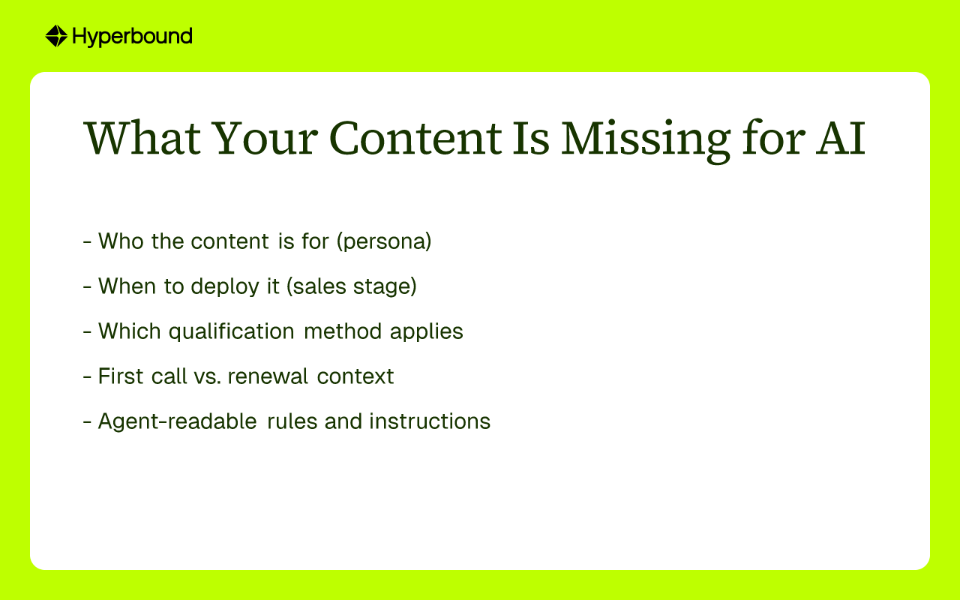
Most AI implementations lack this layer.
A document in a Highspot or Seismic library contains a specific asset type. A pitch deck carries slides. A call script carries language. A battlecard carries competitive positioning. None of these assets contains instructions for the agent: who this is for, when to deploy it, what qualification methodology governs its use, or whether it applies to first calls but not renewal conversations.
Documents in these libraries were not written as instructions for AI agents. The translation into agent-readable rules is a separate step, one that requires human review and approval before it is applied.
Kota CMS calls this layer Guidelines. Guidelines are per-workflow, per-context rules that sit between the content source and the agent. Examples:
Guidelines are not inferred automatically and applied without oversight. They are surfaced by Kota CMS, reviewed by the revenue or enablement team, and approved before the agent acts on them. This keeps a human in the loop at the point where interpretation becomes instruction.
The result is that Highspot or Seismic content does not change. Its organization does not change. What changes is that an agent now has a governed, explicit set of rules for how to apply that content across every workflow it touches.
The category that addresses this problem is agentic content management. The definition is precise: one governed place for the knowledge sales teams sell with, read by the agent and applied across everything the agent does.
Governance is the central requirement. Both Highspot and Seismic have built content governance into their core products. As of August 2026, Highspot's AI agents are grounded in approved content and GTM knowledge, with built-in governance as the mechanism that lets teams act with confidence. Seismic's Aura combines trusted business context, governed content, and AI execution.
The incumbents are right that governance is central. The distinction is scope. Highspot and Seismic govern which content an agent can access. Agentic content management governs how the agent interprets and applies that content across every downstream workflow, not just the ones native to the platform.
When a human misreads a battlecard, the cost is a single conversation. When an agent applies an outdated or misconfigured rule across hundreds of calls, the cost is systemic. The governance requirement scales with the agent's reach.
Kota CMS addresses this with three specific mechanisms:
Kota CMS provides full transparency at every rule change. That is a design requirement.
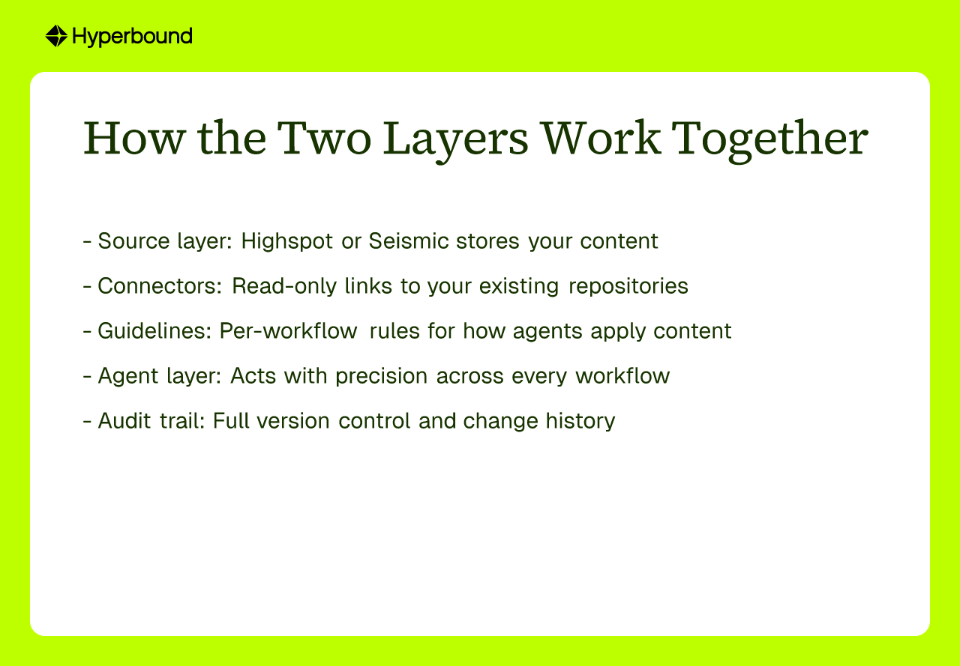
The two layers are complementary.
Source layer (Highspot or Seismic): Remains the governed repository for content files. Reps continue to find, share, and track assets through the platform they already use. The Highspot AI integration that organizations rely on for search and recommendations continues to function exactly as before.
Agentic layer (Kota CMS): Sits on top and provides the rules and context AI agents need to act. Kota CMS connects to Highspot, Seismic, and other sources including Notion, Google Drive, and SharePoint through read-only Connectors that require no edit permissions. It then applies the Guidelines layer to translate that content into instructions the agent can follow with precision.
This means platforms do not need to be migrated. Content does not need to be re-uploaded or reorganized. The agent learns from the content where it is already stored. The concern that content becomes locked inside a single system is addressed at the connector level: Kota CMS reads from sources rather than replacing them, which means content remains in the authoritative repository the organization manages.
The practical effect is that an agent working inside a Hyperbound workflow draws on Guidelines derived from Highspot or Seismic content, applied to the right persona, the right sales stage, and the right qualification criteria, without a rep having to manually specify any of that context in the moment.
Investment in Highspot or Seismic built the library. Kota CMS adds the intelligence layer that teaches AI agents how to use every resource in the library, with a full audit trail and without requiring migration.
Kota CMS is a paid add-on from Hyperbound, currently in private preview. Private preview capabilities, scope, and availability are subject to change as we continue development and incorporate customer feedback.
To add the agentic content management layer to your existing sales stack, request access through your Hyperbound account manager.
If your team is re-evaluating the underlying sales content platform rather than adding an agentic layer to it, the Highspot vs. Seismic vs. Hyperbound comparison and the Highspot and Seismic alternatives guides cover that decision in full.
Kota CMS is Hyperbound's agentic content management layer that teaches AI agents how to use the sales content organizations already store in Highspot, Seismic, Notion, Google Drive, or SharePoint. It sits on top of existing content repositories rather than replacing them. It adds governed, per-workflow Guidelines, version control, audit trails, and transparency so AI agents can apply the right content to the right persona, sales stage, and qualification framework.
Kota CMS connects to Highspot through a read-only Connector, so content remains in Highspot as the governed source of record. Highspot's own MCP Server can expose content search and recommendations to AI agents, but Kota CMS adds a Guidelines layer that tells the agent when and how to use that content. No migration, re-uploading, or reorganization is required.
Kota CMS connects to Seismic through a read-only Connector and layers agent-readable Guidelines on top of an existing Seismic library. Seismic Aura focuses on surfacing permissioned, governed content and GTM context to AI execution layers. Kota CMS extends that by governing how agents interpret and apply the content across downstream workflows such as cold call bots and scorecards.
Agentic content management is a governed system for the knowledge sales teams sell with, designed to be read by AI agents and applied across everything they do. Unlike traditional content management built for human readers, it includes machine-readable rules, version control, audit trails, and transparency so agents use content consistently and accountably.
No. Kota CMS is designed to be additive. It connects to Highspot, Seismic, and other sources through read-only Connectors, so content remains in its existing repository. Organizations do not need to move files, re-upload assets, or change the organization inside Highspot or Seismic. The agent learns from the content where it is already stored.
Guidelines are per-workflow, per-context rules that sit between the content source and the AI agent. They specify details such as the target persona, sales stage, qualification methodology, and when a document should or should not be used. For example, a Guideline can tell a cold call bot to assume a VP Sales persona at mid-market SaaS or tell scorecards to use BANT.
Kota CMS records a complete history of which files generated which Guidelines, so teams know exactly what an agent learned from each document version. It also logs every rule change with before-and-after diffs and maintains a full record of connected applications and uploaded files. Nothing is applied without human review and approval.
Highspot's MCP Server is a read-and-retrieve layer that tells an agent what content exists and lets it access trusted content, training, and recommendations. Kota CMS is an interpretation and application layer that tells the agent how to use that content in specific workflows. Connectors establish what content exists and whether the agent can access it; Kota CMS answers how this content should be applied for this persona, stage, and methodology.
AI agents cannot infer context the way humans do. They can read the text of every document, but they cannot determine when to use an asset, for which persona, at which stage, or under which qualification framework. Without explicit rules, an agent produces inconsistent outputs with no audit trail. Governed rules turn content from an information source into actionable instructions.
Yes. In addition to Highspot and Seismic, Kota CMS connects to sources such as Notion, Google Drive, and SharePoint through read-only Connectors. This means teams can consolidate agent-readable Guidelines across multiple repositories without moving or duplicating content. The same governance, version control, and audit trail apply across all connected sources.










Use Cases
Legal