
You've invested in a CRM system to better manage your customer relationships and sales pipeline. But when you log in to forecast this quarter's numbers, you find yourself once again manually adjusting data, double-checking outdated information, and second-guessing the system's predictions. Despite all your efforts, your forecasts still miss the mark by 20% or more, leaving you scrambling to explain the variance to stakeholders.
These frustrations aren't unique. Across industries, professionals are discovering that traditional CRM forecasting—reliant on manual inputs and static algorithms—fails to deliver the accuracy needed in today's dynamic business environment. As one frustrated user put it, "There should be no reason to have to 'manually update' a contact or lead's status" in a modern system.
Beyond the endless manual updates lies a more fundamental problem: many CRM platforms are essentially "30-year-old tech trying to take an old codeset and add something fundamentally different." The result? AI features that are "mostly hype right now," leaving users underwhelmed and skeptical.
But amid the disappointment, a revolution is underway. AI-driven forecasting is transforming CRMs from static databases into intelligent prediction engines that dramatically improve accuracy, eliminate tedious data entry, and deliver actionable insights that drive business growth.
Traditional CRM forecasting suffers from fundamental weaknesses that limit its effectiveness and reliability:
.png)
The Data Quality Dilemma: Poor data quality is the Achilles' heel of traditional forecasting. With average data accuracy in CRMs under 80%, organizations face significant consequences:
Reactive Rather Than Proactive: Legacy systems are fundamentally reactive, analyzing what happened rather than what will happen. This explains why 81% of organizations using traditional CRMs struggle to predict customer churn accurately.
Manual Processes and Human Error: The reliance on manual data entry creates bottlenecks and introduces errors. As one user lamented, "the one workflow that AI should eliminate today is data entry." This manual burden isn't just annoying—it's costly. Studies show that 52% of sales leaders report lost opportunities directly due to CRM inefficiencies.
Data Silos and Integration Problems: Traditional CRMs often create isolated data repositories that don't communicate effectively with other business systems. These silos can cause a 20% decrease in customer satisfaction and make comprehensive forecasting nearly impossible.
AI-driven forecasting represents a fundamental shift in how CRMs operate and deliver value. Rather than simply recording data, these systems actively analyze patterns, predict outcomes, and recommend actions. Here's how AI is transforming CRM accuracy:
Dramatic Error Reduction: The most immediate benefit of AI-driven forecasting is significantly improved accuracy. Companies report improvements in forecast accuracy by 15% to 30% after implementing AI solutions. This precision comes from AI's ability to process vast datasets and identify complex patterns that humans would miss.
Real-Time Analysis and Adaptation: Unlike traditional systems that provide static reports, AI-driven forecasting continuously monitors data streams and adjusts predictions in real-time. This dynamic approach ensures that sales teams always work with the most current information and can respond rapidly to emerging opportunities or threats.
Data-Driven Decision Making: AI eliminates guesswork by providing data-backed recommendations at every stage of the pipeline. This enables teams to make confident decisions about resource allocation, opportunity prioritization, and risk management.
Core Technologies Powering the Revolution:

The power of AI-driven forecasting becomes clear when we examine specific applications that deliver tangible business value:
Predictive Lead Scoring: AI analyzes thousands of data points to identify which prospects are most likely to convert, allowing sales teams to prioritize their efforts effectively. This directly addresses the user need for AI to "help prioritize leads" and focus on high-value opportunities.
Churn Prediction and Prevention: By analyzing customer interactions, product usage, and support ticket history, AI can identify customers at risk of churning with remarkable accuracy. One case study found that an AI-powered CRM platform increased customer retention rates by 25% and reduced churn by 30% by triggering proactive retention workflows.
Dynamic Pricing Optimization: AI predicts a customer's willingness to pay based on historical data, market conditions, and competitive intelligence, enabling dynamic pricing strategies that maximize revenue without sacrificing conversion rates.
Automated Sentiment Analysis: AI detects shifts in customer sentiment from communications and triggers appropriate responses or alerts, eliminating the need for manual monitoring and interpretation.
The Business Impact: These capabilities translate into impressive results:
While the benefits are compelling, successful implementation requires a strategic approach:
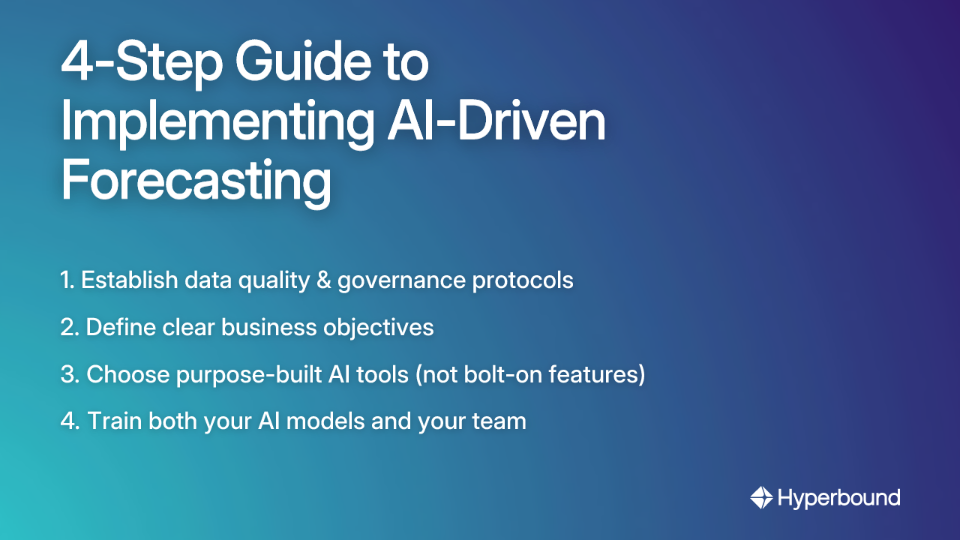
Step 1: Start with Data Quality & Governance
The foundation of effective AI forecasting is high-quality data. As industry experts often note, poor quality, outdated, or biased data can lead to inaccurate predictions. Before implementing AI solutions:
Step 2: Define Objectives & Choose the Right Tools
Identify specific business goals that AI forecasting should address, such as:
Then select AI tools that integrate seamlessly with existing systems while avoiding the "old codeset" problem mentioned by users. Look for solutions built from the ground up for AI rather than legacy systems with AI features bolted on.
Step 3: Train the Model & Your Team
AI models require training on high-quality historical data to deliver accurate forecasts. Equally important is training your team to:
Advanced Strategy for Data-Light Environments:
For organizations with limited historical data, consider these approaches:
As AI technology evolves, several emerging trends will further transform CRM forecasting:
Generative AI: Beyond prediction, generative AI will create content based on forecast data—drafting follow-up emails, generating call scripts, and creating personalized marketing materials. This directly addresses user needs for "email writing assistance" and "creating text and emails suggestions." This also paves the way for AI-powered sales coaching, where reps can practice delivering these new scripts in realistic AI roleplays to ensure they are ready for any customer conversation.
Advanced NLP & Emotion Detection: Next-generation AI will understand nuance, sarcasm, and emotional cues in customer communications, enabling hyper-personalized interactions and more accurate sentiment analysis.
Ethical Considerations: As AI becomes more powerful, ethical questions around data privacy, transparency, and compliance with regulations like GDPR and CCPA will become increasingly important. Organizations must balance the benefits of AI forecasting with responsible data stewardship.
AI-driven forecasting fundamentally transforms CRMs from systems of record to systems of intelligence. By automating data entry, providing predictive insights, and continuously learning from new information, AI addresses the most significant pain points users experience with traditional CRMs.
The result is not just improved accuracy but a complete reimagining of how organizations understand and engage with customers. In this new paradigm, sales and marketing teams spend less time managing data and more time acting on insights that drive growth and build lasting customer relationships.
For businesses ready to move beyond the limitations of traditional forecasting, AI offers a path to unprecedented accuracy, efficiency, and competitive advantage. The question is no longer whether to adopt AI-driven forecasting, but how quickly you can implement it to stay ahead in an increasingly data-driven world.

AI-driven CRM forecasting uses artificial intelligence technologies like machine learning and predictive analytics to analyze vast amounts of data and predict future sales outcomes with much higher accuracy than traditional methods. Unlike the static, rule-based forecasting in legacy CRMs, AI models continuously learn from new data—including customer interactions, market trends, and historical performance—to adapt their predictions in real-time. This transforms the CRM from a simple data repository into an intelligent system that provides actionable, forward-looking insights.
AI improves sales forecast accuracy primarily by identifying complex patterns and correlations in data that are invisible to humans and by eliminating errors from manual data entry. AI algorithms can process thousands of data points simultaneously, including historical sales data, customer behavior, and even unstructured information from emails and call notes (via NLP). This comprehensive analysis leads to more precise predictions, with companies reporting accuracy improvements of 15% to 30%.
Traditional CRM forecasting is often inaccurate due to its heavy reliance on manual data entry, poor data quality, and the use of static algorithms that cannot adapt to changing market conditions. With average CRM data accuracy below 80%, forecasts built on this foundation are inherently flawed. Furthermore, manual updates from sales reps can be subjective or outdated, and legacy systems lack the ability to analyze the vast datasets needed to make truly predictive assessments.
No, AI-driven forecasting is designed to augment, not replace, sales managers. It acts as a powerful tool that empowers them to make smarter, data-driven decisions. The goal of AI is to handle the heavy lifting of data analysis and prediction, freeing up managers to focus on strategic activities like coaching their teams, developing customer relationships, and closing complex deals. AI provides the "what," allowing managers to focus on the "why" and "how."
The first and most critical step is to ensure high-quality data. Before implementing any AI tool, you must audit your existing data for accuracy and completeness and establish strong data governance protocols. Once your data foundation is solid, you should define clear business objectives for what you want AI to achieve (e.g., reduce churn by 15%). Then, you can choose the right purpose-built AI tools and begin training both the AI models and your team on how to use the new insights effectively.
Predictive lead scoring is an AI-powered feature that analyzes prospect data to determine the likelihood of a lead converting into a customer. It goes beyond traditional scoring by incorporating behavioral data, engagement levels, and historical conversion patterns. This allows sales teams to prioritize their efforts on the leads with the highest potential, increasing efficiency and conversion rates.
While more high-quality historical data is always better, you don't necessarily need massive datasets to begin. Many modern AI models are designed to work effectively even in data-light environments. For organizations with limited internal data, strategies include incorporating external data sources (like market trends or economic indicators), using models designed for smaller datasets, and focusing on specific, well-defined use cases. The key is the quality and relevance of the data, not just the volume.










Use Cases
Legal