
At Hyperbound, we use our own product. We ran Hyperbound Perform internally as our primary AI deal coaching software. The result? We closed our strongest quarter ever. That is not a marketing claim. That is a practitioner's observation from a team that lives inside this problem every day.
This guide is written from that vantage point. If you are a VP of Sales or a frontline manager evaluating AI deal coaching tools, this walkthrough will tell you exactly what the software should do, how Perform works in practice, and where the category tends to overpromise.
The target keyword you came searching for is "AI deal coaching software," and it matters because the category is getting crowded fast. Understanding the difference between tools that report on deals and tools that actually change what your rep does in the next meeting is the most important distinction you can make right now.
Most sales leaders have experienced a version of this frustration. You review a call recording. You see something that went wrong. But by the time you surface it in a 1:1, the rep has already had two more meetings with that prospect. The moment has passed.
As sales practitioners on Reddit have put it, the real problem is the "inability to analyze trends across multiple interactions." Reviewing one call in isolation gives you a snapshot. Deals are not snapshots. They are sequences.
Here is what effective AI deal coaching software must actually deliver.
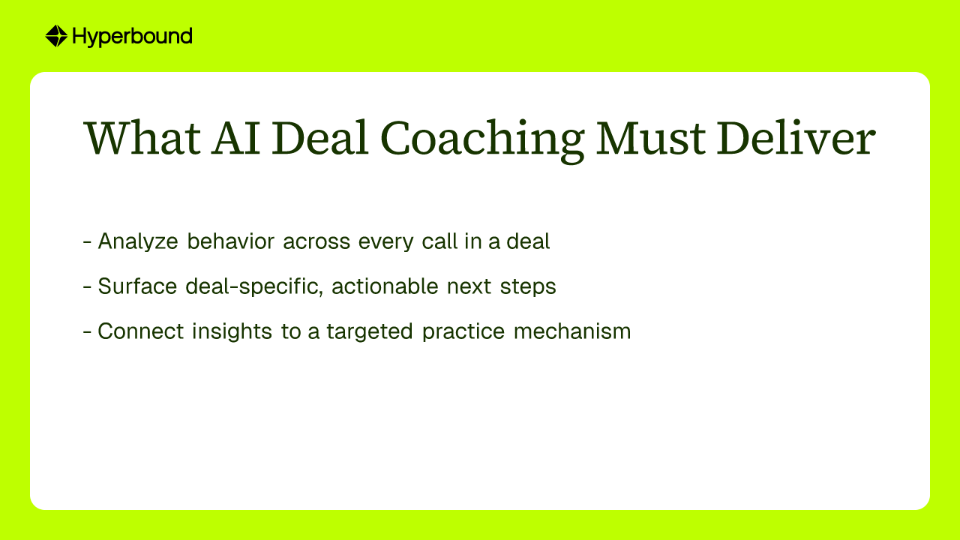
A rep does not lose a deal in one meeting. They lose it across four or five touchpoints where small missteps compound. A tool that scores call number two but ignores the pattern from calls one, two, and three is not coaching. It is auditing.
The right tool treats the entire opportunity as a unit of analysis. It connects signals across every touchpoint and reads the arc of the deal, not just the individual moment.
Transcripts alone do not close deals. As one sales ops practitioner noted on Reddit, "current AI tools struggle to provide proactive recommendations due to lacking comprehensive context." The tool needs to answer: what should this rep do differently in their next meeting with this specific account?
Descriptive data tells you what happened. Prescriptive coaching tells you what to do next. Only the second one changes outcomes in active deals.
Identifying a gap is the beginning, not the end. If a rep knows they struggled with a pricing objection but has no way to practice handling it before their next call, the insight is wasted.
Effective AI deal coaching closes that loop. It takes the specific risk inside a live deal and converts it into a targeted practice scenario the rep can complete before the next meeting.
Before the features, the proof. Vanta achieved a 60% reduction in ramp time using Hyperbound. Nivoda saw a 50% reduction. These numbers reflect what happens when coaching is connected directly to execution, not just observed from a distance.
Here is how Perform works as a deal coaching tool.
Perform does not treat each call as a separate event. It ingests every conversation tied to an opportunity and analyzes them as a sequence. This means it can surface patterns like: the champion went quiet after call two, or the pricing conversation was introduced too early relative to where the deal stood.
This is the difference between coaching a rep on a moment versus coaching them on a strategy. The deal arc view gives managers and reps the context they need to make smarter decisions on active opportunities.
Once Perform has analyzed the deal sequence, it automatically flags what is working and what is creating risk. It highlights behaviors driving the deal forward and behaviors likely to stall it.
Managers can use the Kota AI Assistant to ask natural-language questions about any deal. Questions like "What are the biggest risks in this account?" or "What has the rep failed to confirm?" return data-backed answers, not opinions.
This replaces the guesswork in deal reviews with specific, evidence-based observations. The conversation in your 1:1 shifts from "how do you feel about this deal?" to "Perform flagged that budget authority has not been confirmed in three calls. Here is how we fix that."
This is the closed loop that most conversation intelligence tools do not close. When Perform identifies a risk in a live deal, it can generate a targeted Bitesized Roleplay scenario built around that exact situation.
If a rep is facing a skeptical economic buyer and has not yet established ROI in their conversations, Perform creates a practice simulation for that scenario before the next meeting. Not a generic objection-handling drill. A simulation built from the signals inside the actual deal they are working.
Sales reps on Reddit have specifically called out that practice tools fail when they "produce robotic interactions that don't mimic natural conversation." Bitesized Roleplays are built from real deal context, which makes the practice feel directly relevant, not rehearsed.

Perform automatically scores calls against established sales methodologies like MEDDICC or SPICED, and it routes those scorecards based on meeting type and content. A discovery call gets scored as a discovery call. A late-stage negotiation gets scored differently.
It also reduces one of the most common sources of rep frustration: manual CRM data entry. Perform automatically fills CRM records with key details captured during calls with its native HubSpot integration (Salesforce coming soon). This ensures your deal data is always current without adding to your reps' workload.
Here is the contrast that matters most to frontline managers.
The old way. You ask your rep, "How is the Meridian deal tracking?" They give you their read. It is optimistic because reps are optimistic. You take notes, suggest a few things, and move on. The coaching is based on what the rep remembers and how they felt about it.
The new way with Perform. You come into the 1:1 with the deal arc already summarized. Perform has flagged that the champion has not spoken in the last two recorded meetings. It has noted that the business case has not been formally presented. It has scored the last discovery call against MEDDICC and identified that the "identified pain" field is still weak.
Your coaching conversation becomes: "Perform flagged that we have not locked in the economic buyer. We also still do not have a confirmed timeline. Before your Thursday call, here is a Bitesized Roleplay on navigating that conversation with a skeptical CFO. Let's debrief after."
This is the shift from gut feel to data-driven coaching. The most effective deal coaching combines human intuition with AI analysis. Perform handles the analysis, so the manager can focus on strategic judgment.
Both are necessary. Perform does not replace the manager. It removes the information gap that made coaching imprecise.
This is where the category needs a clear boundary. Several tools have expanded their positioning into adjacent territory, and the overlap creates confusion. Here is what AI deal coaching software should not be mistaken for.
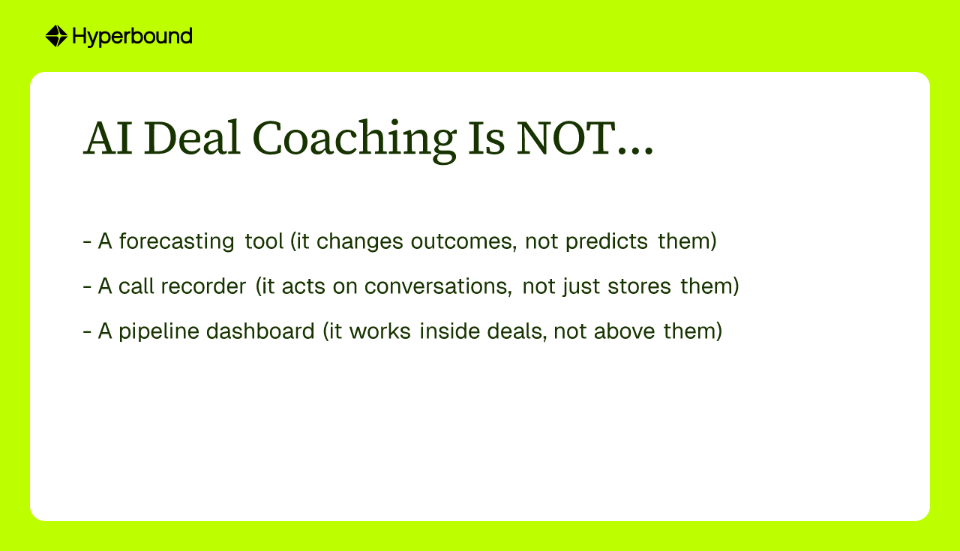
Forecasting tools predict whether a deal will close. AI deal coaching tools are designed to change whether a deal closes. The purpose is action, not prediction. Perform is not a forecasting tool. It does not tell you your Q3 attainment number. It tells you what to do differently in the Meridian account before Thursday.
The moment you start treating a deal coaching platform as a forecast signal, you stop using it to actually coach.
A call recorder passively stores conversations. An AI deal coaching platform actively analyzes those conversations and produces coaching recommendations. Storing calls is a starting point. Perform starts where recorders stop.
A pipeline dashboard gives you the 30,000-foot view of where deals stand in your funnel. That is useful for pipeline management. It does not tell you why the Apex deal is stalling or what your rep should do differently in their next conversation. AI deal coaching operates at ground level, inside individual opportunities, where behavior can still be changed.
If your organization needs forecasting, use a forecasting tool. If you need pipeline visibility, use a pipeline dashboard. If you need to change what your reps do in active deals, that is what AI deal coaching software is for.
The best AI deal coaching software does not tell you what went wrong after the deal is lost. It tells you what is going wrong while you can still fix it.
That is the standard Perform is built to meet. It analyzes the full arc of every deal, surfaces the specific risks that are killing momentum, and connects those risks directly to targeted practice so reps walk into their next meeting better prepared.
The insight-to-action gap is where deals are won or lost. Perform closes that gap.
If you want to see how Hyperbound Perform works as a deal coaching tool for your team, start there.
AI deal coaching software is a tool that analyzes sales conversations across an entire deal to provide reps with actionable, prescriptive advice on what to do next. Unlike simple call recorders, it focuses on changing future outcomes by identifying risks and generating targeted practice scenarios based on real deal context.
AI coaching improves sales performance by providing data-driven, specific feedback that reps can act on immediately. It identifies patterns and risks across multiple calls that a manager might miss, connects those insights to a practice mechanism, and ensures coaching is based on evidence, not just gut feel. This leads to faster ramp times, more consistent execution, and more closed deals.
The main difference is that AI deal coaching is prescriptive, while most conversation intelligence tools are descriptive. Conversation intelligence tools record and transcribe calls, telling you what happened. AI deal coaching analyzes those conversations to tell you what to do next to move the deal forward, closing the gap between insight and action.
No, AI deal coaching software is designed to augment, not replace, sales managers. It automates the time-consuming process of call review and data analysis, freeing up managers to focus on high-impact strategic coaching, mentorship, and motivation. It provides the data so managers can provide the judgment.
Hyperbound Perform generates deal-specific practice using "Bitesized Roleplays." When the software identifies a risk in a live deal—such as a rep struggling with a pricing objection from a specific buyer—it automatically creates a targeted simulation for the rep to practice that exact scenario. This makes the practice highly relevant and immediately applicable before their next meeting.
Hyperbound Perform can be configured to support various sales methodologies, including MEDDICC, SPICED, and BANT. The platform automatically scores calls against your chosen framework, ensuring that coaching and deal reviews are aligned with the qualification criteria and sales process your team already uses.
Perform integrates with HubSpot, with Salesforce integration coming soon. It automatically updates CRM records with key information from calls, reducing manual entry and keeping deal context current without relying on reps to log everything themselves.
Results vary by team size and starting point, but customers have reported meaningful changes in ramp time quickly. Vanta saw a 60% reduction in ramp time. Nivoda saw a 50% reduction. The feedback loop between coaching insight and practice is tighter with Perform, which accelerates how quickly reps adapt.










Use Cases
Legal