
Most deal coaching tools are built for sales managers, not for the teams that actually own the revenue infrastructure. They're designed around individual call reviews — a manager listens back, leaves a comment, moves on. The insight dies in the recording.
For RevOps teams, that's a structural problem. You're not just trying to improve one rep's discovery call in isolation. You're trying to connect behavior in the field to pipeline health, forecast accuracy, and deal governance. When your AI deal coaching platform for RevOps teams can't write back to your CRM, can't surface risk signals across a deal's full lifecycle, and can't plug into your forecast review cadences, it's not infrastructure — it's a silo with a subscription fee.
There's also a real tension in the market worth naming up front. Real practitioners are skeptical — and rightly so. "Success in AI simulations doesn't guarantee success in real sales calls." That's not a knock on AI coaching tools; it's a signal that the tools need to close the loop between practice and live execution, not treat them as separate products.
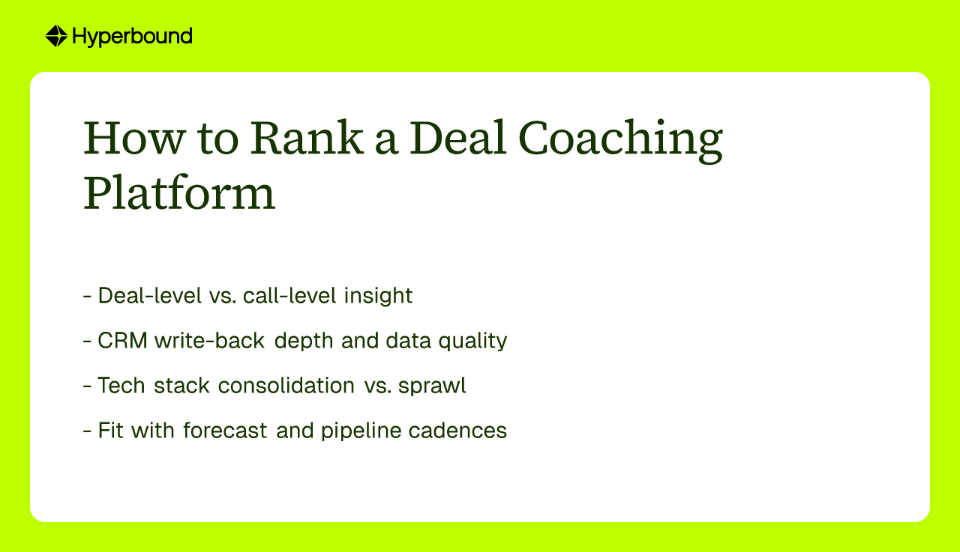
This ranking is built around the criteria RevOps teams actually care about:
Here are the seven best platforms, ranked accordingly.
Best for: End-to-end deal lifecycle analysis and revenue activation.
Hyperbound isn't positioned as a coaching add-on — it's built as a Revenue Activation Platform, designed to close the gap between what your conversation intelligence tool captures and what actually changes deal outcomes.
The core of its RevOps value proposition sits in two products: Hyperbound Perform and Kota Activate.
Perform does something most call coaching tools don't: it looks across all touchpoints in a deal, not just the last call. That means connecting a cold call from week one to a negotiation conversation in week six, surfacing what's helping or hurting momentum across the full lifecycle. It integrates with Gong, Chorus, Salesloft, and other call recording systems, so it layers on top of your existing stack rather than replacing it.
For RevOps specifically, Auto-CRM Fill is the standout feature. It automatically captures and structures CRM data from real sales conversations — currently for HubSpot, with Salesforce on the way. Critically, reps can review the data before it's pushed, which means cleaner records without creating a governance headache.
Kota Activate sits above Perform as an orchestration layer, available in Slack, Teams, or directly inside Hyperbound. Ask it about deal health across your pipeline, surface objection trends across multiple deals simultaneously, or trigger targeted practice roleplays for a rep based on a skill gap identified in a live call. It connects real-world performance data to the practice layer — which addresses one of the clearest gaps practitioners keep flagging: AI practice that isn't tethered to what's actually happening in the field.
The proof points are real. Vanta used Hyperbound to cut ramp time from 210 to 72 days — a 60% reduction — while growing pipeline 5x. Hyperbound also used Perform internally before public launch and closed its strongest quarter ever as a result.
One important note: Perform is not a forecasting tool. It's a behavioral signal layer that improves the quality of your forecast inputs — the distinction matters when you're scoping what you're buying.
Best for: Enterprise-grade conversation intelligence and call analytics.
Gong is the market standard for recording, transcribing, and searching customer interactions at scale. If you need a comprehensive library of call data, it delivers. The platform is mature, deeply integrated across the enterprise tech stack, and genuinely useful for surfacing patterns across large volumes of calls.
The limitation, from a RevOps lens, is that Gong is fundamentally an analytics tool. It tells you what happened. It doesn't systematically help reps change what happens next. Analysis is primarily at the call level, so building a coherent narrative of deal momentum across multiple touchpoints requires significant manual effort from managers who are already stretched thin — listening to less than 1% of recorded conversations on average.
There's also no native coaching loop. The gap between surfacing an insight in Gong and getting a rep to actually practice and fix the underlying behavior is wide — and largely manual.
Best for: AI-driven forecasting and pipeline management.
Clari is a RevOps staple for good reason. It aggregates data from CRMs, calendars, and email to give leadership a unified view of pipeline and improve forecast accuracy. If your primary need is revenue prediction and pipeline visibility, Clari is a serious tool.
Where it falls short for deal coaching specifically: its risk signals are built on activity data and CRM fields, not the content of sales conversations. It can tell you a deal is stalling, but it can't tell you why — whether the rep failed to identify a champion, missed the budget conversation, or ran a weak discovery. There's no coaching mechanism to fix the underlying cause of the risk it surfaces.
Best for: Post-call feedback integrated with GTM data.
Chorus offers strong individual call analysis, and its connection to ZoomInfo's account and contact data adds useful context. For teams already running ZoomInfo across their GTM stack, there's a consolidation argument here.
The core limitation is retrospective focus. Coaching insights arrive after the call — after the moment to change the outcome has passed. And like Gong, it struggles to connect the dots across multiple calls in a deal to show how stakeholder sentiment is evolving or whether deal momentum is building or fading. The intervention gap is real: by the time an insight surfaces in a post-call summary, the rep is already in the next meeting.
Best for: Sales engagement and process standardization.
Salesloft excels at making sure reps follow a process — cadences run, activities get logged, engagement is tracked. For RevOps teams building consistency into the top of funnel, it's a solid platform.
The gap is that deal health in Salesloft is largely activity-based. It tracks whether a rep sent the follow-up email, not whether that email was any good. A rep can execute a cadence flawlessly and still lose the deal because their discovery was shallow or they never built a real champion. The coaching layer doesn't go deep enough into the behavioral quality of interactions to give RevOps the signal they actually need.
Best for: Enterprise-scale sales engagement and automation.
Outreach brings robust sequencing, analytics, and workflow automation for managing deal-cycle activities at scale. It's a legitimate backbone for enterprise GTM teams.
The same limitation applies here as with Salesloft: the deal health view is activity-centric. High activity can create false confidence in opportunities that are actually at risk due to poor discovery or weak stakeholder alignment. Outreach surfaces what reps are doing; it doesn't surface how well they're doing it or where the conversation is breaking down.
Best for: Standalone AI sales simulations and practice environments.
Second Nature gives reps a space to practice pitches and objection handling before live calls. For teams starting their AI coaching journey, it's an accessible entry point.
The problem is the disconnect from the pipeline. As practitioners have flagged directly: "AI simulations may overlook certain nuances of real conversations," and the practice scenarios tend to be generic rather than tied to what's actually happening in a rep's live deals. Without a closed loop between real call analysis and targeted practice, you're left with reps who perform well in simulations but still struggle when the stakes are real.
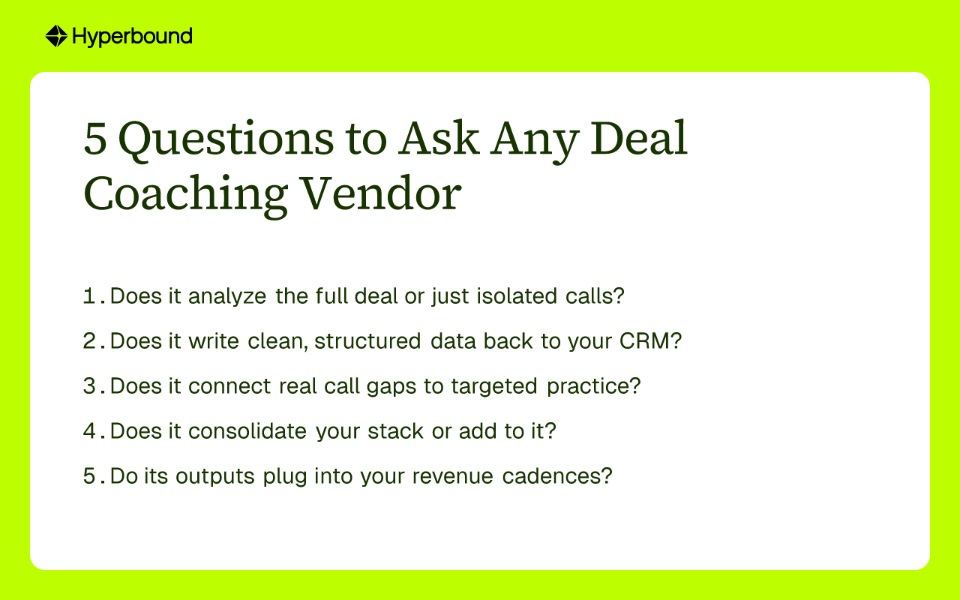
Before you commit to any of these platforms, use this checklist to cut through the marketing and pressure-test whether a tool is real infrastructure or just another call library with a coaching label on it.
1. Does it analyze the full deal lifecycle or just isolated calls?
Ask vendors to show you — live, in a demo — how insights connect across multiple calls in a single deal over time. You need to understand deal momentum and stakeholder narrative. If they can only show you call-level summaries, you're looking at a recording tool, not a deal coaching platform. Effective deal coaching should surface what's shifting across the full arc of a deal, not just what happened in the last 30 minutes.
2. How deep is the CRM integration — does it read and write back clean data?
A tool that only reads from the CRM is another dashboard. A tool that writes back unstructured notes creates cleanup work. Ask specifically: what data does it capture automatically, how is it structured before it hits the CRM, and can reps or managers review it before it's pushed? Data hygiene is a top RevOps concern — your deal coaching platform needs to respect it, not create more of it.
3. How does it connect real-world performance to targeted practice?
Insights without action are expensive data. Ask how the platform identifies a skill gap in a live call and then automatically surfaces a practice scenario to close it. If the answer involves a manager manually connecting the dots, the loop isn't closed — and the insight will die before it changes anything. The best tools, like Hyperbound's Practice and Perform combination, automate this connection so reps get deal-specific prep at the right moment.
4. Does it consolidate your stack or add to it?
RevOps teams are under constant pressure to reduce tool sprawl and justify every line item. Ask whether the platform replaces an existing tool or integrates with it to increase its ROI. A strong answer is: "We layer on your existing conversation intelligence tool and push structured data into your CRM" — not "you'll also need to migrate off your current call recorder."
5. How do its outputs plug into your core revenue cadences?
Your forecast calls, QBRs, and pipeline reviews should get better because of this tool — not just exist alongside it. Ask vendors to walk you through exactly how deal health signals from their platform can be used to challenge a rep's forecast, guide manager deal inspection, or flag at-risk deals before they slip the quarter. If they can't answer concretely, the tool lives outside your revenue process, not inside it.
An AI deal coaching platform is a software tool that analyzes sales conversations to provide insights and guidance for improving deal outcomes. Unlike traditional call recording tools that focus on individual calls, modern platforms designed for RevOps analyze the entire deal lifecycle, connect sales behaviors to pipeline health, and often integrate directly with your CRM to ensure data is clean and actionable.
The primary difference is that deal coaching platforms are designed for action and intervention, while conversation intelligence tools are primarily for analysis and recording. Tools like Gong and Chorus are excellent for recording and analyzing what happened on a call. A true deal coaching platform, like Hyperbound, takes the next step. It connects insights across multiple touchpoints in a deal's lifecycle, identifies skill gaps, and often automates a coaching loop to help reps practice and improve before the next critical call.
CRM write-back is critical because it ensures that the rich, qualitative data from sales conversations is captured as clean, structured data in your system of record, improving data hygiene and forecast accuracy. When a platform only reads from a CRM, it's just another dashboard. When it writes unstructured notes back, it creates manual cleanup work. A platform with automated, structured CRM write-back (like Hyperbound's Auto-CRM Fill) enriches your data without creating a governance nightmare, giving RevOps a more accurate view of deal health.
Yes, AI deal coaching can significantly improve forecast accuracy by providing a layer of behavioral signal that is often missing from CRM activity data. Forecasting tools like Clari are powerful but often rely on activity metrics (e.g., emails sent, meetings booked). A deal coaching platform analyzes the content of those interactions. It can tell you why a deal is at risk—perhaps the rep missed the budget conversation or failed to identify a champion—providing a qualitative reality check on the quantitative data and leading to a more reliable forecast.
The main problem with standalone AI sales simulators is their disconnect from real-world deal performance. Practice is valuable, but it's most effective when it's targeted. When simulations are generic and not based on a rep's actual skill gaps identified in live calls, the learning doesn't stick. The most effective platforms create a closed loop, using analysis from real deals to trigger specific, relevant practice scenarios for the rep.
The most important thing for RevOps to look for is a platform that provides deal-level insight, not just call-level analysis. RevOps needs to understand deal momentum and narrative over time. A platform that only analyzes isolated calls misses the bigger picture. You need a tool that connects the dots from the first cold call to the final negotiation, surfacing how stakeholder sentiment is changing and whether the deal is truly progressing, giving you the signal needed for effective governance and pipeline management.
The passive call library era is ending. Recording what happened is table stakes — the differentiation is now in what you do with that data before the deal is lost.
For RevOps teams, the goal is infrastructure that connects conversation behavior to pipeline governance, forecast inputs, and coaching interventions that actually land in time to matter. That means deal-level analysis, not just call-level snapshots. It means CRM writes, not just reads. It means a practice layer that's tethered to what's happening in real deals, not generic simulations that reps forget within a week.
The platforms at the top of this list move in that direction. Hyperbound, in particular, represents what this shift looks like in practice — a Revenue Activation Platform that analyzes behavior across the full deal lifecycle, closes the gap between insight and action, and gives RevOps teams the signal quality they need to run their most important cadences with confidence.
Stop watching deals. Start winning them.










Use Cases
Legal