
You run the pipeline review. You pull up the CRM. You see which deals are stalled, which reps are behind, and which opportunities have gone quiet. And then... you move on to the next meeting.
Sound familiar?
Here's the uncomfortable truth about pipeline reviews: they produce data, but they almost never produce behavior change. And that gap — between what the dashboard shows and what a rep actually does differently on their next call — is exactly where deals die.
As one sales manager put it in a recent community discussion: "The key is to find a solution that connects call analysis, performance metrics, and enablement into one seamless workflow." Most tools today fail that test. They show you a single call. They flag a single issue. But they don't help you find the common threads across all your rep interactions, and they certainly don't help reps practice their way out of the pattern.
Frontline sales managers already spend only 5–8% of their time coaching, and it's the first thing cut when the quarter gets noisy. That makes it even more critical that when coaching does happen, it's targeted, deal-connected, and drives real behavior change — not just another review session.
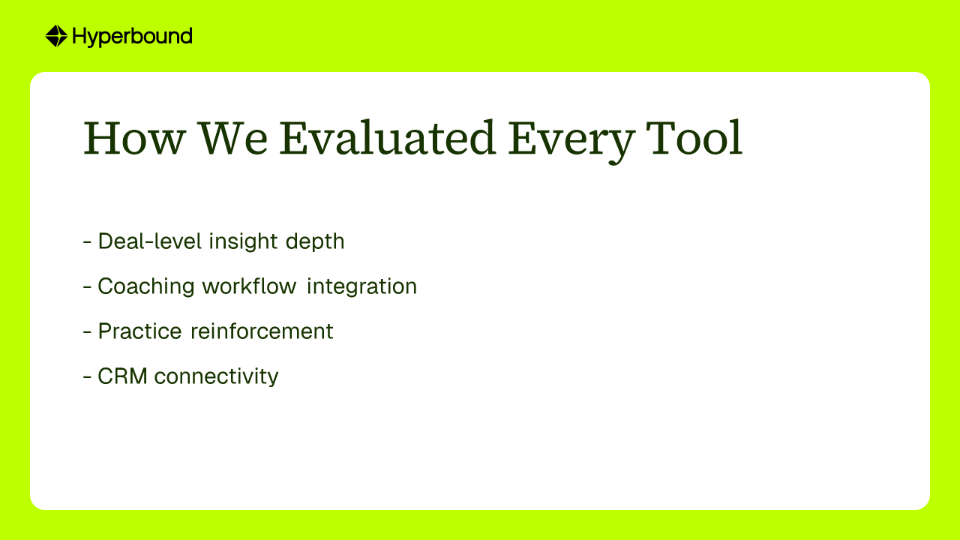
That's the standard we used to evaluate this list. Every tool was assessed against four criteria:
With that lens, here are the 7 best AI pipeline coaching tools for frontline sales managers.
Best for: Closing the loop between deal-level analysis and rep behavior change.
If you're a frontline manager tired of knowing what is wrong in your pipeline but not knowing how to fix it at the rep level, Hyperbound's Revenue Activation Platform was built specifically for you.
Hyperbound operates on a triangle model: Practice → Perform → Activate. Each layer feeds the next, creating a continuous improvement cycle that no other tool on this list fully replicates.
Hyperbound Perform sits at the core of the pipeline coaching workflow. Instead of reviewing a single call in isolation, Perform analyzes 100% of customer conversations across the entire deal lifecycle — from first cold call through closing conversation. It automatically scores real calls against your custom sales methodology scorecard to surface early risk signals and deal momentum shifts. You're not just seeing that a deal is stalled; you're seeing why, grounded in actual buyer conversations — not CRM fields or gut instinct.
Kota Activate is the orchestration layer sitting above Perform. Think of Kota as your AI Revenue Analyst. Ask it a question about a deal or a rep, and it pulls answers from real call data, deal intelligence, and roleplay performance simultaneously. More importantly, Kota recommends personalized coaching interventions at the right time — so instead of a manager manually translating a dashboard into a coaching plan, Kota does the heavy lifting.
And when those coaching recommendations land? Hyperbound Practice converts them into Bitesized Roleplays — short, targeted practice sessions built around the exact objection or skill gap surfaced from the real deal. Reps don't practice a generic objection; they practice the objection that's actually killing the opportunity in their pipeline right now.
The loop looks like this: Score Real Calls → Identify Skill Gaps → Practice Roleplays → Score Real Calls Again. That's not a dashboard. That's behavior change.
The results speak for themselves. Hyperbound saves managers 3.5 workweeks of coaching time per cycle. Vanta's CRO Stevie Case reported a 5x pipeline increase and a 60% reduction in ramp time (from 210 days down to 72) after implementing Hyperbound. Nivoda achieved 2x revenue growth YoY alongside a 150% increase in demo conversion rates.
For teams that need AI pipeline coaching that actually changes what reps do in their next conversation, Hyperbound is the clear #1.
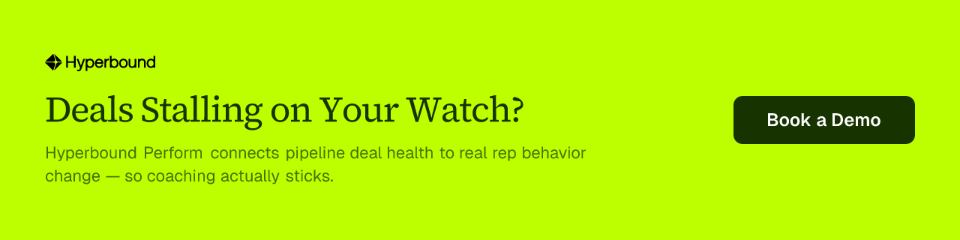
Best for: Large-scale conversation intelligence and call trend analysis.
Gong is the market leader in conversation intelligence, and for good reason. It captures and analyzes calls, emails, and meetings at scale — giving managers data-driven visibility into what reps are actually saying on the front lines. Keyword tracking, deal risk alerts based on conversational cues, and strong pipeline review dashboards make it a powerful tool for any org with the budget to support it (and as many managers have noted in community forums, "you're easily looking at six-figures per year").
Where Gong excels is in telling you what happened. It's exceptional at surfacing patterns, flagging risk, and giving managers ammunition for their 1:1s.
The gap? Gong stops at diagnosis. There's no integrated practice layer to help reps fix the identified issue. A manager might see that a rep consistently fails to establish next steps, but then it falls entirely on that manager to manually design a coaching plan and find time to reinforce it. For teams where coaching time is already scarce, that last mile is where the insight dies.
Gong provides excellent pipeline visibility. But visibility without reinforcement is an incomplete coaching solution.
Best for: Pipeline visibility and revenue forecasting.
Clari gives sales leaders a real-time command center for their pipeline. By aggregating CRM data, email activity, and calendar signals, Clari builds a high-fidelity picture of opportunity health and helps improve forecast accuracy. For VPs and CROs who need to know which deals are truly progressing, it's a strong platform.
But Clari is fundamentally a "what" and "when" tool, not a "how" or "why" tool. It can tell you a deal is at risk of slipping. It can flag that engagement has dropped. What it can't do is analyze the conversations inside that deal to tell you why engagement dropped — and it certainly can't recommend a rep-specific coaching action or practice session to address the root cause.
Clari is a revenue intelligence platform. It's powerful for leadership-level pipeline inspection. But for frontline managers who need to turn deal health signals into rep-level behavior change, it leaves a significant gap unfilled.
Best for: Sales engagement automation and activity-based deal execution.
Outreach is a sales engagement platform that helps teams automate cadences, manage multi-touch sequences, and track deal activities across the pipeline. Its deal management features give managers a view of where reps are in their engagement sequences and which prospects are responding.
The limitation for pipeline coaching purposes is that Outreach's intelligence is primarily activity-based, not behavior-based. It can tell you a rep made 10 touchpoints. It can't tell you whether those conversations were effective, whether objections were handled well, or whether the rep is positioning value correctly. The focus is on process adherence and engagement volume — not the conversational quality that ultimately determines whether a deal moves forward.
For disciplined pipeline execution, Outreach is excellent. For coaching reps on how to execute better, it falls short.
Best for: Post-call review and conversation analysis.
Chorus offers conversation intelligence similar to Gong — recording, transcribing, and analyzing sales calls to identify coaching opportunities. It helps managers standardize feedback and spot moments where rep behavior diverged from the playbook.
Like Gong, Chorus is a retrospective tool. The analysis happens after the fact, the insights are surfaced in a dashboard, and the manager is still left to bridge the gap between "here's what happened" and "here's how you practice your way to a better outcome." There's no native mechanism to connect a call insight to a targeted practice session, making it a useful review tool but not a complete AI pipeline coaching solution.
Best for: Integrating sales cadences with deal pipeline management.
Salesloft has evolved from a pure cadence tool into a more holistic revenue platform, with conversation intelligence and deal management features built in. Managers can inspect pipelines, track engagement, and review call recordings — all within a single platform.
The coaching focus in Salesloft, however, leans toward process compliance rather than behavioral depth. The platform is well-suited for asking "did the rep follow the playbook?" — but less equipped to answer "how well did they execute the conversation, and what specific skill do they need to sharpen for the next deal stage?" For frontline managers trying to connect deal-level patterns to rep-level development, the gap between insight and action remains wide.
Best for: Onboarding readiness and standalone sales practice.
Second Nature and similar AI sales simulators give reps a risk-free environment to practice pitches, objection handling, and discovery conversations. For ramping new hires or certifying reps on a new messaging playbook, these tools provide real value at scale.
The critical limitation in the context of AI pipeline coaching is disconnection from live pipeline data. A rep practicing objection handling in a vacuum is useful. But if that same rep is struggling with a specific procurement objection on a real deal in their pipeline right now, a generic simulator doesn't know that — and can't adapt to it.
As practitioners have noted firsthand: "I found it a bit unrealistic for B2B sales role-playing. Prospects often ask unexpected questions or take the conversation in different directions, which it doesn't really handle well." When practice isn't tethered to real-deal context, it's harder for reps to see the direct connection between the simulation and what they need to do differently tomorrow.
Standalone simulators are a useful piece of the enablement puzzle. But without a live pipeline signal driving the practice, they're missing the most important ingredient: relevance.
The pattern across this list is consistent: most tools are excellent at showing you what's wrong in your pipeline. Very few help you do something about it at the rep level.
Gong and Clari provide essential visibility for pipeline inspection. Outreach and Salesloft drive process adherence. Chorus offers solid post-call review. Second Nature delivers scalable practice. Each has real value — but none closes the full loop from deal health to rep behavior change.
That loop is precisely what Hyperbound's Perform + Kota Activate model is built to close. It doesn't just analyze what happened in a deal — it tells your reps and managers what to do next, and makes it possible to practice that exact thing before the next call. The result is AI pipeline coaching that actually moves the needle: on deal momentum, on rep skill, and on revenue.
If your pipeline reviews are generating data but not driving behavior change, that gap has a solution.
AI pipeline coaching is an approach that uses artificial intelligence to analyze sales conversations and deal data, identify specific skill gaps in reps, and automatically recommend or provide targeted practice to improve performance. It moves beyond simply reviewing dashboards by creating a direct link between what's happening in the pipeline (e.g., a stalled deal) and the specific conversational behaviors that need to change.
Traditional pipeline reviews often fail because they produce data and identify problems without leading to actual changes in a sales rep's behavior. They highlight what is wrong (e.g., stalled deals, low conversion rates) but don't bridge the gap to how a rep can fix it. This disconnect between data insight and practical coaching means the same issues reappear, and deals continue to die for preventable reasons.
The main difference is that AI pipeline coaching platforms close the loop between analysis and action, while conversation intelligence tools primarily focus on analysis. Tools like Gong and Chorus are excellent for retrospective analysis—recording and flagging what happened on calls. A true pipeline coaching platform, like Hyperbound, takes it a step further by not only analyzing conversations across the entire deal lifecycle but also integrating a practice and reinforcement layer to help reps actively work on the identified skill gaps.
Look for a platform that offers deep deal-level insights, integrates coaching directly into the workflow, provides a mechanism for practice reinforcement, and connects seamlessly with your CRM. These four criteria ensure the tool does more than just populate a dashboard. It should analyze the full deal lifecycle, prompt coaching actions, allow reps to practice the exact skills they need, and sync with your system of record to avoid data silos.
Hyperbound changes rep behavior by creating a continuous improvement cycle: it analyzes real calls, identifies specific skill gaps, and then automatically generates targeted roleplays for reps to practice those exact skills. This model—Score Real Calls → Identify Skill Gaps → Practice Roleplays → Score Real Calls Again—ensures that coaching isn't a one-off event. By connecting deal-level problems directly to personalized practice, reps can immediately work on the objection or skill that's impacting their live pipeline.
Yes, strong AI pipeline coaching tools are designed to connect with your existing CRM. CRM connectivity is a critical feature that allows the coaching platform to pull in deal data for a complete picture of pipeline health and ensures that insights are tied to your single source of truth for sales activity. This prevents the creation of another data silo and enriches your understanding of what drives deal progression.
AI coaching tools can save sales managers a significant amount of time by automating analysis and personalizing coaching workflows. For example, Hyperbound is cited as saving managers an average of 3.5 workweeks of coaching time per cycle. It achieves this by automatically surfacing coachable moments and providing reps with self-serve practice tools, freeing up managers to focus on high-impact strategic coaching instead of manual call reviews.
Ready to see how Hyperbound Perform connects deal health to rep action? Explore Hyperbound Perform →










Use Cases
Legal