
If you're a sales leader, you know the sinking feeling that comes with a manual QA process. You're sampling 5–10% of calls at best — which means 90% of your team's conversations, and every coaching opportunity buried inside them, are disappearing into the void. And it gets worse: the calls that do get reviewed are often the ones reps dread most. As one agent put it on Reddit, managers will "go thru your calls and pick the most messed up ones just to piss you off." That's not a QA process — it's a morale-killer.
The result? Inconsistent coaching, slow ramp times, stagnant win rates, and no reliable way to identify and replicate the behaviors of your top performers.
AI call scoring software changes that equation entirely. By automatically analyzing 100% of your team's calls — objectively, consistently, at scale — these tools turn every conversation into a data point for improvement. But not all tools are created equal. Some just report on what happened. The best ones actually help you change what happens next.
In this guide, we break down the 9 best AI call scoring tools for 2026, evaluated on scoring accuracy, coaching integration, and whether they actually drive behavioral change (not just produce dashboards). We'll close with a decision matrix to help you pick the right fit based on your team size, existing tech stack, and goals.
Before we get to the tools, let's be clear on what's at stake.
You're flying blind on 90% of your pipeline. Manual QA's 5–10% sampling rate means most deal-losing behaviors — poor objection handling, weak discovery questions, off-message pitches — go undetected and uncorrected. Reps who "completely freeze when prospects hit them with unexpected objections" don't get the coaching they need because nobody heard the call.
Coaching time is already scarce. Sales managers spend only 5–8% of their time coaching — and it's typically the first thing cut when things get busy. AI call scoring acts as a force multiplier, automating the initial analysis so managers can focus their limited time on high-leverage conversations.
Subjective QA creates distrust. When scoring feels arbitrary or biased, reps disengage. AI removes that subjectivity: every rep is measured against the same custom scorecard, aligned to your methodology (MEDDPICC, Sandler, BANT — whatever fits your team), every single time.
Training effectiveness becomes measurable. Instead of tracking completion rates on training modules, you can track actual skill improvement over time and connect coaching to outcomes like conversion rates and win rates.
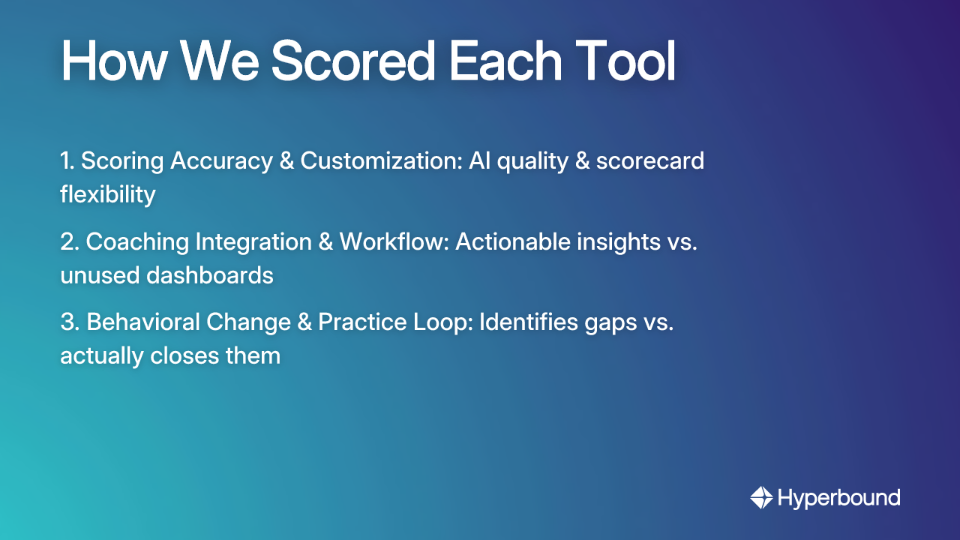
We assessed each tool on three criteria:
With that framework in place, here are the 9 best AI call scoring software tools for sales teams.
Best for: Sales teams that want scoring AND a built-in path to fix what they find
Hyperbound Perform is the only AI call scoring tool on this list built around a true closed-loop model — and that distinction matters enormously.
Most call scoring tools stop at step two: they record the call, score it, and hand you a report. Hyperbound goes further with a four-step cycle that no competitor currently offers:
This is what Hyperbound calls Revenue Activation — not just analyzing what happened, but changing what happens next. Results from customers back it up: Vanta reduced ramp time from 210 to 72 days (a 60% reduction), and Nivoda saw a 50% ramp reduction alongside a 150% increase in demo conversion rates.
Perform also goes beyond call-level analysis to provide deal-level intelligence — rolling up insights across every touchpoint in an opportunity to surface what's helping or hurting the deal while it's still winnable.
Pros: Only tool with an integrated score → practice → rescore loop. Deal-level (not just call-level) insights. Supports 25+ languages. Integrates with Gong, Salesloft, Chorus, HubSpot, and Salesforce.
Cons: Not a forecasting tool — the value is improving deal execution and behaviors that lead to better outcomes, not predicting pipeline.
Best for: Enterprise teams that need comprehensive revenue analytics
Gong is the heavyweight of the revenue intelligence category. It captures and analyzes calls, emails, and video meetings at scale, providing a 360-degree view of every revenue activity. Its AI surfaces deal health signals, tracks competitor mentions, and benchmarks rep performance across thousands of interactions.
Pros: Industry-leading analytics engine, extensive integrations, strong enterprise track record.
Cons: Premium pricing can be a barrier for growing teams. Gong is a world-class analysis tool, but it doesn't natively provide a way for reps to practice and close the skill gaps it identifies. Teams that use Gong often layer Hyperbound Perform on top to add that practice loop.
Best for: Teams embedded in the ZoomInfo ecosystem
Chorus excels at surfacing key moments in calls — risks, action items, competitor mentions — and enriching that data with ZoomInfo's B2B contact and company intelligence. If your team is already running ZoomInfo for prospecting, Chorus adds a natural layer of conversational context.
Pros: Seamless data enrichment from ZoomInfo. Clean UI for call review and moment-by-moment analysis.
Cons: Primarily an analysis and intelligence platform. Like Gong, it identifies gaps but doesn't close them — the coaching loop requires human follow-through.
Best for: High-volume, compliance-driven call centers
Balto takes a different approach: instead of post-call analysis, it provides real-time prompts and checklists during the call. Reps see recommended responses on-screen as the conversation unfolds.
Pros: Can enforce script adherence and compliance in real time, helpful in regulated industries.
Cons: The latency issue is real. As one experienced sales rep noted, "by the time the tool actually processes the conversation and makes a suggestion, the conversation has moved further." There's also a deeper concern: real-time coaching tools can create dependency, eroding the core skills reps need when the tool isn't available.
Best for: RevOps teams connecting conversation data to pipeline forecasting
Clari Copilot (formerly Wingman) is part of the broader Clari Revenue Platform. It links call scoring and conversation intelligence directly to pipeline management and forecasting, giving RevOps leaders a single view of what's being said on calls and how it connects to forecast health.
Pros: Tight integration between conversation data and pipeline visibility. Real-time cue cards help reps in the moment.
Cons: The primary focus is revenue predictability rather than granular skill development. Teams specifically focused on rep improvement may find the coaching depth less than purpose-built tools.
Best for: Sales managers who want collaborative, manager-led call review
Jiminny builds structured coaching around curated call playlists — managers can tag and share moments like "best objection handling" or "strongest discovery questions" to create a library of team best practices.
Pros: Strong features for building a "game film" culture. Live manager listening and whisper functionality add flexibility.
Cons: The coaching process relies more heavily on active manager involvement than on AI automation. Without consistent manager engagement, the platform's value diminishes. No integrated practice component to close identified skill gaps.
Best for: SMBs wanting an all-in-one communications + basic call scoring tool
Dialpad is a unified communications platform that embeds AI features — real-time transcription, sentiment analysis, and keyword-triggered assist cards — directly into its phone and video system.
Pros: Convenient bundling of call scoring within the same tool used for business communications. Often more affordable than standalone enterprise platforms.
Cons: AI scoring capabilities are generally less customizable and less sophisticated than dedicated conversation intelligence platforms. Complex sales methodologies (MEDDPICC, Sandler) are difficult to replicate at the scorecard level.
Best for: Large enterprises with formal, structured enablement programs
Mindtickle is a comprehensive sales readiness platform that includes call coaching (Call AI) as one component of a broader suite covering onboarding, training, and learning management.
Pros: Connects call performance to structured training modules, providing a meaningful link between real-world behavior and formal learning.
Cons: Call scoring is one feature among many — it may lack the depth of a purpose-built scoring tool. AI roleplay functionality exists, but Hyperbound's simulations are specifically trained on real B2B call data, addressing the realistic concern that generic role-play scenarios fall short for complex deal conversations.
Best for: Budget-conscious teams or highly regulated industries
MiaRec is a call recording and quality management solution with automated scoring, screen recording, voice biometrics, and robust PCI/HIPAA compliance features.
Pros: Strong value-to-cost ratio. Reliable compliance and security features make it well-suited for finance, healthcare, and insurance.
Cons: AI-driven coaching and analytics capabilities are less advanced than newer, AI-native platforms. Better suited as a compliance and QA tool than a performance development platform.
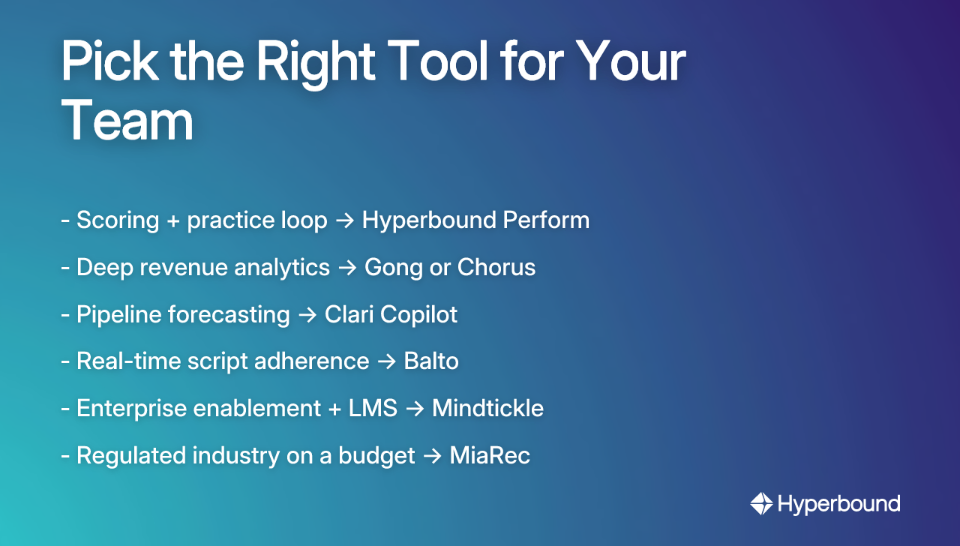
This isn't a one-size-fits-all category. Use this framework to self-select based on your team's profile:
.png)
.png)
The key question to ask yourself: Do you want a tool that identifies skill gaps, or one that closes them?
Most tools on this list are exceptional at the former. If your goal is the latter — if you want to move from passive analysis to active behavior change — the closed-loop model that Hyperbound Perform offers is, as of 2026, uniquely suited for that job.
The best AI call scoring software in 2026 doesn't just listen — it activates. The paradigm has shifted from reviewing past performance to proactively shaping future outcomes.
Dashboards full of call data are table stakes now. The real differentiator is what happens after you identify a problem. Does your platform help reps practice the skill before their next call? Does it close the feedback loop between scoring and behavior change? Does it connect individual rep improvement to deal outcomes — not just completion rates on training modules?
That's the standard worth measuring against. Whether you're a sales enablement leader trying to prove the ROI of your program, a frontline manager who can't review every call personally, or a VP trying to figure out why win rates are flat despite all the tools you've invested in — the answer isn't more data. It's a tighter loop between insight and action.
AI call scoring is software that uses artificial intelligence to automatically listen to, transcribe, and evaluate 100% of a sales team's conversations against a custom scorecard. Unlike manual QA which only samples 5-10% of calls, AI scoring provides comprehensive, objective, and consistent feedback at scale. It identifies key moments, tracks talk-time, and measures adherence to specific sales methodologies to uncover coachable moments across the entire team.
AI call scoring improves sales coaching by automating the time-consuming process of call review, allowing managers to focus their limited time on targeted, high-impact coaching conversations instead of searching for them. The software automatically surfaces specific skill gaps (like poor objection handling or weak discovery) for each rep, providing objective data to make coaching sessions more effective and taking the guesswork out of performance improvement.
Yes, the best AI call scoring platforms allow you to create fully customized scorecards that align with your team's specific sales methodology, such as MEDDPICC, Sandler, BANT, or your own unique framework. This ensures the AI is measuring reps on the behaviors and criteria that matter most to your business — like asking budget questions or identifying the champion — making the feedback directly relevant and actionable.
While initial concern is possible, most sales reps come to appreciate AI call scoring because it provides fair, objective, and consistent feedback that helps them improve and earn more. It replaces the often biased and "gotcha"-style feedback of random manual reviews with a transparent system focused on development, helping top performers get recognized and struggling reps get the specific help they need.
Post-call scoring analyzes conversations after they happen to identify skill gaps and strategic coaching opportunities, while real-time guidance provides live, on-screen prompts to reps during the call. Post-call analysis (used by tools like Hyperbound and Gong) is designed to build lasting skills and critical thinking. Real-time guidance (used by tools like Balto) focuses on immediate script adherence but can create dependency and may not be fast enough for dynamic sales conversations.
Gong and Chorus are primarily analysis platforms that excel at identifying skill gaps across all revenue interactions. Hyperbound Perform is a revenue activation platform that not only identifies those gaps but also provides an integrated practice loop with AI roleplays to actively close them. It completes the cycle: it scores calls, identifies a weakness, assigns targeted practice, and then rescores future calls to track improvement, turning insights into measurable behavior change.

If you're ready to see what that looks like in practice, explore Hyperbound's closed-loop model connecting real call scoring to AI-powered roleplays.






Use Cases
Legal