
Most sales reps only "practice" when they get crushed on a live call and spend the drive home replaying what went wrong. That reactive loop: call, fail, reflect, repeat. That is not training. It is damage control.
The reps who show up to high-stakes meetings with genuine confidence are the ones who have already had the hard conversation. Not in their head. Not in a mirror. Against something that fought back.
The problem is that most sales training tools make this kind of preparation nearly impossible. You open the app, pick "The Budget-Conscious VP" from a dropdown, and run through a script that ends with the bot agreeing you made great points. It feels productive. It is not.
As one sales rep put it in a Reddit thread on AI roleplay tools: "ChatGPT helped at practicing our responses to basic objections, but it still couldn't replicate realistic responses to what we say. It just agrees and tells me why I'm right."
That is the core failure of generic roleplay. When the simulation is not challenging, preparation becomes performance. You feel ready, but you have only rehearsed a version of reality that does not exist.
The fix is not a better dropdown. It is a digital twin: a bot built from the actual LinkedIn profile of the specific person you are about to call.
Buyer personas have real value in marketing. They help teams understand segments, shape messaging, and prioritize audiences. But when you import that same archetype model into sales training, something breaks.
A persona is a composite. It is built to represent a group, not a person. And actual sales calls do not happen with groups. They happen with individuals who have specific roles, specific pressures, and specific ways of pushing back.
According to the Digital Marketing Institute, 71% of consumers expect personalized interactions, and 76% report frustration when they do not receive them. If buyers expect personalization in the sales conversation itself, it follows that practicing against a generic proxy does not prepare you for that expectation.
The reps who struggle in discovery are often the ones who practiced the generic version of their pitch so many times that they stopped listening. They are waiting for the cue that matches the archetype. But real buyers do not follow the script.
As another sales professional observed in the same Reddit thread: "I found it a bit unrealistic for B2B sales role-playing. Prospects often ask unexpected questions or take the conversation in different directions, which it doesn't really handle well."
This is the gap. Generic roleplay builds generic reflexes. It does not train you for the specific human sitting across from you on Thursday.
The concept of a digital twin comes from industrial engineering. Companies like Chen Hsong use digital twins to create interactive simulations of entire production lines, validating configurations and identifying bottlenecks before any physical deployment. The insight is simple: simulate with specificity, and you make better decisions.
Hyperbound applies this same logic to people. Instead of representing a buyer type, the Hyperbound Bot Builder ingests a specific prospect's public LinkedIn profile and constructs a bot that reflects that individual's professional identity, not a composite category.
The difference in practice looks like this:
This is not a cosmetic upgrade. It is a structural shift in how sales preparation works.
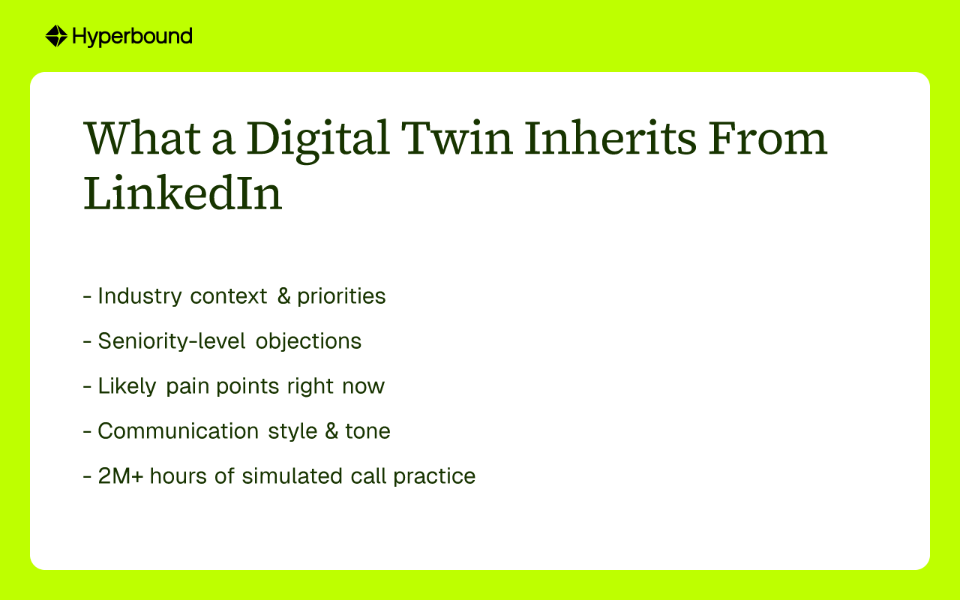
The Bot Builder does not just pull a name and title from a LinkedIn page. It analyzes the profile to inherit a set of signals that shape how the bot behaves in conversation:
The underlying model has been shaped by over 2 million hours of simulated calls. The AI buyer personas are built from analysis of real B2B sales patterns (the actual texture of how B2B buyers talk, push back, and make decisions), so the bots do not give generic answers or rely on generic training data.
One of the most immediately useful features for reps is the Hyperbound LinkedIn Chrome Extension. While browsing a prospect's LinkedIn profile, a rep can click the extension to instantly build the bot and launch a roleplay session without switching tabs or copying URLs into a separate tool.
This directly addresses one of the most common complaints about sales training software: the setup friction. Reps want solutions that are easy to use without heavy setup. The extension removes that barrier entirely. The practice happens where the research already happens.
Here is what this looks like in practice for a sales rep with a high-stakes meeting on the calendar.
Marcus is an account executive who has been working a deal with a VP of Logistics at a mid-market retail company. The meeting is Thursday at 10am. It is the kind of call where showing up underprepared has real consequences.
Wednesday afternoon:
Marcus pulls up the VP's LinkedIn profile. He notices 15 years in supply chain, a recent post about rising fulfillment costs, and a company press release mentioning their push to reduce third-party logistics dependency.
Instead of running through his pitch deck one more time, Marcus clicks the Hyperbound Chrome Extension. Within moments, he has a digital twin of the VP ready to practice against.
He runs three discovery roleplays. The bot pushes back with objections like, "We already have contracts with our current vendor through Q3, and switching costs are not something leadership wants to absorb right now," and, "How are you going to demonstrate ROI when our volumes fluctuate heavily by season?"
These are not random objections. They are the objections that emerge from the specific context of this person's role and industry. Marcus refines his responses, tightens his discovery questions, and identifies two angles where his solution maps directly to what the VP has been publicly discussing.
Thursday morning:
Marcus enters the call having already navigated the likely conversational paths. The VP raises the switching cost concern in the third minute. Marcus does not hesitate. He has answered that exact objection three times the day before.
This is the purpose of a specific AI buyer persona for sales roleplay. It is not about practice in the abstract. It is about preparation for a particular person, on a particular day, with particular stakes.
Reading realistic text objections is one level of preparation. Hearing them in a voice that resembles the actual person you are about to meet is another.
Hyperbound includes voice cloning as part of the Bot Builder experience. This feature matters for a reason that goes beyond novelty. When you practice against a voice that carries the cadence and tone of your actual prospect, the real conversation feels less foreign. Call anxiety drops. Delivery improves. The mental gap between practice and performance narrows.
Producing a high-quality voice clone requires technical precision. To do it well, you need clean audio recorded at high quality, expressive and varied speech across a range of tones, and normalized audio levels. Filler words and disruptive sounds are removed before training. The resulting model is then stress-tested across different dialogue scenarios and tuned for stability and accuracy.
Hyperbound handles this process on the backend. For the rep, the experience is seamless: build the bot, select a voice, start practicing.
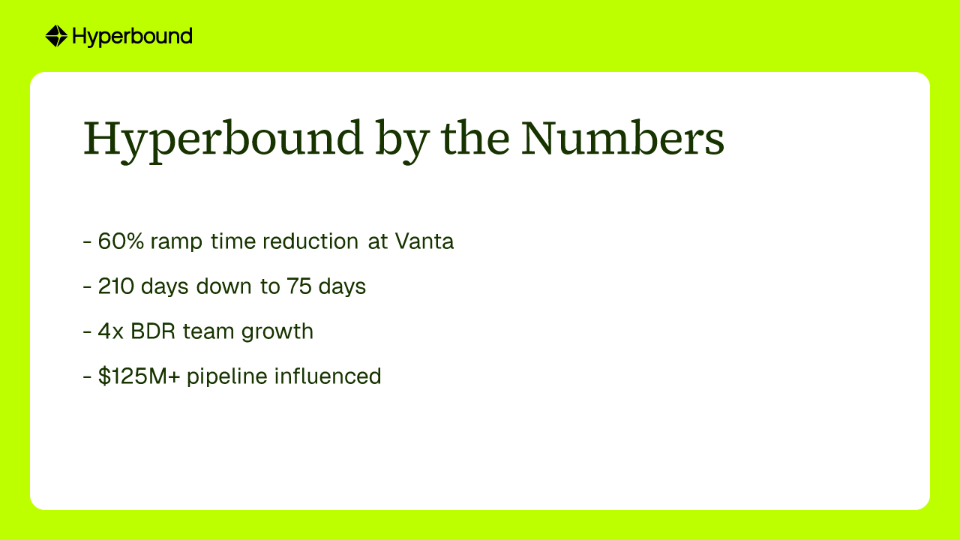
The philosophical case for specific preparation is intuitive. The data behind it is compelling.
Vanta, a leader in trust management, used Hyperbound to scale its BDR team. The results were transformative:
According to Vanta's CRO, Stevie Case, this level of realistic, scalable practice was instrumental to their success. These outcomes are not coincidental. They reflect a training philosophy sometimes framed as "train hard, fight easy." When the practice environment is genuinely challenging and contextually accurate, the real environment feels manageable by comparison. Reps who have already handled a difficult objection twelve times do not freeze when they hear it on a live call.
Generic roleplay cannot produce this effect. A dropdown persona cannot replicate the specific pressure of practicing against a simulation of the actual person in your pipeline.
There is a version of sales training that feels productive and produces nothing. You run through the pitch, the bot agrees with you, you close the session, and you feel ready. On Thursday, you find out you were not.
And then there is the approach that builds genuine readiness: using a specific AI buyer persona for sales roleplay, constructed from the actual LinkedIn profile of the person you are meeting. The bot inherits their industry, their seniority, their likely pain points, and their communication patterns. It pushes back the way they would push back. It asks the questions they are likely to ask.
Hyperbound's Bot Builder is the tool that makes this possible. And it's just one part of the broader Hyperbound platform: sitting inside Hyperbound Practice and connecting to Perform for real-call deal coaching and Kota Activate for AI coaching orchestration, closing the loop from practice to pipeline outcomes. No more dropdown menus of archetypes. No more bots that agree with everything you say. Instead: a digital twin of your most important prospect, available to practice against the night before your biggest meeting of the quarter.
For sales leaders building out a modern Revenue Activation strategy, this is where the standard needs to shift. The reps who close more deals are not the ones who practiced more in general. They are the ones who practiced against the right simulation, at the right time, for the right call.
Build the twin. Have the hard conversation before it counts. Walk into Thursday prepared.
A digital twin for sales roleplay is a specific AI buyer persona created from an individual prospect's public data, like their LinkedIn profile. Unlike generic personas that represent a type of buyer, a digital twin simulates a specific person, inheriting their industry context, seniority, likely pain points, and communication style to provide highly realistic and targeted sales practice.
A digital twin is fundamentally different because it represents an individual, not a composite group. While a buyer persona like "Skeptical CFO" is a generalized archetype, a digital twin of a specific CFO is built from their personal LinkedIn profile, reflecting their unique career history, industry, and professional context. This shifts practice from generic objection handling to preparation for a conversation with a specific human.
Most generic AI roleplay tools fail because they are not challenging enough and cannot replicate realistic, unexpected responses. They often rely on broad archetypes that agree too easily or provide predictable objections. This leads to a false sense of confidence, as reps are rehearsing for a version of a sales call that doesn't exist in the real world.
You can create a highly specific AI buyer persona using tools like Hyperbound's Bot Builder and its LinkedIn Chrome Extension. By simply providing the prospect's LinkedIn profile URL, the tool analyzes public information, such as their industry, role, seniority, and company, to construct a digital twin. The Chrome extension streamlines this, allowing you to build the bot and start a roleplay session directly from the prospect's profile page.
The realism of a digital twin simulation comes from two key factors: specific inputs and a robust training model. The AI inherits context directly from the prospect's LinkedIn profile, including their industry priorities and seniority level. Furthermore, Hyperbound has delivered over 2 million hours of simulated calls, with AI buyer personas built from analysis of real B2B sales patterns, enabling them to replicate the nuances, objections, and conversational patterns of actual buyers.
The primary benefit is genuine readiness for high-stakes calls. Practicing against a digital twin allows sales reps to anticipate and rehearse specific objections, refine discovery questions for a particular individual, and reduce call anxiety. This leads to measurable business outcomes, such as reduced new hire ramp time, increased team growth, and a significant increase in sales pipeline.









Use Cases
Legal