
You've got an AI roleplay tool. Your reps are logging in, running simulations, and checking the box. But when they get on a real discovery call, they're still stumbling over objections they've "practiced" a dozen times.
The problem isn't the tool. It's the persona powering it.
Generic AI bots give generic practice. If the simulated buyer doesn't sound, think, or push back like your actual prospects, the effectiveness of the training collapses entirely. As one sales rep put it bluntly: "AI role-playing tools often fail to adapt to unexpected inquiries during sales interactions." That's not practice — that's theater.
The fix is a well-built AI buyer persona for sales roleplay: a detailed, layered profile that gives the AI the context it needs to behave like a real prospect. When you get this right, your reps stop running through scripts and start having genuine conversations — ones that actually prepare them for the unpredictability of live B2B sales.
This guide gives you a complete five-layer framework for building high-fidelity AI buyer personas from scratch, a fill-in-the-blank template you can use today, and a look at how to automate the entire process in minutes.
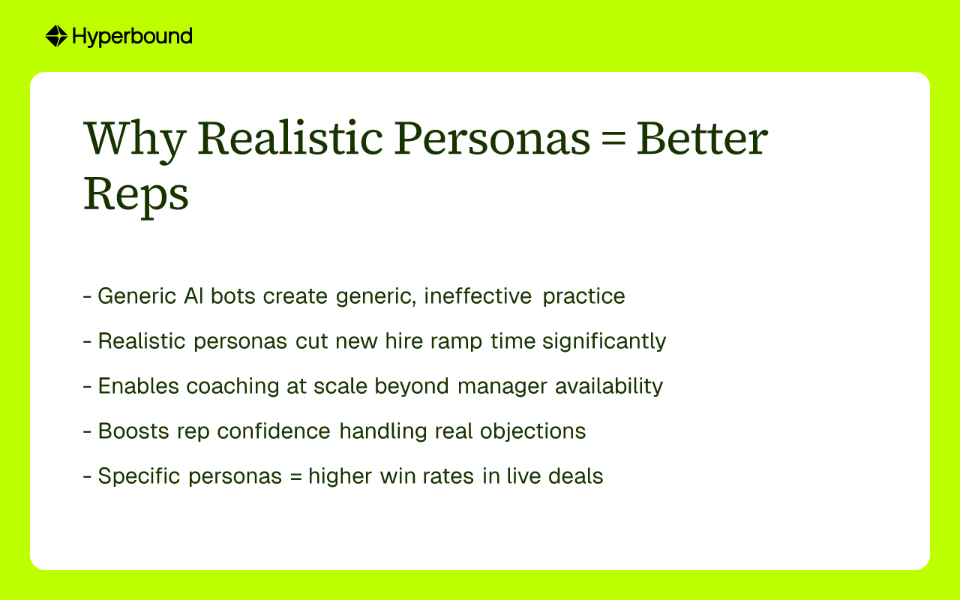
A buyer persona is, at its core, a semi-fictional representation of your ideal customer built from real data and market research. Demographics, psychographics, goals, pain points, buying behaviors — the whole picture.
For AI sales roleplay, a persona is the soul of the simulation. It's what separates a bot that recites canned responses from one that pushes back on pricing, brings up a competitor, or goes quiet when the rep asks a vague question.
This matters for three reasons:
The more specific your persona, the more valuable your practice. Let's build one.
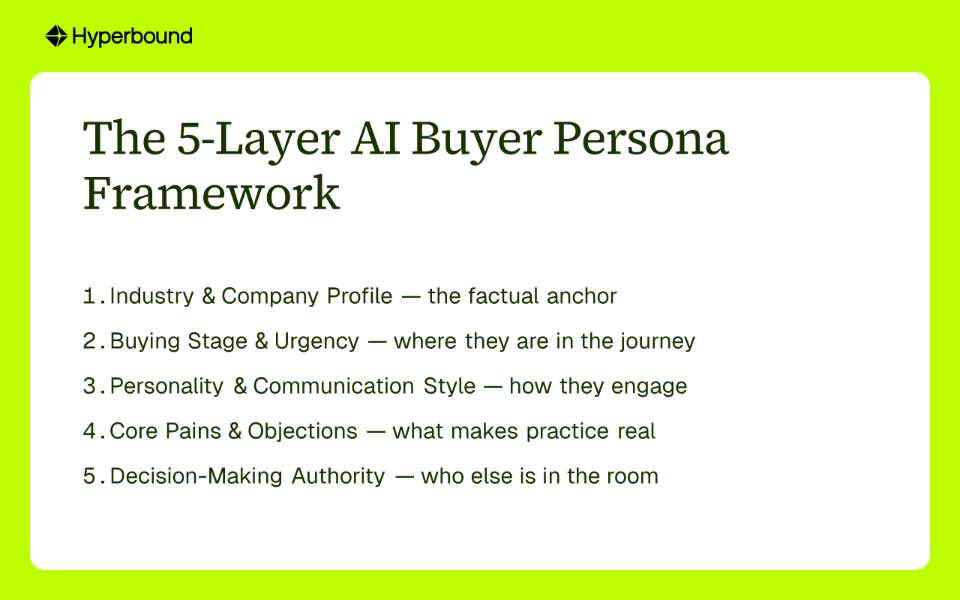
Salesforce's buyer persona framework outlines the core dimensions every persona needs. For AI roleplay, we go deeper — layering in behavioral and situational attributes that make the simulation dynamic rather than static.
Start with the factual anchor:
Then go beyond the basics. What's happening at this company right now? Did they just close a Series B and are scaling their sales team fast? Are they in the middle of a tech stack consolidation? Were they burned by a bad vendor six months ago?
This company context is what makes roleplay scenarios specific and challenging — not generic. For example, a detail like "This company uses Salesforce but lacks call recording" can shift the entire conversation.
Where is this buyer in their journey?
Urgency is equally important. Why are they looking now? A new executive mandate, a bad quarter, a competitor gaining ground, or a board-level initiative can create urgency that changes how the buyer behaves in a conversation. A low-urgency buyer in awareness mode requires completely different handling than a high-urgency buyer in the decision stage — and your reps need practice with both.
This is where personas come alive. Give your AI buyer a distinct personality, drawing from common archetypes:
Also define communication preferences. Does this persona prefer a formal tone or casual conversation? Do they want a high-level overview or detailed specifics? Are they comfortable with silence, or do they fill gaps with questions?
This layer directly addresses one of the most common gaps in AI roleplay: the lack of tools focused on rapport-building. A persona with a defined communication style forces reps to match that style — which is exactly what rapport-building requires.
This is where the practice gets real. Define the specific business pains your buyer is experiencing — the ones your product is designed to solve — and arm the persona with the toughest objections your reps will encounter in the field.
Example pains for a Sales Enablement Leader:
Common objections to program into the persona:
The more faithfully these objections mirror what reps actually hear in the field, the more valuable the practice session. Pull directly from real call recordings, win/loss interviews, and CRM notes to populate this layer.
Apply all five layers with this ready-to-use template. Copy it, fill it in, and hand it to your bot builder or AI roleplay platform.
### AI Buyer Persona: [Persona Name, e.g., "Skeptical Sarah"]

**Layer 1: Industry & Company Profile**
- Title:
- Industry:
- Company Size:
- Company Context / Recent Triggers:

**Layer 2: Buying Stage & Urgency**
- Current Stage: (Awareness / Consideration / Decision)
- Urgency Level: (Low / Medium / High)
- Reason for Urgency:

**Layer 3: Personality & Communication Style**
- Personality Archetype: (e.g., Data-driven, Skeptical, Methodical, Enthusiastic)
- Communication Preference: (e.g., Formal and concise / Casual and talkative)
- Rapport Style: (e.g., Warms up slowly, needs trust first / Open immediately)

**Layer 4: Pains & Objections**
- Core Business Pains:
  1.
  2.
  3.
- Most Common Objections:
  1.
  2.
  3.

**Layer 5: Decision-Making Authority**
- Role in Purchase: (User / Influencer / Champion / Economic Buyer)
- Other Stakeholders Involved:
- Typical Approval Process:
This template works whether you're building personas manually for a custom bot or briefing your sales enablement team on a new ICP segment. The more specific you get on each layer, the more realistic — and more valuable — the resulting roleplay will be.
The five-layer framework above is powerful. It's also time-consuming when you're building personas at scale across multiple ICPs, industries, and buying stages.
That's where automation changes the equation entirely.
Hyperbound Practice offers a LinkedIn Chrome Extension that automates the entire persona-building framework. Here's how it works:
Within minutes, reps can practice a cold call, discovery conversation, or objection-handling scenario against a persona that reflects the actual person they're about to call — not a generic archetype.
What makes this meaningfully different from a simple profile scraper is the underlying model. Hyperbound's AI is trained on over 2 million hours of real B2B sales conversations. That means the personas it generates don't just reflect what a buyer looks like on paper — they reflect how buyers in those roles, industries, and company stages actually talk, object, and respond. The realism gap that sales reps consistently flag as the core failure of AI roleplay gets addressed at the data level.
The LinkedIn-generated persona is a strong starting point. From there, reps and enablement leaders can refine it inside Hyperbound's bot builder — layering in specific objections, adjusting personality settings, and calibrating urgency to match a real pipeline scenario.
For teams practicing more complex deals, Hyperbound's Multiparty Roleplays let reps run simulations with multiple AI personas simultaneously — for example, a friendly internal champion alongside a skeptical economic buyer asking hard ROI questions. This directly mirrors the reality of enterprise B2B sales, where the conversation rarely involves just one stakeholder.
A well-built persona is only valuable if it's paired with a well-structured roleplay. Here's how to operationalize it.
Define what the rep needs to accomplish in this specific simulation. Vague practice produces vague outcomes. Be specific:
Each goal maps to a specific skill gap — and a specific persona scenario is needed to practice it.
Before the rep hits "start," establish what success looks like. This is what the AI scorecard will measure against. Examples:
Clear winning criteria take the subjectivity out of feedback — which is one of the primary reasons sales managers resist adopting AI roleplay tools in the first place. When there's a defined rubric, feedback becomes objective and actionable rather than a matter of opinion.
After every simulation, Hyperbound's AI Scorecards deliver instant, objective feedback across the dimensions that actually matter:
This creates the improvement loop that makes practice compound over time: Practice → AI-Scored Feedback → Identify Gaps → Practice Again. Reps know exactly where they lost the conversation and can re-run the same scenario immediately to course-correct.
For managers and enablement leaders, the aggregate scorecard data surfaces skill gaps across the team — without requiring anyone to listen to a single call recording. Hyperbound customers report saving 3.5 workweeks of coaching time using this model, while simultaneously giving reps more reps than any manager could provide manually.
The real cost of a weak AI buyer persona isn't a bad roleplay session. It's a rep who burns a qualified lead while learning on the job, a new hire who takes six months to ramp instead of three, or a deal that stalls because no one on the team had practiced navigating a skeptical CFO.
The five-layer framework — Industry and Company Profile, Buying Stage and Urgency, Personality and Communication Style, Core Pains and Objections, and Decision-Making Authority — gives you a structured blueprint for building AI buyer personas that actually prepare reps for the complexity of real B2B sales conversations.
Use the template above to start building manually, or skip the hours of work and let Hyperbound's LinkedIn Chrome Extension generate a ready-to-use persona from a prospect's profile in minutes — grounded in data from 2 million+ hours of real sales conversations.
Your reps will get better at-bats. Your pipeline will thank you.
An AI buyer persona is a detailed, data-driven profile that instructs an AI simulation on how to behave like a specific customer during a sales roleplay. It goes beyond basic demographics to include the buyer's industry, company situation, personality, core pain points, and common objections. This level of detail ensures the AI doesn't just give generic responses, but pushes back and asks questions like a real prospect, making the practice session far more effective.
Generic AI roleplay bots fail because they lack the specific context, personality, and objections of your actual buyers. This leads to predictable, script-like conversations that don't prepare reps for the unpredictability of real-world sales calls. When a rep has only practiced against a bot that agrees easily, they are unprepared to handle the nuanced pushback, skepticism, and specific challenges that a well-defined AI buyer persona can simulate.
An effective AI buyer persona is built on five key layers: Industry & Company Profile, Buying Stage & Urgency, Personality & Communication Style, Core Pains & Objections, and Decision-Making Authority. Together, these layers create a complete picture of the buyer. The persona knows where they work (company context), when they are buying (urgency), how they communicate (personality), what their problems are (pains/objections), and who else is involved in the decision (stakeholders).
You can create a realistic AI buyer persona either manually using a structured template or automatically using a tool like Hyperbound. The manual approach involves filling out a detailed framework with information gathered from call recordings, CRM data, and interviews with your sales team. Automated tools, like Hyperbound's LinkedIn Chrome Extension, can analyze a prospect's public profile and instantly generate a high-fidelity persona based on a model trained on millions of hours of real sales conversations, saving significant time.
Integrate AI buyer personas by pairing them with specific, goal-oriented roleplay scenarios and using AI feedback to track progress. First, define a clear goal for the simulation (e.g., "handle three pricing objections"). Second, assign the relevant AI buyer persona. Third, have the rep run the simulation. Finally, use an AI scorecard to provide immediate, objective feedback on their performance against predefined winning criteria. This creates a continuous improvement loop: practice, get feedback, and practice again.
Yes, advanced AI roleplay platforms can simulate complex deals by using multiple AI buyer personas in a single scenario. This feature, often called Multiparty Roleplays, allows a sales rep to practice navigating conversations that involve different stakeholders simultaneously. For example, a rep could practice a meeting with an enthusiastic internal champion and a skeptical CFO, each with their own unique personality, pain points, and objections, mirroring the reality of enterprise B2B sales.
Ready to build AI buyer personas that actually move the needle? See how Hyperbound can cut your ramp time by 50% and give your team the realistic, high-stakes practice they need to win more deals. Book a Demo →










Use Cases
Legal