
Most sales AI is read-only. It summarizes calls, surfaces alerts, drafts follow-up text, and answers questions about the pipeline. It observes and reports. Very little of it writes back into the system it lives in.
That gap matters. An insight that does not result in a system change still requires a human to open the scorecard, add the criterion, build the bot, and update the module. The AI produced a report. The human still has the job.
There is a clear structural divide in how AI assistants are built: those that answer questions, and those that do the work. The distinction is most consequential for sales enablement, where the work is high-volume, highly repeatable, and almost entirely about execution at scale.
AI assistants, as IBM describes them, are reactive. They respond to prompts, surface information, and hand the output back to the user. They lack persistent memory and do not act on what they find.
This is the category that dominates sales technology today. When asked which deals are at risk, it returns a list. When asked to summarize the last call with a prospect, it returns a transcript digest. When asked to show all calls where reps mentioned more than five features before the prospect named a pain point, it returns a filtered view.
Each output is useful. Each also becomes a to-do list.
An observed pattern across sales teams is that the gap between explaining what happened and helping teams act on it is where productivity stalls. The tool confirms the problem. The human then opens the CRM, updates the scorecard, rebuilds the training module, and routes the new version to the right people. The AI shifted the reading; the work remained manual.
AI agents are built differently. They are proactive, able to plan and execute multi-step tasks without requiring a human to manage each step. They retain context. They interact with multiple systems. Critically, they write back. This is the closed loop that separates a reporting tool from a system that changes outcomes.
The practical difference is structural rather than incremental, and it is exactly what revenue activation is built on. A question-answering assistant asked to identify every discovery scorecard missing a feature-dumping criterion returns a list of records. An AI agent that does the work asked to add the criterion to all 80 scorecards, build 100 practice bots for the new behavior, deploy them across languages, and surface a diff before anything goes live removes the to-do list. The instruction replaces the project. This is the difference between conversation intelligence, which records what happened, and a system that acts on it.
Most business functions deal with work that is episodic or judgment-heavy. A deal desk reviews one contract. A finance team models one scenario. Human oversight at each step is reasonable because the volume is manageable and the decisions are individual.
Enablement does not work that way. When a new methodology rolls out, every scorecard changes. Every coaching guide changes. Every practice scenario needs to reflect the new behavior. When a product launches, the playbook updates, the call frameworks update, and the readiness content updates, simultaneously, for every team, often in multiple languages.
Research on AI and sales enablement identifies knowledge management as one of the clearest efficiency gains from AI adoption. Efficiency gains from reading faster are bounded. The larger gain comes when the AI does not just surface the 80 scorecards that need updating but updates all of them on instruction.
This is the distinction between mass notification and mass execution. "Here are the records that require changes" creates the same administrative queue as before, just with better search. "Change all of them" removes the queue entirely.
Enablement teams that operate with question-answering tools end up caught between two pressures: the speed at which the business expects programs to land, and the manual overhead of building them. When the work of identifying a problem and the work of fixing it fall on the same person with the same tools, throughput is capped by hours in the day.
An AI agent that does the work changes that arithmetic. Research on task chaining in AI automation shows that the efficiency gain from AI does not come primarily from making each individual task faster. It comes from eliminating the coordination costs between tasks: the handoffs, the re-checks, the context that has to be re-established each time a human picks the project back up. When a single instruction triggers a full chain of dependent actions, those coordination costs disappear.
In a launch scenario, sales leadership wants to drive a behavior change: grade every discovery call for feature dumping, defined as a rep mentioning more than five distinct features before the prospect has named their primary pain point. Reps need a practice environment for the corrected behavior before it counts on a live call.
Under the traditional process, this is a multi-week project. Scorecard criteria require approval workflows. Each scorecard has to be opened and updated individually. Practice scenarios have to be built, reviewed, and translated for global teams. By the time the program is live, the original coaching moment is weeks old.
With a question-answering AI, the process appears faster at first. The assistant is asked to pull all calls from the last 30 days where reps mentioned five or more features in the first half of the call. It returns the list. The team now has data confirming the problem. The implementation project remains entirely ahead.
With an AI agent that does the work, the sequence is different:
Two instructions complete the program: the scorecards are updated, the practice environments exist, and nothing goes live without review. Moveworks describes this shift as moving from a request-driven model, where humans ask for information and then act, to an intent-driven model, where humans state a goal and the system executes the full workflow.
The difference is structural rather than a matter of interface or convenience. The question-answering assistant is a tool that generates tasks. The AI agent that does the work is a system that completes them.

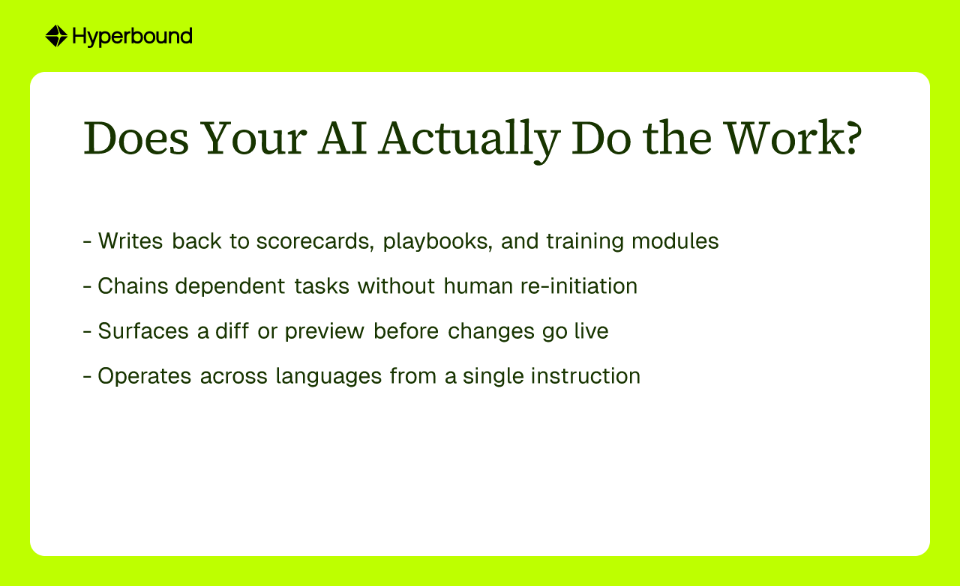
The practical test for any AI assistant in an enablement context is whether it can write back. Summarization, call scoring visibility, and pipeline alerts all have value. If the system cannot update a scorecard, deploy a practice scenario, or push a change to a playbook on instruction, it is producing a to-do list rather than reducing one.
MIT Sloan's analysis of AI and workflow redesign draws a useful distinction between AI that accelerates individual tasks and AI that reshapes the workflow itself. The second category is where enablement teams recover the hours currently spent on implementation overhead, and where the function can operate at a level closer to strategy than administration.
When evaluating whether a tool crosses the line from question-answering to work-doing, the criteria are concrete:
If the answer to those questions is no, the tool is an analyst. It will tell enablement teams what needs to change. It will not change it.
The distinction between an AI agent that does the work and one that answers questions is structural. It is the difference between a function that scales and one that stays capped by the hours its team can spend on forms.
An AI assistant answers questions and surfaces information, while an AI agent plans and executes multi-step work by writing back into the systems it reads from. In sales enablement, an assistant identifies which scorecards need updating, while an agent updates all of them, builds practice bots, and deploys changes on instruction.
An enablement team can determine this by checking whether the tool writes back to scorecards, playbooks, and training modules, chains dependent tasks without human re-initiation, surfaces a diff or preview before changes go live, and operates across languages from a single instruction. If it only summarizes, alerts, or answers questions and cannot make changes to these systems, it is producing a to-do list rather than eliminating one.
"Writes back" means the AI can modify the systems it reads from: updating scorecard criteria, deploying practice scenarios, or pushing changes to playbooks and training modules. Read-only AI can only report what needs to change; write-back AI can execute that change on instruction.
Task chaining matters because the main efficiency gain from AI comes from eliminating coordination costs between dependent tasks, not just speeding up individual tasks. When a single instruction triggers a full chain, such as updating 80 scorecards, building practice bots, and deploying them in five languages, the handoffs and re-checks disappear, allowing enablement teams to scale execution without adding headcount.
Yes, a work-doing AI agent can operate across languages and team configurations from a single instruction. For example, an enablement team can instruct it to build three practice bots for a new discovery-call criterion and deploy them in English, Spanish, French, German, and Japanese without creating separate workflows for each language.
No, AI agents do not remove the need for human review. The strongest implementations surface a diff or preview before changes go live, so enablement teams can approve or adjust updates before scorecards, playbooks, or training modules are changed across the organization.
Enablement teams should demand proof that the AI writes back to the systems it reads from, chains dependent tasks, provides a review state such as a diff or preview, and works across languages from a single instruction. If a vendor cannot demonstrate these capabilities, the tool is an analyst that reports problems but does not solve them.
Question-answering AI improves search and visibility but still leaves a to-do list for humans to work through. It can confirm which records or calls need attention, but it cannot complete the underlying administrative work, so throughput remains capped by team hours and manual overhead.









Use Cases
Legal