
Revenue organizations manage more content than sales representatives can reasonably review. According to Docket, 54% of organizations rely on more than five different platforms for information, and 62% of agents report that the information in their knowledge systems is outdated. The content exists, but it is not connected, versioned, permissioned, or trusted.
The problem becomes more consequential as AI agents move into seller workflows. An AI assistant that surfaces a stale pricing sheet, or a battlecard that no longer reflects the competitive landscape, does more than fail to help; it actively misleads. As Amplience notes, content creation is no longer the primary challenge; content management is.
This is the infrastructure problem that agentic content management is designed to solve.
A traditional CMS stores and publishes content for human readers. An agentic CMS holds content as structured, related knowledge an AI agent can interpret, apply in context, and act on, inside guardrails a human sets. The distinction reflects a structural change in who, and what, consumes the content.
A conventional CMS operates as a document repository. Documents are stored and retrieved by humans. The system has no model of what the content means, how pieces relate to one another, or under what conditions a given asset should be used.
When AI agents are layered on top of these systems, the gaps become consequential. Traditional CMS platforms process text rather than products, pricing tiers, or competitive positioning, as Amplience notes. Without semantic structure, an agent has no context to reason over. The result is the behavior revenue teams already recognize from early AI tools: generic outputs, missed specificity, and responses that confidently cite outdated information.
The governance gap is equally serious. Docket states that connecting a traditional knowledge management system to an LLM wrapper does not resolve the governance problem; it often conceals it until a buyer asks a difficult question.
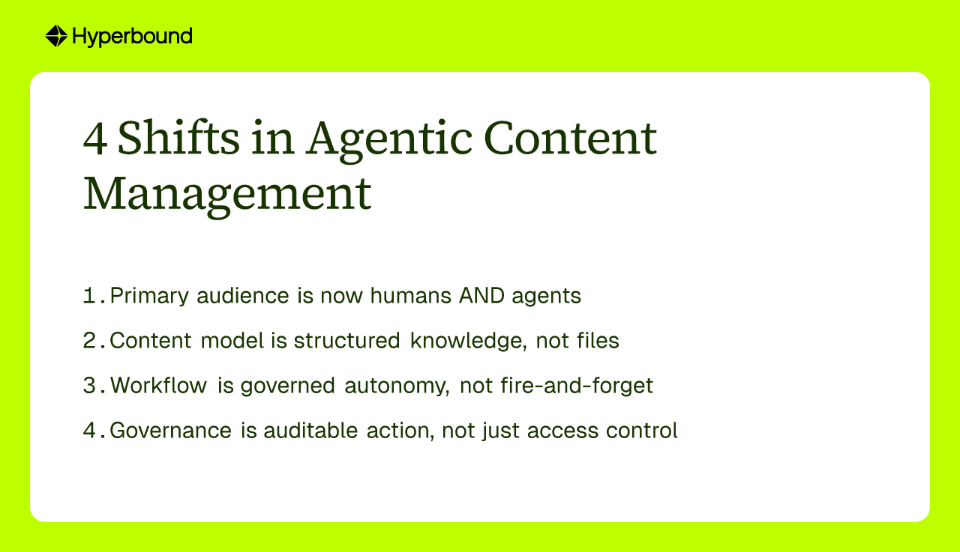
Agentic content management is defined by four structural changes from the traditional model. Each shift addresses a specific failure mode of legacy systems when agents are added to the workflow.
A traditional CMS is built for human readers. Page layouts, navigation hierarchies, and document formats serve people who browse, skim, and decide what is relevant. That model becomes insufficient when the consumer is an AI agent.
As BCMS observes, humans read pages; agents read knowledge. Agents do not navigate menus. They query structured entities and follow semantic relationships. An agent assisting a seller needs to know that a specific pricing plan applies to enterprise accounts, is available only in certain geographies, and is countered by a named competitor's offering. A PDF on a shared drive cannot supply that context. An agentic system can supply that context because it stores the relationships between those facts, not just the facts themselves.
For revenue teams, this requires content to be authored and structured with two first-class audiences in mind simultaneously.
Traditional CMS content is organized by format: decks, documents, pages. Agentic content management organizes content by meaning: what it is, what it relates to, when it applies, and who is authorized to use it.
The goal is a single approved layer of product, pricing, security, enablement, and competitive knowledge that both reps and agents can trust. Docket frames this as a maturity journey through three stages: a static knowledge management system, a dynamic knowledge base, and finally governed agentic execution. The third stage is only reachable when the underlying content model supports versioning, permissioning, and semantic relationships. A file-based system cannot support it.
A traditional content workflow is linear. A human authors, a manager approves, and the content publishes. The human makes every consequential decision. An agentic workflow is dynamic and trigger-driven. The agent can propose, retrieve, assemble, and in some cases act, without a human initiating each step.
This is the shift that most concerns revenue teams confronting AI for the first time, and the concern is legitimate. Full automation without oversight produces the failure mode that practitioners already recognize: an agent takes a consequential action, such as surfacing a non-public pricing commitment to a prospect, without any human having approved it.
The solution is governed autonomy. Amplience describes this as the maker-checker pattern: business users, without writing code, set rules such as auto-publish if AI confidence exceeds a defined threshold, otherwise route to human review. The agent proposes; the human approves or overrides; the threshold determines which actions clear automatically and which do not.
Highspot frames the same principle at the revenue team level: agentic AI does not replace human judgment or expertise. It gives teams better visibility, quicker answers, and clearer next steps. The agent compresses the time between a trigger and a recommended action. The human retains the decision on whether to act.
Traditional content governance asks who can view a document. It is permission management. Agentic governance specifies which actions an agent can take, under which conditions, and what auditable record is produced for every decision.
Arthur.ai identifies human-in-the-loop governance as a per-action design decision, not a single system-wide setting. Whether a specific agent action requires a human gate depends on four criteria: its reversibility, its blast radius, the sensitivity of the data it touches, and the agent's own confidence in the output. A low-stakes, reversible action with high confidence may clear automatically. An action that modifies a customer-facing commitment does not.
The second component is a decision log. Every approval, denial, override, and timeout needs to be recorded with full context. This converts oversight from a process commitment into verifiable governance. The decision log supplies an auditable record.
For revenue teams, this translates to role-tiered access with distinct permission levels: an SDR, an account executive, and an AI agent surfacing content to a prospect do not share the same permission level, and every action the agent takes is traceable.
Three misconceptions commonly arise when revenue teams evaluate this category.
Agentic content management is not an AI writing assistant or a chatbot. BCMS classifies those as features. Autonomy, rather than intelligence, is the defining characteristic of an agentic system. The system initiates actions based on triggers and context. It does not wait to be prompted.
The category does not involve autonomous content creation. The framework is built around human oversight and governed workflows by design. The maker-checker pattern, the decision log, and the per-action HITL criteria exist precisely to prevent what Arthur.ai describes as unapproved consequential action. Removing human controls from the loop is the failure mode the category is designed to prevent, not its objective.
An agentic CMS is not an LLM wrapper on a knowledge base. Amplience and Docket both state that this approach fails on two fronts. Technically, it produces hallucinations because the agent has no structured context to reason over. Operationally, it hides governance risk rather than managing it.

Defining the category is a first step. Building the infrastructure it requires is the more difficult one, and it requires tooling designed from first principles rather than retrofitted from existing systems.
Hyperbound offers Kota CMS. The full definition:
"Kota CMS is Hyperbound's emerging approach to agentic content management for revenue teams. It is designed to centralize and govern sales knowledge, understand the context in which it should be used, and activate the right information across Practice, Perform, Activate, and connected seller workflows."
Each element of that definition maps to one of the four shifts. Centralizing and governing sales knowledge addresses the content model shift: structured, versioned, permissioned knowledge instead of scattered files. Understanding the context in which content should be used addresses the audience shift: the system serves both human sellers and AI agents, and it understands the difference. Activating the right information across seller workflows addresses the workflow and governance shifts: governed, trigger-driven execution with human controls built in.
Kota CMS is currently available as a private, paid preview. It is not generally available and is not included in existing Hyperbound plans.
AI agents are becoming a standard component of revenue team workflows. The content infrastructure those agents depend on determines whether they produce accurate, governed actions or introduce material risk. An agent operating on a fragmented, unstructured, ungoverned knowledge base produces the outcomes associated with early AI tools: generic outputs, outdated facts, and actions taken without appropriate oversight.
Agentic content management is the category of infrastructure that addresses those risks directly. It requires a structured and semantically connected content model, a governed workflow that preserves human review at the right decision points, and an auditable record of every agent action. The category does not require full automation; it supports controlled deployment with safeguards that catch and correct errors before they reach a prospect.
Revenue teams that are planning AI agent deployments need to assess their content infrastructure before they assess the agents themselves, because the content layer is the primary constraint. Two companion pieces make the case and the how-to concrete: Structured Revenue Knowledge (why the content model decides consistency) and Content Governance for Sales Teams Who Change What an AI Enforces (the audit trail that makes it safe).
To learn more about Kota CMS and request access through your Hyperbound account manager, visit the Kota CMS introduction page.
Agentic content management is an approach to organizing, governing, and activating business knowledge so that both humans and AI agents can use it reliably. It stores content as structured, related knowledge with versioning, permissions, and semantic context, rather than as disconnected files.
A traditional CMS is built for human readers and organizes content by format: pages, decks, documents. An agentic CMS treats content as a structured knowledge graph that AI agents can query, reason over, and act on. The audience shifts from humans only to humans and agents, and governance expands from access control to auditable action.
AI agents need structured content because they cannot "read" pages the way humans do. They rely on relationships between entities such as product, pricing, competitor, geography, and permission to provide accurate, context-aware answers. Without structure, agents hallucinate, cite outdated information, or miss critical nuances.
The four shifts are: (1) the primary audience becomes humans and agents, (2) the content model moves from files to structured knowledge, (3) workflow becomes governed autonomy rather than fire-and-forget publishing, and (4) governance becomes auditable action, not just access control.
It prevents hallucinations by providing agents with a structured, versioned, permissioned knowledge base with semantic relationships. Instead of retrieving text from scattered documents, the agent queries an approved knowledge layer, which reduces the risk of outdated or incorrect information being surfaced. Human-in-the-loop controls add a further safeguard for high-stakes actions.
Human-in-the-loop governance ensures that consequential agent actions, such as surfacing a non-public pricing commitment, require human review. Per-action criteria such as reversibility, blast radius, data sensitivity, and agent confidence determine which actions clear automatically and which are routed to a human. Every decision is logged for auditability.
Kota CMS is Hyperbound's emerging approach to agentic content management for revenue teams. It centralizes and governs sales knowledge, understands the context in which that knowledge should be used, and activates the right information across Practice, Perform, Activate, and connected seller workflows. It is currently available as a private, paid preview.
Revenue teams should first assess whether their content is structured, versioned, permissioned, and semantically connected. Then they should adopt a governed workflow with human review at the right decision points and an auditable record of agent actions. Finally, they should select tooling designed for agentic content management rather than retrofitting a traditional CMS.










Use Cases
Legal