
You've done your homework on Gong. Maybe you even got a quote. And then you saw the number — somewhere in the range of $1,200 to $1,500 per user per year, which can balloon to $20,000+ annually for a team of any real size. As one sales leader put it on Reddit: "the pricing is insane for our stage, got quoted around $20k+ per year which we just can't justify right now."
That's the Gong trap. Enterprise pricing that forces mid-market teams to either overpay for features they'll never use — or go without call intelligence entirely.
But here's the real problem: even teams that can stomach the cost often find themselves underwhelmed. Zoom summaries and basic transcripts are useful, sure. But as one user summed it up: "we've tried the zoom summaries, they're useful for quick recaps but as we're starting to grow we need more than just transcripts." Surface-level analysis doesn't drive behavior change. And without behavior change, you don't get shorter ramp times, higher win rates, or consistent deal execution.
This article is different from the typical "Gong alternatives" list. We're not just listing call recorders. We filtered specifically for tools that offer transparent pricing and coaching depth — platforms that go beyond transcription to help reps practice, get structured feedback, and measurably improve. Because the goal isn't to analyze what went wrong after the fact. It's to build skills that win deals before the call even happens.
Not all "call intelligence" tools are created equal. Before diving into the list, here are the criteria we used:
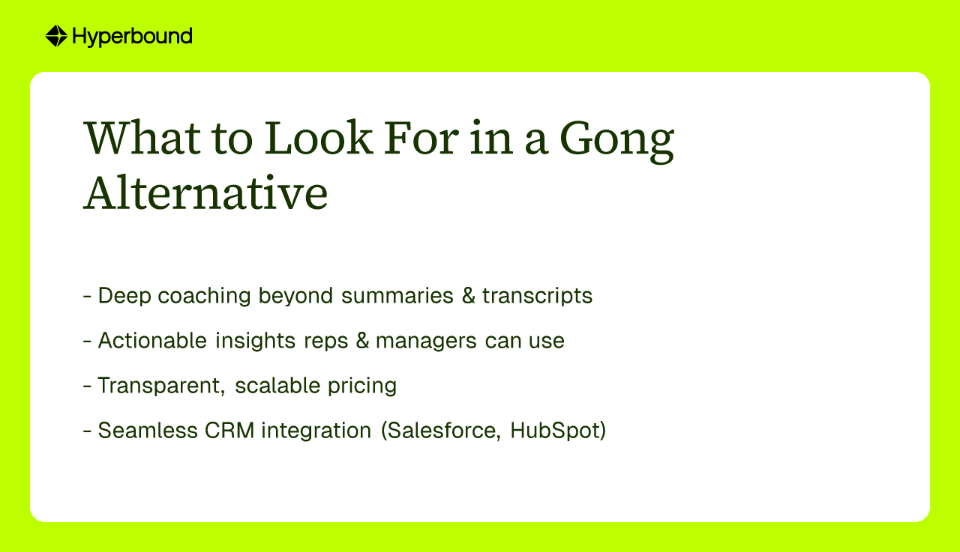
With that in mind, here are the 7 best budget-friendly Gong alternatives for sales teams that take coaching seriously.
Best for: Mid-market sales teams focused on reducing ramp time, scaling consistent coaching, and tying training directly to revenue outcomes.
Hyperbound isn't just a Gong alternative — it's a different category entirely. Gong has recently expanded beyond call analysis with the launch of AI Trainer for roleplay practice, which is a meaningful step. But Hyperbound goes further by closing the full gap between insights and outcomes through automated orchestration. The company coined the term Revenue Activation to describe this: using real call data to identify the behaviors that win deals, then building practice and coaching workflows that actually change how reps perform — with Kota automatically connecting the dots.
Here's how it works through three integrated products:
Practice — Reps master conversations before talking to a real buyer. AI buyer personas are built from analysis of 2M+ hours of real B2B sales conversations — not generic scripts. Whether it's cold calls, discovery, demo objections, or renewal conversations, reps can run realistic simulations and get instant AI scorecards with methodology-aligned feedback. Bitesized Roleplays let tenured reps sharpen specific skills without sitting through full-length generic sessions.
Perform — Real call scoring at scale. AI scorecards automatically evaluate 100% of customer conversations and surface deal-level coaching insights — looking across all calls in a deal to identify what's helping or hurting the opportunity, and what to do next. This is deal health and deal inspection, not forecasting. (Live March 2026.)
Kota Activate — The orchestration layer. Kota connects Practice and Perform data to recommend personalized coaching interventions at the right time — so managers know exactly where to focus and reps know exactly what to work on.
The result is a continuous improvement loop: Score Real Calls → Identify Skill Gaps → Practice Roleplays → Score Again.
Pricing: Transparent, designed for mid-market scalability — available upon request.
CRM Integration: Salesforce, HubSpot, Pipedrive. Also integrates with Gong, Outreach, Zoom, Google Meet, and MS Teams.
Ramp Impact: 50% faster ramp, 3.5 workweeks of coaching saved per manager, and 2x faster time to first won deal. Vanta used Hyperbound to reduce ramp from 210 days to 72 days — a 60% reduction — while growing their BDR team 4x and achieving a 5x increase in pipeline.
Best for: Startups and cross-functional teams that need affordable meeting intelligence without complexity.
Avoma is a solid entry point for teams outgrowing Zoom summaries but not yet ready for enterprise pricing. It offers AI-powered meeting summaries, a searchable conversation library, and custom coaching recommendations based on call analysis. Its biggest selling point is the price — starting at just $19/user/month, it's one of the most accessible tools on this list.
The tradeoff: Avoma is primarily post-call analysis. There's no built-in practice layer to help reps proactively build skills before a live deal.
CRM Integration: Salesforce, HubSpot. Ramp Impact: Moderate.
Best for: Sales teams that want to embed structured coaching into their daily workflow.
Jiminny goes a step further than basic transcription by giving managers tools to build custom coaching scorecards and curated playlists of best-practice calls. It integrates with Slack for real-time feedback, making it easier to keep coaching visible and consistent across distributed teams.
It's a strong choice for teams trying to standardize coaching culture without the Gong price tag.
CRM Integration: Salesforce, HubSpot. Ramp Impact: Moderate — strong for reinforcing past performance, less proactive on skill-building.
Best for: High-volume outbound teams (SDRs/BDRs) who need in-the-moment guidance.
Salesken.ai is built around real-time coaching. It listens to live calls and surfaces prompts, objection-handling cues, and qualification frameworks as the conversation unfolds. Post-call, it delivers automated assessments to help reps understand what worked and what didn't.
For teams that run high volumes of cold calls and need reps to get productive fast, the live guidance model can accelerate confidence quickly.
Pricing: Custom, with SMB-friendly tiers. CRM Integration: Salesforce, HubSpot. Ramp Impact: Moderate to High.
Best for: Individuals and small teams who want a fast, free solution for call summaries.
Fathom is the tool that keeps coming up in community discussions, and for good reason. As one sales professional put it: "Fathom is the best... It's essentially free and it has so much functionality."
Fathom automates note-taking, generates AI summaries, and syncs action items directly to your CRM — saving managers and reps hours each week. Where it falls short: it's not a coaching platform. There's no structured feedback, no scorecards, and no practice layer. It frees up time for coaching; it doesn't replace it.
Pricing: Free tier available, with competitive paid team plans. CRM Integration: Salesforce, Slack, Google Meet. Ramp Impact: Low to Moderate.
Best for: Contact centers and teams in regulated industries that need compliance and consistency on every call.
Balto takes a real-time approach to coaching — not through post-call summaries, but through live AI-driven playbooks that guide reps through objection handling, key talking points, and compliance checkpoints as they speak. Managers get alerts for coaching moments as they happen.
For teams where message consistency and compliance aren't optional, Balto is a serious option.
Pricing: Cost-effective enterprise model. CRM Integration: Major CRMs and telephony platforms. Ramp Impact: High — helps new reps perform to standard from day one.
Best for: Larger teams already in the ZoomInfo ecosystem who want to enrich conversation data with market intelligence.
Chorus is the more accessible cousin of Gong — a well-established conversation intelligence platform that still packs robust analytics, deal tracking, and talk-time analysis. Its integration with ZoomInfo adds a layer of prospect and account context that standalone recorders can't match.
That said, Chorus sits on the higher end of this list in terms of cost, and unlike Gong (which has added AI Trainer for practice), Chorus doesn't offer a built-in practice or simulation layer to proactively build rep skills.
CRM Integration: Salesforce, HubSpot, Microsoft Dynamics 365. Ramp Impact: Moderate.
.png)
.png)
Most tools on this list — and Gong itself — were originally built around the same premise: record what happened, analyze it, and surface insights. That's valuable. But it's post-game tape. Gong has taken a step forward with AI Trainer, adding AI roleplay practice built from real customer interactions. But for most of the conversation intelligence category, the core experience is still retrospective — it shows you what went wrong after the deal slipped.
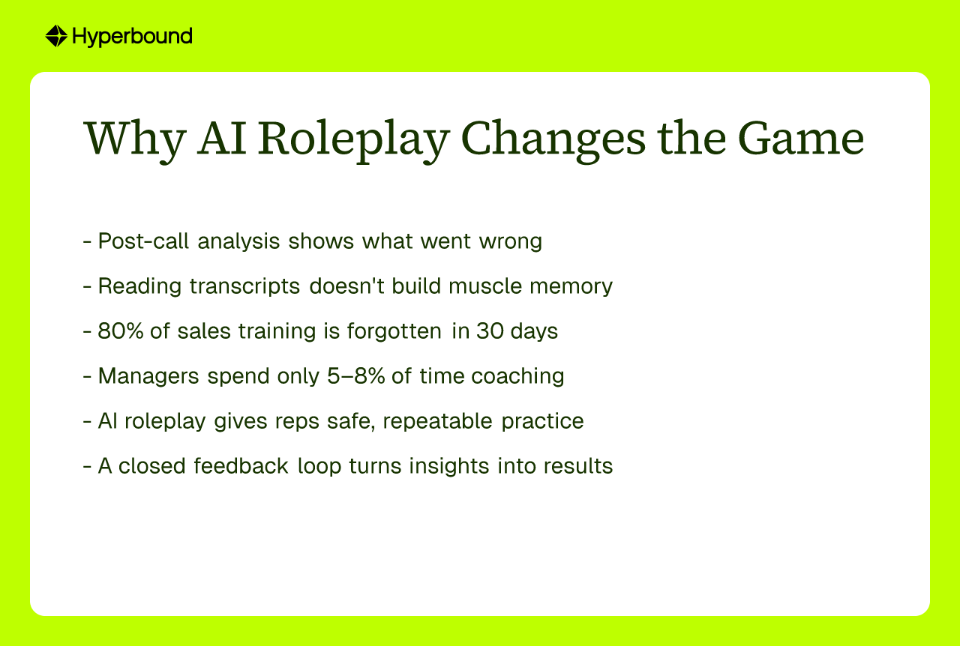
The problem is that analysis alone doesn't build muscle memory. Reps don't get better at handling objections by reading a transcript of themselves fumbling one. They get better by practicing — getting the at-bats they need in a safe environment before a live deal is on the line.
This is exactly the gap users in the community are pointing at when they say they want tools for "pre call planning" and that surface-level tools "aren't great" for actually improving performance. Research backs this up: 80% of sales training is forgotten within 30 days, and most managers spend only 5-8% of their time on coaching. Passive data review doesn't close that gap.
AI roleplay fills it. Think of it as the driving range for your sales team — a place to practice before the real round. Hyperbound's AI Roleplays use buyer personas built from 2M+ hours of real B2B sales conversations, so reps aren't practicing against generic bots. They're facing scenarios modeled on the actual objections, conversation patterns, and buyer dynamics your team encounters every day.
When that practice loop connects back to real call scoring through Hyperbound Perform, you get something none of the other tools on this list can offer: a closed feedback loop. Score real calls → identify skill gaps → practice specifically on those gaps → score again. That's how you turn conversation intelligence into actual performance improvement, not just a data report nobody acts on.
The landscape of Gong alternatives has matured fast. You don't need to pay an enterprise premium to access powerful call intelligence and coaching tools. And you definitely don't need to settle for a tool that just records your calls and generates summaries your team ignores.
The real differentiator in 2026 is whether your sales enablement stack can drive behavior change — not just surface data. Most tools on this list take solid steps in that direction. But if you're serious about cutting ramp time, scaling coaching without burning out your managers, and building a team that executes consistently on every call, you need the full loop: analyze what's happening on real calls, identify exactly where reps are falling short, and give them a realistic place to practice the skills that actually move deals forward.
That's what Hyperbound was built for. And the numbers speak for themselves: 50% faster ramp, 3.5 workweeks of coaching saved, and results like Vanta's 60% ramp reduction and 5x pipeline growth.
The main problem with Gong for mid-market teams is its enterprise-level pricing, which is often prohibitively expensive. While Gong has recently added AI Trainer for roleplay practice — a meaningful step toward proactive skill development — its core strength remains post-call analysis. Many mid-market teams find themselves paying for a broad feature set (forecasting, deal intelligence, CI) when what they need most is a tighter loop between call scoring and targeted practice that drives measurable behavior change.
Beyond call recording, you should look for deep coaching capabilities, actionable insights for reps and managers, transparent pricing, and seamless CRM integration. The most effective Gong alternatives help teams improve performance, not just analyze it. This means features like AI-powered scorecards, structured feedback workflows, and practice environments like AI roleplays that actively help shorten ramp time and drive consistent deal execution.
AI roleplay is a proactive training method that allows reps to practice skills in a safe environment, while reviewing call recordings is a reactive analysis of past performance. Reviewing a transcript shows you a mistake after it has potentially cost you a deal. AI roleplay lets reps practice handling specific objections, new messaging, or difficult buyer personas before a live call, building the confidence and muscle memory needed to win.
Hyperbound is the best alternative for teams focused specifically on sales coaching and reducing ramp time because it creates a closed feedback loop between call analysis and skill practice. While other tools offer strong coaching features, Hyperbound's "Revenue Activation" model is unique. It uses AI to score real calls, identifies skill gaps, and then provides a realistic AI practice environment for reps to close those gaps, cutting ramp time by up to 50%.
Yes, Fathom is a popular and powerful free alternative for call recording, transcription, and AI-generated summaries. It's a fantastic tool for automating note-taking and capturing key moments from meetings. However, it's primarily a productivity tool, not a coaching platform. It saves time that can be used for coaching but doesn't provide the structured feedback, scorecards, or practice environments needed to drive systematic performance improvement.
Behavior change is more important because it directly leads to improved outcomes like higher win rates, whereas call analysis only provides data about past events. Insights from call analysis are useless if they don't lead to reps performing differently on their next call. True sales enablement focuses on creating lasting habits and skills through consistent practice and reinforcement, which is the key to scalable revenue growth.
Ready to see what Revenue Activation looks like in practice?
Book a live demo of Hyperbound →






Use Cases
Legal