You've been through countless discovery calls. You've memorized the pitch deck. You've handled every standard objection in the book. And now, your sales manager wants you to participate in yet another roleplay session with the team.
"Not this again," you think to yourself.
For experienced sales professionals, traditional roleplay often feels like a waste of precious selling time. It's awkward, scripted, and rarely mirrors the complex scenarios you face daily with real prospects. As one veteran rep put it in a recent discussion: "Role play can be helpful to an extent but often fake and weird."
But what if roleplay could actually challenge your skills and prepare you for those high-stakes situations that make or break your quarter?
Traditional sales roleplay typically falls short for tenured representatives for several key reasons:
The good news? There's a better approach.
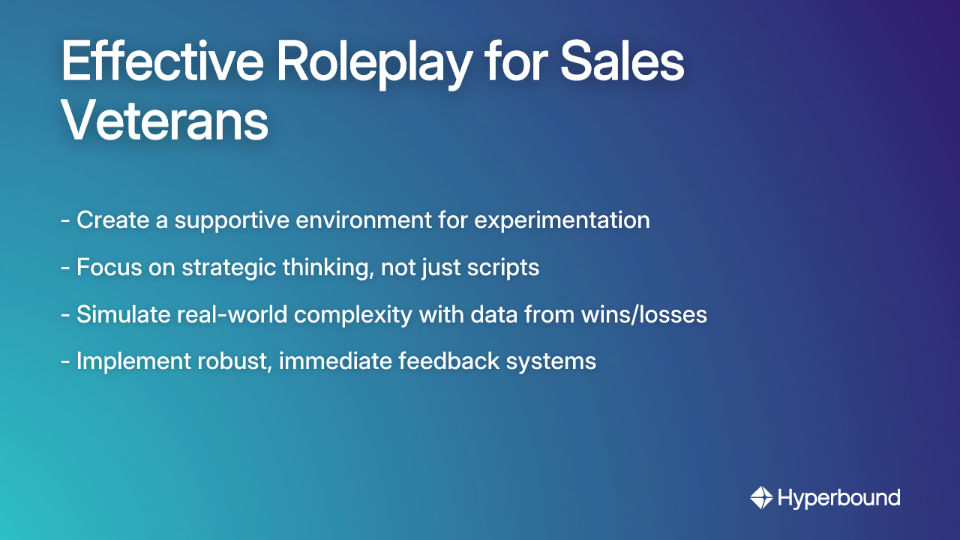
Advanced roleplay isn't about memorizing scripts—it's about developing the strategic thinking and adaptability required to handle complex, high-pressure sales situations. Here's how to reframe the practice for your most seasoned team members:
Ready to elevate your team's roleplay from basic to challenging? Here are 12 scenarios designed specifically for tenured sales professionals, organized by key challenges they're likely to face:
1. The Price Haggler on Steroids
2. The Power Balance Shift
3. Mixed-Motive Bargaining
7. The Unexpected Budget Cut
8. The Feature Fanatic
9. The Skeptical Prospect
These scenarios move beyond "baptism by fire" roleplay and create structured opportunities for sales professionals to develop muscle memory for handling the most challenging situations they'll face in the field. Regularly practicing these advanced scenarios has been shown to significantly improve close rates on complex deals.
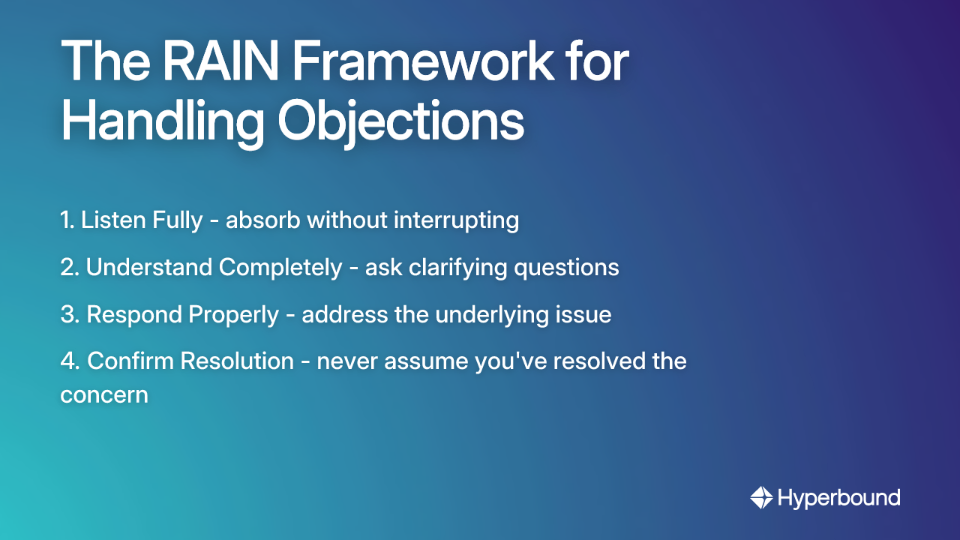
For these advanced roleplays to be effective, tenured sales reps need a structured approach to navigate objections. The RAIN framework provides an excellent mental model:
1. Listen Fully to the Objection
2. Understand the Objection Completely
3. Respond Properly
4. Confirm You've Satisfied the Objection
This framework transforms objection handling from an awkward exchange into a strategic conversation that builds trust through the sales process.
For experienced sales reps, negotiation is where deals are won or lost. Research highlights several advanced techniques that should be incorporated into your roleplay scenarios:
Offering Strategic Trades
Knowing When to Walk Away
Controlling the Frame
The emergence of AI is transforming how sales teams approach roleplay. However, not all AI tools are created equal. While some reps use basic AI for practice, many find it lacking. As one sales professional noted of simpler AI, "I found it a bit unrealistic for B2B sales role-playing... which it doesn't really handle well."
This is where sophisticated AI sales coaching platforms like Hyperbound make a difference. Instead of generic chatbots, these platforms analyze your own winning sales calls to create hyper-realistic AI Roleplays. This allows reps to practice against AI buyers who are armed with relevant objections and questions, mirroring real-world conversations.
The benefits of this advanced approach include:
The verdict? Advanced AI is no longer just a supplement. It’s a powerful co-pilot that prepares reps for the nuance and adaptability required in today's market, ensuring they are ready for any conversation.

For tenured sales representatives, roleplay doesn't have to be a waste of time. When designed correctly, it becomes a powerful tool for sharpening the advanced skills needed to win competitive deals.
As one sales veteran put it, "It's like going to the gym, or meditating. It's hard, and most people will avoid it and not reach their full potential."
The most successful sales professionals understand that mastering complex client pitches, handling unexpected objections during discovery calls, and navigating high-stakes negotiations requires consistent practice in realistic scenarios.
By transforming roleplay from basic script recitation to strategic simulation, you give your experienced team members the opportunity to:
In today's increasingly competitive sales landscape, the difference between good and great often comes down to how effectively your team handles those critical moments in the sales process. Advanced roleplay ensures they're ready when it matters most.
Traditional sales roleplay often fails experienced reps because it lacks the complexity, realism, and high stakes of their actual sales interactions. Scenarios are often too simple, partners don't provide realistic pushback, and there are no real consequences, making it feel like a theatrical exercise rather than valuable practice. This can lead to disengagement and a feeling that it's a waste of time for seasoned professionals.
To make sales roleplay more effective, focus on transforming it into a strategic simulation. This involves using data from recent wins and losses to create hyper-realistic scenarios that mirror the complex, multi-stakeholder deals your team actually faces. Emphasize strategic thinking over script memorization and foster a supportive environment where reps can experiment and receive constructive feedback.
The RAIN framework is a four-step method for structuring your response to any objection: Listen Fully to the concern without interrupting, Understand Completely by asking clarifying questions to find the root cause, Respond Properly with a concise answer to the underlying issue, and Confirm Resolution by asking if you've satisfied their concern.
AI can significantly improve sales roleplay by providing a scalable, non-judgmental, and highly realistic practice environment. Sophisticated AI coaching platforms can analyze your own sales data to create AI buyers who use relevant objections and mirror real-world conversations. This allows reps to practice complex scenarios on-demand and receive objective, data-driven feedback to hone their skills.
Advanced roleplay scenarios should challenge veteran reps with situations they regularly encounter. Examples include handling a prospect who claims a competitor is 35% cheaper, navigating a sudden change in the decision-maker mid-deal, reviving a stalled opportunity, or managing conflicting priorities among multiple stakeholders in a final presentation.
Creating a psychologically safe environment for roleplay starts with leadership framing mistakes as learning opportunities, not failures. Emphasize that the goal is practice and development, not performance evaluation. Encourage experimentation, ensure feedback is constructive and focused on strategy, and foster a culture where reps feel comfortable being vulnerable and tackling difficult scenarios with their peers.
Are you ready to elevate your sales training beyond the basics? Start implementing these advanced scenarios and frameworks today, and watch as your team's confidence—and results—reach new heights.










Use Cases
Legal