Active listening in sales calls is not a soft skill measured by how attentively a rep nods. It is a specific, repeatable set of mechanics: mirroring the buyer's exact words, resisting the urge to fill silence, and capturing what was said without breaking eye contact to type it. The evidence for why this matters is blunt. Across 326,000 sales calls of ten minutes or longer, the average talk-to-listen ratio is still 60% talking to 40% listening, and closed-won deals averaged 57% talk time against 62% on lost deals, a small but consistent gap in the direction of listening more.
This piece is technique, not theory. It walks through what to do differently on the next call, why mirroring the buyer's own language outperforms a rep's own vocabulary, how to capture the words that matter without losing the thread of the conversation, and how sales enablement leaders can turn an individual habit into something the whole team can be coached on.
Active listening in a sales context is the practice of matching and reflecting a customer's verbal and physical cues to build rapport, and it depends on genuinely listening rather than waiting for a turn to speak. One of its core elements is adjusting what a rep says to use the customer's own lingo and speech patterns, which builds familiarity in a way that a rep's internal terminology cannot. (For the broader contrast, see our guide to active versus passive listening.)
Why it matters for outcomes specifically: the details that decide a deal are rarely the ones on the discovery call script. They are the buyer's exact words for their pain, the budget number that slips out in passing, and the name of the actual decision-maker. A rep who is busy formulating a rebuttal, or typing a summary, misses these because they arrive once, in passing, and are gone. Prospects can also tell the difference. A rep who captures everything without touching a keyboard sounds present, and follows up with precision instead of a generic recap.
The instinct in most sales training is to translate what the buyer says into the rep's own framework: their "we lose three days onboarding every new hire" becomes the rep's "so, onboarding inefficiencies." That translation feels efficient. It is also the wrong move, and there is research behind why.
A primary study of nine hostage negotiations, coded across eighteen linguistic categories, found that successful negotiations showed higher aggregate Linguistic Style Matching (LSM) than unsuccessful ones. LSM measures the degree to which two parties coordinate their word use and style, and it predicted the outcome. The more telling finding was about consistency, not peak skill: unsuccessful negotiations showed dramatic fluctuations in LSM because the negotiators could not sustain rapport and coordination, while successful ones held that coordination steady throughout. At the turn-by-turn level, the successful sessions also showed greater coordination of turn-taking, reciprocation of positive affect, and a focus on the present and on alternatives rather than on competition or the past.
LSM measures the coordination of function-word style, not content vocabulary, so it is a close cousin of mirroring a buyer's specific phrasing rather than an identical mechanism. The practical bridge between the two is well documented in negotiation training. Chris Voss's definition of the mirror is precise: repeat the last three to five words the counterpart just said, with an upward inflection, as though it were a question. If a caller asks, "Have you got a few minutes to talk?", the mirror is simply, "A few minutes to talk?" Voss recommends writing that exact script on a 3x5 card and rehearsing it until the mechanic becomes automatic, citing roughly 63 to 64 repetitions to groove a new habit into place. Once the habit sets, the mirror can be more surgical, pulling three to five words from the middle of what someone said rather than only the tail end, and sometimes narrowing to a single word.
Mirroring does double duty. Beyond building rapport, restating a buyer's position back to them forces them to reveal, often without realizing how quickly they have done it, whether that position is soft or firm. A prospect who repeats and reinforces a stated objection when it is mirrored back is telling a rep something different than one who backs off or qualifies it the second time. That is a discovery signal, not just a warmth signal, and it is one that generic "ask more questions" advice does not surface.
The talk-to-listen ratio is the most measured proxy for active listening in sales, and the current data complicates the old rule of thumb. The original benchmark, from 2016, held that the ideal ratio was 43% talking to 57% listening, and that talking past 65% of a call correlated with lower conversion. The more recent 2025 analysis of 326,000 calls found the average has drifted to 60% talking versus 40% listening across the board, meaning most reps are structurally over-talking relative to what the data says wins.
The gap between winning and losing calls is smaller than intuition suggests: 57% talk time on closed-won deals against 62% on lost ones. That five-point difference is directional, not dramatic, and it points to something other than raw willpower to talk less.
The real separator is consistency. Low performers' talk time swings by ten points between their won and lost deals, from 54% to 64%, meaning they listen well when a call is going their way and revert to talking over the buyer when it is not. High performers hold roughly the same ratio regardless of outcome. That distinction reframes active listening from a personality trait into an observable, coachable behavior: the goal is not to be a naturally gifted listener on the calls that feel easy, it is to run the same disciplined ratio on every call, especially the hard ones.
A second counterintuitive finding cuts against the standard advice to "ask more questions." Sellers on winning calls asked 15 to 16 questions on average; sellers on losing calls asked closer to 20. Past a certain point, more questions produce an interrogation, not a dialogue, and the buyer disengages. Lost deals are also marked by longer seller monologues, while won deals show more back-and-forth conducted on the buyer's terms. The fix is not fewer questions for their own sake, but fewer, better ones, built from the buyer's own language rather than a discovery script.
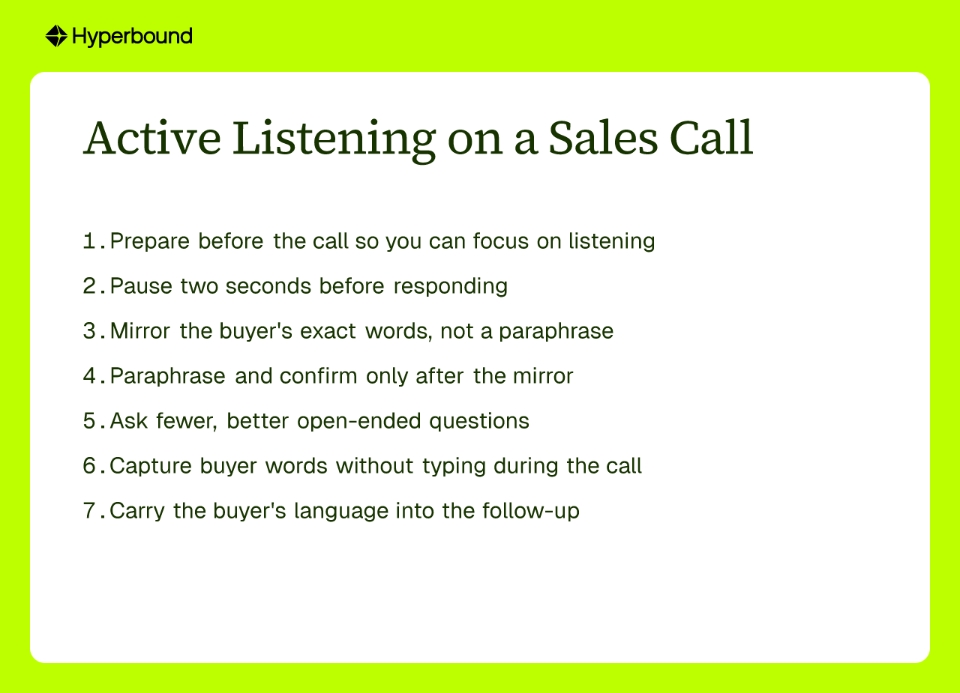
The following sequence is built from mirroring mechanics, talk-ratio research, and the specific mechanics of what breaks listening mid-call. Each step compounds on the one before it.
Preparation is what frees attention during the call itself. A rep walking in cold spends the first several minutes reconstructing context that should already be known, and that reconstruction competes for the same attention that should be on the buyer's language. Reps who arrive with the account's basic shape already loaded can spend the entire call listening rather than orienting.
A simple, mechanical fix for the instinct to jump in the instant a buyer finishes a sentence is to pause for two full seconds before responding. That pause does two things: it confirms the buyer has actually finished, rather than paused mid-thought, and it signals that the rep is processing rather than reciting a pre-loaded response.
This is the technique most reps skip because paraphrasing feels more efficient. It is the wrong trade. When a buyer says, "we lose three days onboarding every new hire," the generic response, "so, onboarding inefficiencies," swaps the buyer's specific, quantified complaint for a vaguer category of the rep's own invention. The mirror instead repeats it close to verbatim: "Three days onboarding every new hire?" That single move does three things at once. It confirms the rep heard correctly, it invites the buyer to elaborate rather than move on, and it keeps the buyer's specific number and framing intact for use later, in the proposal or the follow-up email. The mechanic scales from three to five words down to a single word once it becomes automatic, and it works because it costs the rep almost nothing to execute mid-conversation while a full paraphrase requires more cognitive overhead and more room for the rep's own words to creep in.
Once a mirror has prompted elaboration, a genuine paraphrase-and-confirm step still has a place, but it comes after the buyer has said more, not instead of the initial reflection. "So the onboarding delay is costing you productive time in the first week for every hire, not just the new ones" is a legitimate confirmation once the buyer has supplied enough detail to support it. Confirming too early, before the buyer has finished shaping the thought, is what collapses their specific pain into a generic category.
Given that losing calls average roughly four more questions than winning ones, the discipline is not to prepare more questions, it is to prepare better ones and let the buyer's own answers generate the next one. (See our follow-up question formula for how to turn a buyer's answer into the next question.) "Tell me more" is a deliberately underused prompt: it costs nothing to ask, it cannot be answered with a single word, and it hands the floor back to the buyer at exactly the point where a rep's instinct is to fill the silence with a pitch.
This is the step most active listening advice omits, and it is where the technique usually breaks down in practice. Typing notes live creates a direct conflict between capture and attention: looking down breaks eye contact, live paraphrasing swaps the buyer's exact words for the rep's improvised version in real time, on-the-fly prioritization means a rep guesses at what will matter later and often guesses wrong, and the context-switching between typing and listening degrades the quality of the next question. The result is a rep who is present for maybe half the conversation and has a set of notes that already lost the specific phrasing that made the pain concrete.
The corrective is not "type faster" or "take better notes." It is to not hand-type at all during the call, let the conversation be captured automatically in the background, and work from the transcript and summary afterward. That single change removes the trade-off entirely: full attention stays on the buyer during the call, and the exact words survive intact for review afterward.
The payoff of steps three and six shows up after the call ends. The bridge from listening to a follow-up that actually lands is mirroring the prospect's exact phrasing rather than summarizing it into a template. A follow-up email that repeats the buyer's own words back to them, the specific pain phrase, the budget figure, the name of the real decision-maker, reads as "you get me." A follow-up built from a rep's paraphrased notes reads as a template, because it is one.
The table below shows the difference between the generic response most reps default to and the mirror response, applied to the same buyer statement.
Buyer saysGeneric response (loses the words)Mirror response (keeps the words)"We lose three days onboarding every new hire.""So, onboarding inefficiencies?""Three days onboarding every new hire?""Honestly, budget is tight until next quarter.""Understood, budget constraints.""Tight until next quarter?""Our VP of Ops signs off on anything over this size.""Got it, there's an approval process.""Your VP of Ops signs off?"
For the mirror mechanic itself, Voss's practice method is worth adopting directly: write the exact phrase to be mirrored on a 3x5 card, along with the buyer's likely opening line, and rehearse it until the upward inflection and the pause afterward are automatic. The habit is mechanical before it is natural, and treating it that way, with deliberate repetition, is what makes it usable under the actual pressure of a live call rather than only in a scripted practice.
A few failure patterns show up repeatedly, and each one has a specific fix rather than a general "listen harder" instruction.
Over-mirroring every sentence turns a rapport technique into a verbal tic. Mirroring works because it is used selectively, on the phrases that matter (the pain, the number, the name), not on every clause a buyer utters.
Reverting to old habits under pressure is the pattern behind the ten-point talk-time swing between low performers' won and lost deals. The fix is not more willpower on hard calls, it is running the identical sequence, prepare, pause, mirror, ask fewer and better questions, on every call regardless of how it is going, so the behavior does not depend on how comfortable the rep feels.
Treating paraphrasing as a substitute for verbatim capture is the most common one. A paraphrase confirms understanding; it does not preserve the buyer's specific words for later use. Both have a place, but a paraphrase that arrives before the mirror has done its job tends to flatten the buyer's language into the rep's own categories.
Typing through the call remains the most damaging habit because its costs are invisible in the moment. It feels productive. It is quietly costing eye contact, exact phrasing, and the rep's ability to ask the next good question.
Everything above is achievable by an individual rep with discipline and a 3x5 card. Scaling it across a team is a different problem, and it is the one enablement and coaching leaders are actually accountable for. A manager cannot verify whether a rep mirrored a buyer's language or typed through a call by reading a CRM note afterward, because the note itself was often the casualty of the bad habit. And the consistency finding from the talk-ratio research, that high performers hold their ratio steady while low performers swing by ten points between wins and losses, only becomes coachable if a manager can actually see the ratio on a per-call basis rather than inferring it from outcomes months later.
This is the gap Hyperbound built Live Call Coaching to close, and it is worth naming plainly as one option rather than the only path. Live Call Coaching, launched in August 2026 as part of Hyperbound Perform, is a silent, read-only desktop side panel for Zoom, Teams, Google Meet, Slack huddles, and dialers. It runs in two modes: Guided Coaching, which surfaces a playbook checklist of key points for the rep to hit, and Active Listening, which surfaces the prospect's language in a silent side panel with no typing required from the rep. That second mode addresses the exact capture-versus-attention conflict described above: the transcript and the buyer's verbatim phrases are preserved automatically, in the background, while the rep's eyes and attention stay on the call.
For an enablement leader, the value is less about any single call and more about what it makes visible at scale. Rather than reviewing a fraction of recorded calls after the fact and inferring who listens well, a manager can see talk ratio, mirrored language, and verbatim buyer phrases as a matter of course, and coach to the consistency gap directly rather than guessing at it. That turns active listening from an individual habit worth writing on a 3x5 card into a team-wide, measurable practice inside Hyperbound Perform.

Closed-won calls average about 57% talk time to 43% listening, so the practical target is to stay below 60% talk time. The older benchmark was 43% talking to 57% listening, but the 2025 analysis of 326,000 calls shows most reps now average 60% talking. The gap between wins and losses is only about five points, so the goal is not to eliminate talking but to keep it controlled and consistent on every call.
Sales reps talk too much because preparation gaps, nervousness, and the instinct to fill silence with a pitch compete against the discipline of listening. The data shows low performers swing from about 54% talk time on won calls to 64% on lost calls, while high performers hold a steady ratio regardless of outcome. The fix is a repeatable sequence of preparing, pausing, mirroring, and asking fewer, better questions rather than relying on willpower in the moment.
Aim for roughly 15 to 16 questions on a winning call, not the 20 or more that often appear on losing calls. More questions tend to create an interrogation rather than a dialogue. The better approach is to use open-ended prompts and mirror the buyer's own words, which often generates the next relevant question without needing a fresh scripted one.
No. Active listening is a conversational behavior that includes mirroring, pausing, and asking better questions, while detailed live note-taking is a capture activity that often competes with it. Typing notes during a call breaks eye contact, forces real-time paraphrasing, and splits attention. The exact words the buyer uses are what carry the value, and those are best preserved through automatic capture rather than manual note-taking.
No, when used selectively, mirroring reads as attentiveness rather than manipulation. Repeating a few key phrases, such as the buyer's pain point, a number, or a decision-maker's name, signals that the rep heard exactly what was said. Mirroring every sentence would feel mechanical and obvious, so the technique works best when reserved for the words that carry real information.
The two-second rule is a deliberate pause after the buyer finishes speaking before the rep responds. It confirms the buyer has actually finished rather than paused mid-thought, and it signals that the rep is processing what was said instead of reciting a pre-loaded answer. It is a simple mechanical fix for the common tendency to jump in too early.
Sales managers can coach active listening at scale by making talk ratios, mirrored language, and verbatim buyer phrases visible on a per-call basis. Reviewing CRM notes after the fact cannot show whether a rep listened well, because those notes are often the casualty of the bad habit. Tools such as Hyperbound Perform's Live Call Coaching surface these signals automatically, so managers can coach the consistency gap directly rather than inferring it from outcomes months later.
Stop hand-typing notes during the call and let capture happen automatically in the background. Every other technique, including mirroring, the two-second pause, and asking fewer questions, depends on the rep's attention staying on the buyer rather than being split between the conversation and a keyboard. Removing that split attention is the fastest way to improve the quality of the conversation and preserve the buyer's exact words for follow-up.









Use Cases
Legal