You've crushed your quota for the past three quarters. You've earned a spot in the prestigious presidents club. Your discovery calls consistently uncover pain points that competitors miss.
Yet somehow, when you sit down for that mock call during an interview for that dream AE position, you freeze. Your usual eloquence vanishes. Your strategic questioning feels forced. And that HM who seemed so impressed with your resume is now watching with a stone-cold expression as you stumble through a fake discovery call.
Sound familiar?
"Most people don't enjoy role plays. I'd venture to guess even less enjoy them as part of the interview process. Throw me in that group," confessed one sales professional on Reddit. It's a sentiment echoed across sales floors everywhere: "Role playing sucks and I'm terrible at it but I can rip any sales call easy."
If this resonates with you, you're not alone. The disconnect between stellar real-world performance and awkward role-play fumbling is a common experience among top sales professionals. But here's the good news: this is a game you can win with the right mindset and strategy.
The psychology behind role-play struggles is fascinating. Here's what's really happening:
"For some reason, I have severe difficulty pretending it's real, and as a result, act/speak/question in an entirely different way than in the real world," explains another sales pro.
This disconnect happens because your brain knows "nothing is genuine...you are not actually selling anything, nothing you say will actually sway the other person's mind." There's no real ICP sitting across from you with actual problems to solve.
During a role play, you're not just trying to conduct a discovery call—you're performing for "armchair quarterbacks" who scrutinize every word. "Thinking on the clock is really stressful," admits one sales professional, and this stress compounds when you know the CRO is judging whether you're worth hiring.
Your mindset drives or destroys sales performance. When faced with a mock situation, many salespeople adopt a defensive, test-taking mindset rather than the consultative approach that makes them successful in real scenarios.
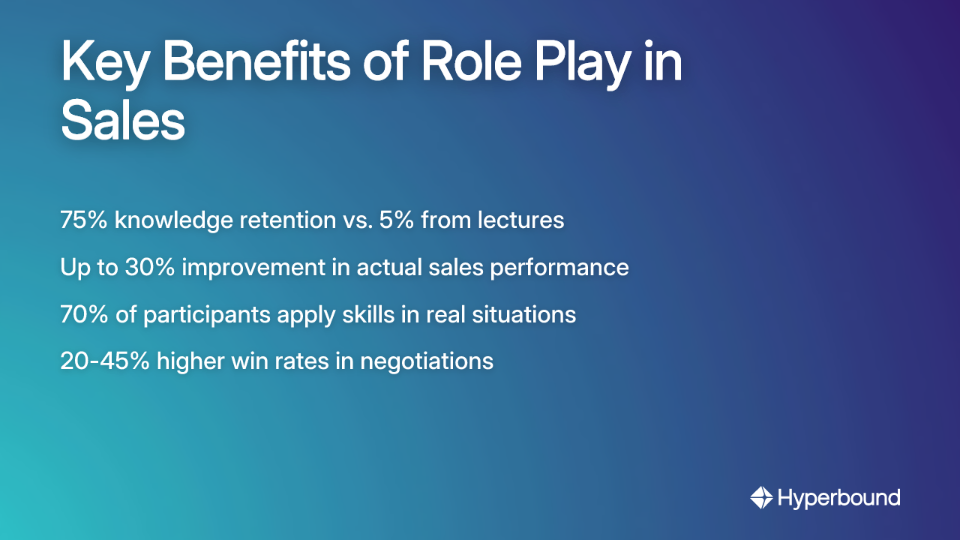
Despite being universally disliked, role plays remain a staple in sales hiring for good reason:
So while it might feel like an artificial hoop to jump through, mastering the role play can be your ticket to landing that dream position—and potentially improving your actual sales skills in the process.
The first step to acing your next role play isn't about perfecting your BANT questions or polishing your sales pitch. It's about fundamentally reframing how you see the exercise.
Sales professionals generally operate with two types of mindsets:
Your goal in a role play isn't to demonstrate perfect technique—it's to showcase a strong, adaptable "soft-coded" mindset that proves you're coachable and can thrive in new environments.
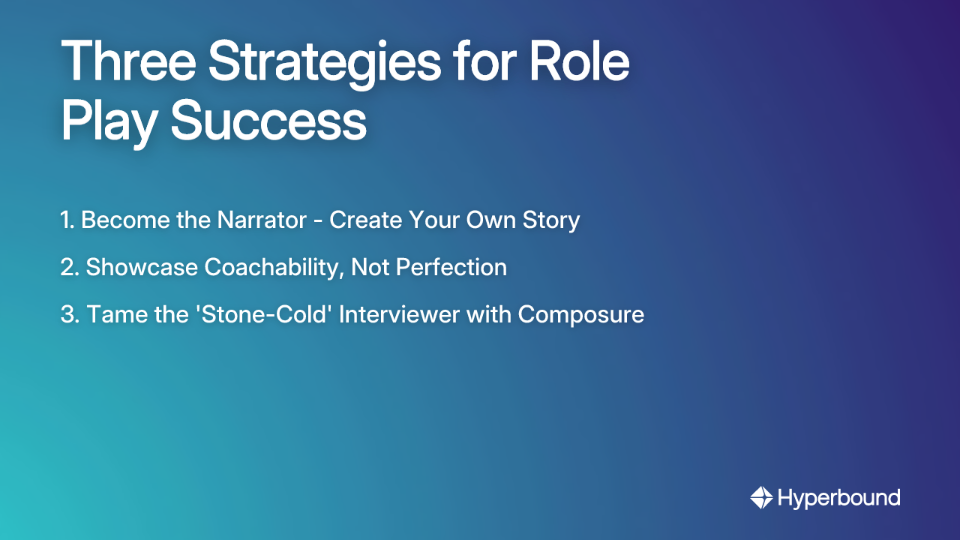
Many salespeople struggle to "build a fake pitch" or engage with a "fake scenario." The solution? Take control of the conversation.
"If you take control of the conversation by spinning your own narrative then role play becomes infinitely easier," noted a sales professional who overcame role play anxiety.
How to Do It:
Hiring managers and panel interviews aren't just looking for a perfect pitch; they want to see if you are coachable. This is often more valuable than flawless execution.
"When someone tells you something to improve, put your ego aside and be open to accepting the influence," advises a sales leader.
How to Do It:
Facing an intentionally difficult or unresponsive interviewer is a common tactic to test your resilience—especially for enterprise sales roles where long TAT and complex buying committees are the norm.
How to Do It:

Before your interview, ask what the role play will involve. Will you be doing discovery? Handling objections? Closing? Understanding the format lets you prepare more effectively.
When asked about your approach or past experiences, structure your answers using:
This storytelling method makes your experiences clear and memorable while demonstrating your strategic thinking.
Don't just practice one pitch. Rehearse common situations to build flexibility:
One successful candidate shared, "I practiced the pitch at least 5 times," highlighting the importance of repetition. This is where AI tools like Hyperbound's AI Sales Roleplays provide a massive advantage, offering unlimited, on-demand practice to build muscle memory and confidence.
Show your engagement and interest by having insightful questions ready:
Before your interview, engage in mock role plays with friends or mentors and ask for constructive criticism. This builds your confidence and helps identify blind spots in your approach.
The key to success isn't about having a perfect, robotic script. It's about:
Remember that a sales role play is your chance to show how you think, adapt, and learn. It's an opportunity to demonstrate your potential as a future top performer and consultant. By shifting your approach from "this is a fake test" to "this is a game I can win," you can turn this dreaded exercise into a moment where you truly shine.
The next time you're faced with a role play in an interview, rather than seeing it as an artificial barrier, view it as your opportunity to showcase exactly why you deserve that spot in next year's presidents club.

Companies use role plays in sales interviews to assess a candidate's practical skills, problem-solving abilities, and coachability in a simulated real-world scenario. Unlike traditional interview questions, role plays reveal how a candidate actually performs under pressure. They offer a window into knowledge retention (75% vs. 5% from lectures), methodology adoption, and how a candidate handles unexpected challenges, which are strong predictors of on-the-job success.
To overcome the artificiality of a role play, you should take control of the narrative and create your own story within the given scenario. Instead of passively reacting to a "fake" situation, proactively guide the conversation. Leverage real examples from your past experiences to make your responses feel more authentic. Frame the exercise as "Let's imagine your team is facing X," turning the abstract prompt into a concrete problem you can solve, just like you would on a real call.
Hiring managers are often looking for coachability and resilience more than a flawless, perfect performance. While strong sales skills are important, a hiring manager wants to see if you are open to feedback, can adapt your approach on the fly, and can remain composed under pressure. Demonstrating that you can accept and incorporate feedback is often more valuable than executing a perfect, rigid script, as it shows you can grow and thrive within their team's culture.
The best way to prepare is to thoroughly understand the scenario, practice with diverse situations, structure your answers using the STAR method, and prepare your own insightful questions for the interviewer. Start by asking what the role play will entail (e.g., discovery, objection handling). Practice with common challenges like price objections or tight deadlines. Using AI role-play tools can help build muscle memory. Finally, having questions ready about the company’s sales cycle or challenges shows you are engaged and thinking strategically.
Stay composed by using breathing techniques, pausing to think before you speak, and using silence strategically. A difficult interviewer is often an intentional test of your resilience. Don't rush to fill every silence. It's perfectly acceptable to say, "That's a good question, let me think about that." This shows confidence and thoughtfulness. Remember, your composure under pressure is what's being evaluated, especially for senior or enterprise roles.
The best mindset is to view the role play as a game you can win or a learning opportunity, not as a pass/fail test. Shifting your perspective from a high-stakes performance to a collaborative exercise reduces anxiety. Focus on showcasing your adaptable, "soft-coded" mindset—your coachability, resilience, and problem-solving skills. Visualizing success beforehand and reframing the interaction as a casual conversation can also significantly alleviate performance pressure.










Use Cases
Legal