You've set up the perfect cold call opener. You've researched your prospect, prepared your value proposition, and you're ready to build rapport from the first "hello." Then reality hits—you have to start by announcing you're on a recorded line.
"Opening a call with 'this is being recorded' is a great way to never get an opp."
Sound familiar? If you're like most B2B sales professionals, the thought of starting a conversation with a recording disclosure feels like throwing cold water on a budding relationship. You worry about conversion rates taking a hit, prospects hanging up, and your carefully crafted opening falling flat.
But here's the truth: while this compliance requirement might feel obnoxious, it doesn't have to derail your sales momentum or hurt your pipeline generation. With the right approach, you can transform this awkward moment into a seamless part of your introduction—or even leverage it to build trust.
This guide provides five tested scripts and delivery techniques to help you navigate call recording announcements while maintaining rapport and quickly transitioning to your value proposition.
Before diving into the scripts, let's address why this requirement exists in the first place.
Call recording laws vary by jurisdiction, with some states requiring one-party consent (only one person on the call needs to know it's being recorded) while others demand two-party consent (all participants must be informed). Companies enforce these disclosures to maintain legal compliance and protect themselves from liability.
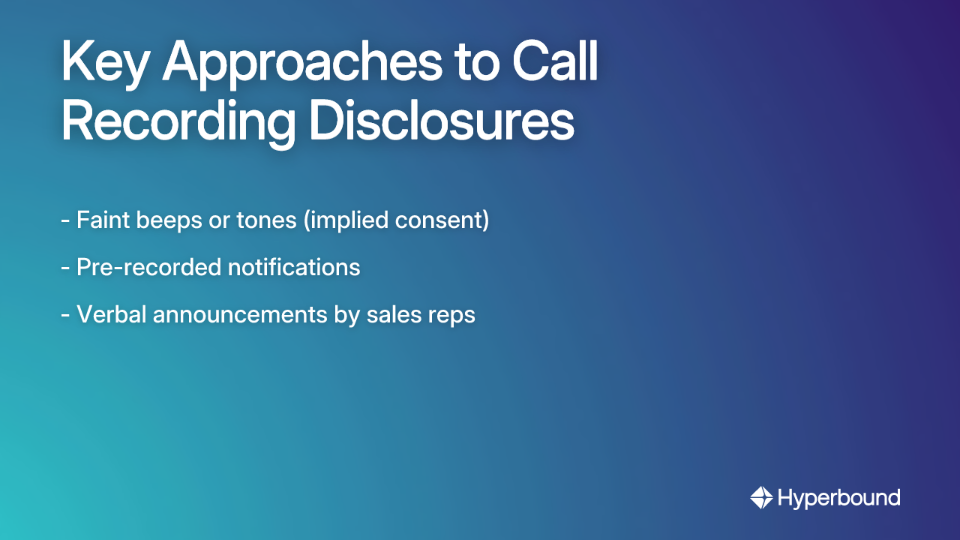
There are several ways to handle disclosure requirements:
For cold calls and B2B sales, the verbal announcement delivered by a rep typically works best, as it allows for a more natural, personalized transition into your value proposition.
Purpose: To disarm the prospect and lighten the mood, making the announcement feel less formal and intimidating.
Example Scripts:
Best for: Less formal B2B environments, particularly when you've already established some rapport or when targeting industries where a lighter approach would be welcome. This works especially well for BDRs looking to stand out from robotic-sounding competitors.
Purpose: To deliver the announcement clearly and professionally without unnecessary elaboration.
Example Scripts:
Best for: Formal business environments, regulated industries, or high-level executive calls where professionalism is paramount. This approach acknowledges the compliance requirement without drawing undue attention to it.
Purpose: To frame the recording as a benefit to the customer, increasing the likelihood of acceptance through the principle of reciprocity.
Example Scripts:
Best for: Consultative sales approaches where demonstrating attentiveness and care for the prospect's needs is crucial. Industry data shows this script type has a remarkable 93% positive response rate because it provides a clear, prospect-centered reason for the request.
Purpose: To minimize the emphasis on the recording announcement and swiftly move to the value proposition, addressing the primary concern of maintaining momentum.
Example Scripts:
Best for: High-volume calling environments where efficiency is critical, or when calling prospects who are likely to be busy and appreciate directness. This approach works well for maintaining conversion rates in competitive markets.
Purpose: To tailor the message to specific industry concerns, making it feel more relevant and less intrusive.
Example Scripts:
Best for: Sales calls to highly regulated industries or sectors where trust and security are paramount concerns. This approach demonstrates your understanding of industry-specific priorities.

Even the best script can fall flat if delivered robotically. Here's how to make your recording announcement sound natural:
.png)
Many sales professionals view recording requirements with dread, fearing micromanagement or awkward conversations. However, reframing your perspective can transform this compliance necessity into a valuable asset:
"It's an excellent tool for call reviews for yourself."
Recorded calls provide the rare opportunity to hear yourself as prospects do. Instead of seeing recordings as your manager looking over your shoulder, view them as a mirror that reflects your strengths and areas for improvement. The most successful sales professionals regularly review their own calls to refine their approach.
"You never know what could be said or what can occur on any call."
In today's litigious business environment, recorded calls provide protection for both you and your company. If a customer later claims you made promises you didn't, or if there's confusion about what was discussed, the recording serves as an objective reference point.
Call recordings can transform individual experiences into team learning opportunities. Many sales organizations now use recorded calls for:
Modern AI sales coaching platforms like Hyperbound take this a step further by automatically analyzing calls to surface winning behaviors, which can then be used to create hyper-realistic AI roleplays for targeted practice.
While starting calls with a recording announcement might feel awkward initially, it's a hurdle that can be cleared with minimal impact on your sales metrics and pipeline generation. The key lies in selecting the right script for your situation, delivering it naturally, and quickly transitioning to value.
Remember these five approaches:
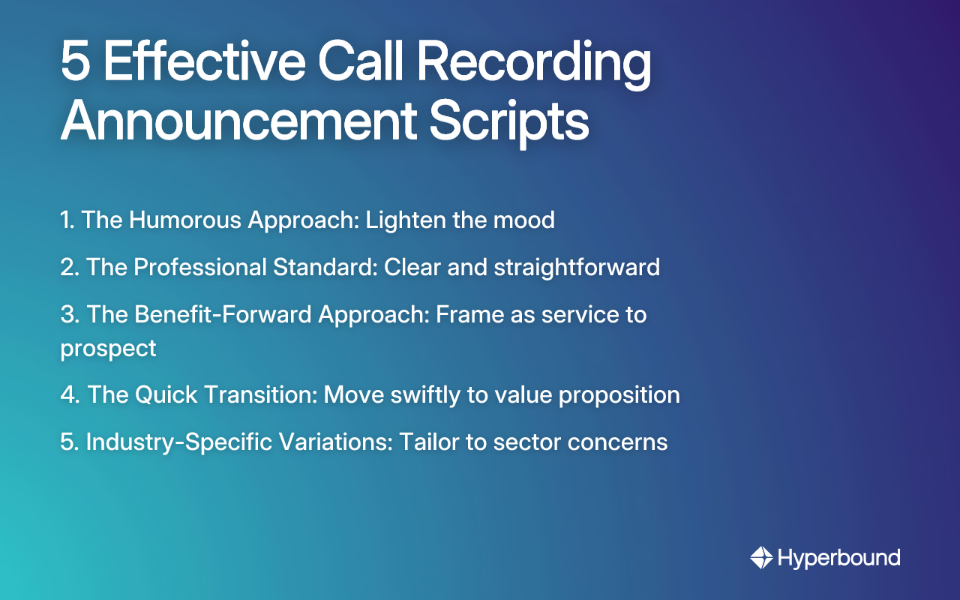
By mastering these scripts and delivery techniques, you can transform the recording announcement from a conversion-killing obstacle into a seamless part of your sales process. Your prospects will barely notice the disclosure as you guide them confidently toward the opportunity you're presenting.
After all, as one experienced sales professional put it: "It's obnoxious but it shouldn't hurt conversions too much." With these scripts in your arsenal, it might not hurt your conversions at all.
You must announce that a call is being recorded to comply with legal requirements, which vary by location. Many jurisdictions have "two-party consent" laws, meaning everyone on the call must be informed that the conversation is being monitored or recorded. This protects both your company from legal liability and respects the prospect's privacy.
To make the announcement sound natural, you should rehearse your script, use a warm and conversational tone, and maintain a consistent pace. Avoid rushing through the disclosure or delivering it like a legal disclaimer. The key is to integrate it seamlessly into your opening so it feels like a normal part of your introduction, not an awkward interruption.
The best script depends on your industry and the prospect you are calling. The "Benefit-Forward" approach, which frames the recording as a way to help you focus on the conversation (e.g., "May I record this call so I can give you my full attention instead of taking notes?"), has a very high positive response rate. However, a simple "Professional Standard" script is often best for formal environments.
Announcing a recorded call does not have to lower your conversion rates if handled correctly. While many sales professionals fear it will cause prospects to hang up, using a smooth, confident script and immediately transitioning to your value proposition minimizes any negative impact. The key is to not draw unnecessary attention to the announcement.
If a prospect objects to being recorded, you should respect their wishes immediately and turn off the recording. You can say something like, "No problem at all, I've turned off the recording. As I was saying..." This shows you are respectful and flexible, which can help build trust. Ensure you are able to proceed with the call unrecorded or offer to follow up via email.
The difference lies in who needs to know about the recording. In a one-party consent jurisdiction, only one person on the call (which can be you) needs to be aware that it's being recorded. In a two-party consent (or "all-party") jurisdiction, everyone on the call must be informed that the conversation is being recorded before you begin. Companies often default to two-party consent rules to ensure compliance across all locations.









Use Cases
Legal