You've just hired a promising new sales rep. They're eager, talented, and ready to crush their quota. But three months later, they're struggling, frustrated, and considering their options. Sound familiar?
If you're nodding your head, you're not alone. Across sales organizations, new reps are being thrown into the deep end with "insufficient or outdated resources" and expected to "independently learn about accounts and processes" while facing "unrealistic pressure for immediate sales results."
The result? Confusion, burnout, and costly turnover that could have been prevented.
Enter the 30/60/90 day ramp plan – the strategic blueprint that transforms your onboarding chaos into quota-crushing clarity. This structured approach guides new sales hires through their critical first three months, setting clear expectations and providing the support they need to succeed.
In this ultimate guide, we'll walk you through creating an effective 30/60/90 day sales ramp plan that benefits both your organization and your new hires. Whether you're a sales leader looking to improve team performance or a new sales rep wanting to excel in your role, this comprehensive framework will help you build a foundation for long-term success.
Ramp time – the period it takes for a new sales hire to reach full productivity – is more than just an HR metric. It's a critical business factor that directly impacts your bottom line.
According to a 2023 study by The Bridge Group, the average sales ramp time is 3.2 months. But the breakdown reveals a concerning spread:
That means for nearly half of organizations, new sales reps take more than five months to reach full productivity. During this extended ramp period, you're paying full compensation for partial productivity – a significant hidden cost that compounds with every new hire.
But the costs go beyond financial implications. The challenges that prolong ramp time include:
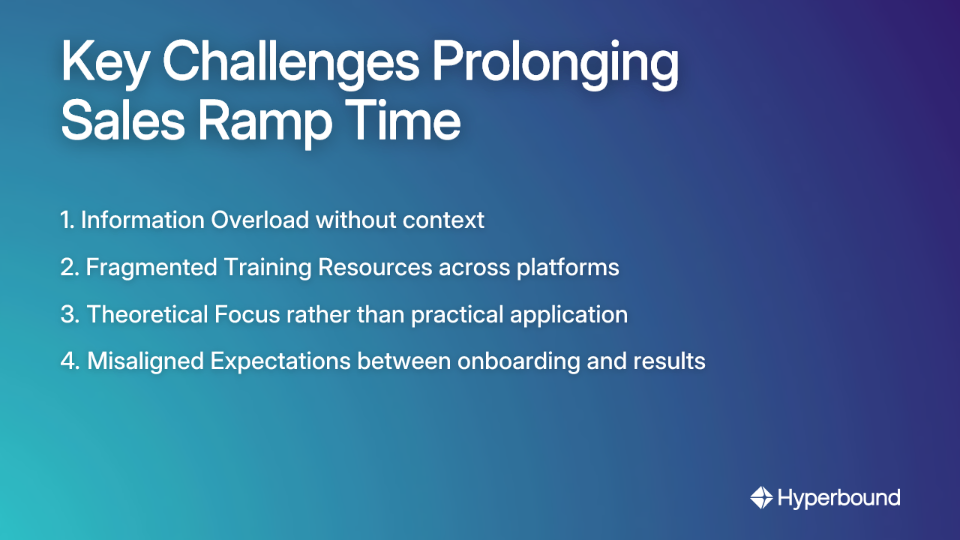
An effective 30/60/90 day ramp plan isn't just a document – it's a strategic tool that delivers value to both the organization and the new sales rep.
Perhaps most importantly, a well-designed 30/60/90 day plan establishes aligned expectations for success. Both the manager and the new hire have a shared understanding of what success looks like at each stage, eliminating the guesswork and frustration that often characterize the onboarding period.
Now let's dive into the specific components of an effective 30/60/90 day ramp plan for sales teams. Each phase has distinct objectives that build upon the previous stage, creating a progressive journey from learning to leadership.
The first 30 days are all about learning – absorbing information, understanding the landscape, and building internal relationships. The goal during this phase is not to close deals but to build a strong foundation for future success.
Company & Culture Immersion:
Product & Market Knowledge:
Process & Systems Training:
Learning Goals: By Day 30, the rep should be able to articulate the company's value proposition, describe the target customer, and navigate the CRM competently.
Personal Goals: Build rapport with their direct manager and at least three teammates.
The second 30 days mark a transition from learning to doing. During this phase, the new rep begins applying their knowledge in real-world scenarios and starts contributing to team goals.
Active Engagement:
Performance Goals:
Skill Development:
The final 30 days focus on demonstrating mastery of the role, operating with increasing independence, and taking initiative on projects that benefit the team.
Full Productivity:
Initiative Goals:
Advanced Skills:
Today's sales organizations have access to powerful tools that can significantly accelerate the ramp process. By incorporating these technologies into your 30/60/90 day plan, you can reduce ramp time while improving knowledge retention and skill development.
Combat the problem of "fragmented training resources" by creating a single source of truth for all sales knowledge:
AI-powered tools can analyze sales conversations to identify patterns of top performers and provide real-time feedback:
In a compelling case study, GetAccept collaborated with Hyperbound to use AI role-play for sales training, resulting in a 50% reduction in ramp-up time, improved call quality, and more effective sales conversations. This real-world example demonstrates how technology can dramatically accelerate the onboarding process.

For a 30/60/90 day ramp plan to be effective, it must include clear metrics for success and mechanisms for accountability.
All goals in the plan should be Specific, Measurable, Achievable, Relevant, and Time-bound. For example:
This directly addresses the need for "structured ramp plans with clear accountability and milestones" expressed by sales professionals on Reddit.
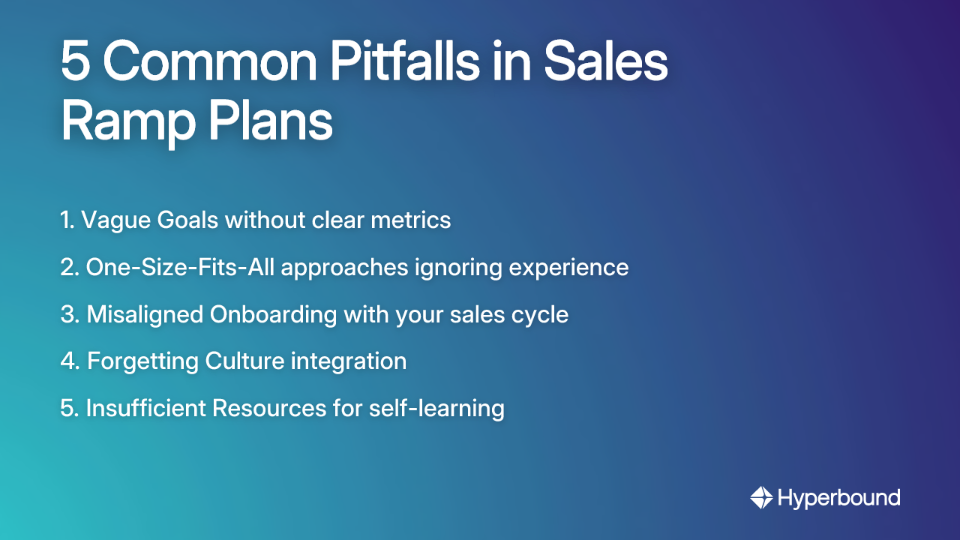
Learn from the mistakes of others by avoiding these common pitfalls in your 30/60/90 day sales ramp plan:
A well-designed 30/60/90 day ramp plan is more than just an onboarding document – it's a strategic investment in your people and your business. By providing a structured framework that guides new sales hires through the critical phases of learning, contributing, and leading, you set them up for long-term success while accelerating their path to productivity.
Remember that the goal isn't just to get new reps ramped up quickly – it's to build a foundation for sustained high performance. This means balancing short-term activities with long-term skill development, and combining knowledge transfer with practical application.
By implementing the strategies outlined in this guide and leveraging modern tools and technologies, you can create a 30/60/90 day sales ramp plan that transforms your onboarding process from a potential point of failure into a competitive advantage. Your new hires will feel supported and empowered, your managers will have clear visibility into progress and performance, and your organization will benefit from faster time-to-productivity and improved retention.
The result? A winning sales team that consistently meets and exceeds its targets – starting from day one.
A 30/60/90 day sales ramp plan is a structured onboarding document that outlines specific goals, activities, and expectations for a new sales representative during their first three months. It acts as a strategic roadmap, breaking down the overwhelming onboarding process into manageable phases: foundation and learning (first 30 days), practical application (days 31-60), and achieving autonomy (days 61-90). This ensures the new hire builds a solid base of knowledge and skills before being expected to perform at full capacity.
Reducing sales ramp time is critical because it directly impacts revenue and profitability by getting new hires to full productivity faster. A long ramp time, which averages 3.2 months but can extend beyond five months, means you are paying a full salary for partial output. A faster ramp, facilitated by a structured plan, not only improves financial performance but also boosts new hire morale, confidence, and retention.
The key goals progress from learning to independent contribution. The first 30 days focus on foundational knowledge, days 31-60 focus on applying that knowledge, and days 61-90 focus on achieving autonomy and full productivity.
The success of a sales ramp plan is measured using a mix of leading and lagging indicators defined by SMART (Specific, Measurable, Achievable, Relevant, Time-bound) goals. Instead of just looking at closed revenue (a lagging indicator), you should track leading indicators like the number of calls made, meetings booked, and pipeline generated. Success is also measured through milestone reviews at 30, 60, and 90 days, assessing proficiency in areas like CRM usage, product knowledge articulation, and call quality scores.
The most common mistakes include setting vague goals, using a one-size-fits-all approach, misaligning the plan with the actual sales cycle, and providing insufficient resources. Failing to tailor the plan for a rep's experience level can lead to boredom or overwhelm. Similarly, if your sales cycle is six months long, expecting a rep to close deals in their first 60 days is unrealistic. Ensure the plan is supported by centralized, accessible training materials and includes cultural onboarding to avoid setting new hires up for failure.
AI and technology can significantly improve sales onboarding by providing centralized resources, personalized practice, and data-driven feedback. Tools like a Learning Management System (LMS) can create a single source of truth for training materials. Most powerfully, AI role-play platforms allow new reps to practice customer conversations in a risk-free environment, building practical skills and confidence much faster than traditional shadowing, potentially reducing ramp time by up to 50%.
The average sales ramp time is 3.2 months, according to research from The Bridge Group. However, this varies significantly, with nearly half of all organizations reporting ramp times of five months or longer. Factors that influence this duration include the complexity of the product, the length of the sales cycle, and, most importantly, the quality and structure of the onboarding and ramp plan provided to the new hire.











Use Cases
Legal