You've just launched into your pitch with a prospect who seemed interested. But thirty seconds in, you notice their eyes glazing over. They're asking you to repeat key points. By the end of the call, you've talked yourself out of a deal without even realizing why.
Sound familiar?
"I have a habit of talking way too fast and getting overly excited to the point it can sound like gibberish," confesses one sales rep in an online discussion. Another admits to being "too matter of fact" and trying to "sleep with them on the first date sorta speak" – rushing through the relationship-building phase that's crucial for sales success.
If you've ever found yourself speaking at lightning speed during high-stakes calls or noticed prospects struggling to follow your message, you're not alone. The culprit might be simpler than you think: your speaking pace.
Research consistently points to an optimal speaking rate for maximum comprehension and engagement: 150 words per minute (WPM). This is what I call the "sales sweet spot."
Why 150 WPM matters:
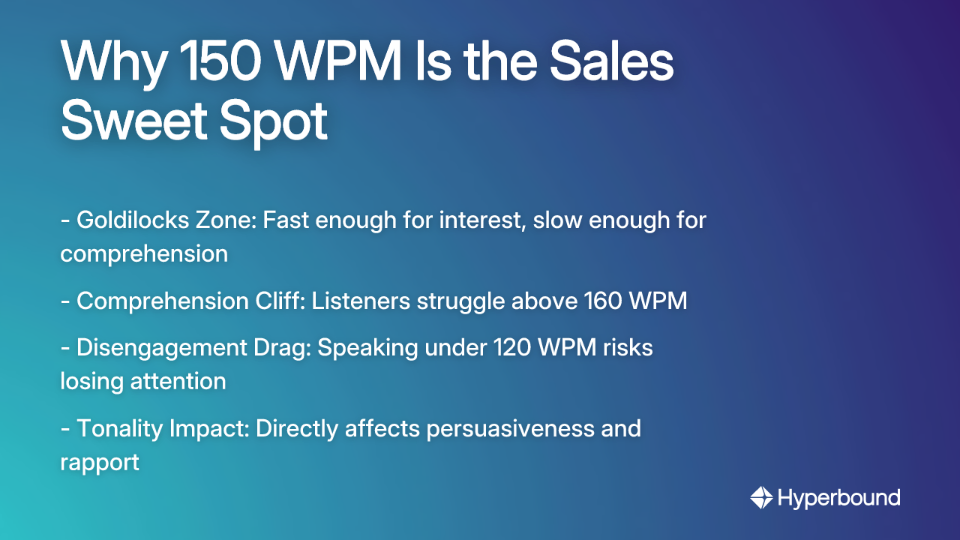
The science is clear: pace is a critical component of tonality that directly impacts your persuasiveness and ability to build rapport. As one sales professional notes, "Pace contributes to how well someone understands you, and hence, your persuasiveness."
Before you can improve your speaking pace, you need to know your starting point. Here are three practical methods to measure your current words per minute:
This simple exercise gives you an immediate baseline to work with.
For example, if your 6-minute pitch contained 900 words, you're speaking at 150 WPM. This method has the added benefit of revealing your filler word usage, articulation issues, and inflection patterns in a real-world context.
For the most accurate and context-aware feedback, use an AI Sales Coaching platform. Tools like Hyperbound's AI Real Call Scoring can analyze your actual sales calls to measure WPM, filler word usage, and talk-to-listen ratios. This gives you data-driven insights on your pacing in real-world scenarios, not just practice runs.
Once you've identified your baseline, try these exercises to master the 150 WPM sweet spot:
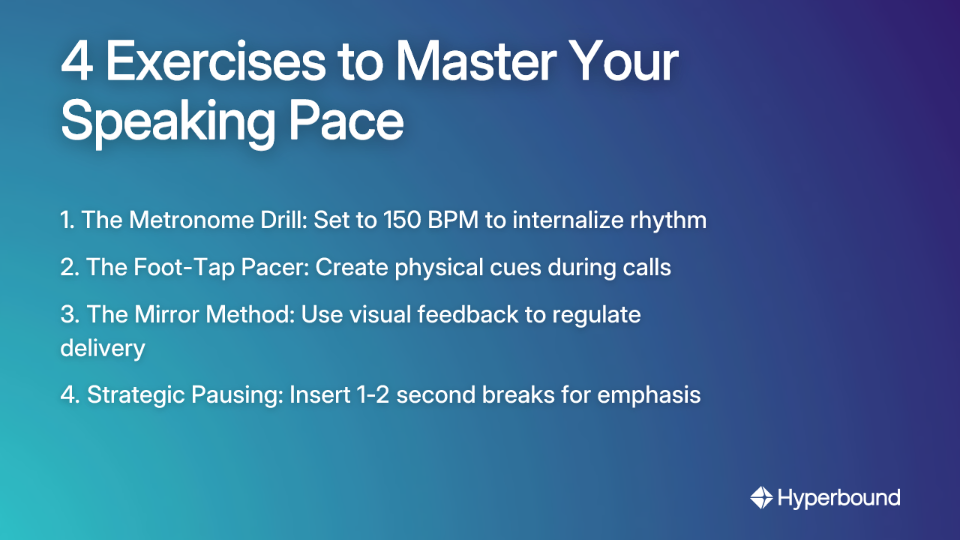
Download a metronome app and set it to 150 beats per minute. Practice delivering your sales pitch, timing one word to each beat. This helps internalize the rhythm of the ideal pace.
"The metronome technique is extremely effective," notes one communication coach, "but be careful of developing a robotic quality in your speech." Use it as a training tool, not a performance crutch.
One sales professional recommends: "If you're on the phone, tap out a slow beat with your foot or hand. It helps slow your pace down." This simple physical cue can be incredibly effective for those who get overly excited during calls.
"Put a mirror in front of you when you are making phone calls," suggests another experienced sales rep. Even though sales calls are a non-visual medium, seeing your own facial expressions and body language can help you self-regulate your delivery, making you appear more calm and confident to the listener through your voice alone.
Pauses aren't a sign of weakness; they're a tool for emphasis. Practice inserting 1-2 second pauses before and after key points (like pricing or a key benefit) to let your message land. This evidence-based strategy increases intelligibility and gives your listener time to process important information, according to speech experts.
The 150 WPM benchmark is a starting point, not a rigid rule. Great communicators vary their pace strategically throughout a conversation:
When discussing complex technical features, pricing details, or contract terms, deliberately slow down. This builds trust and ensures your prospect understands critical information.
When telling an engaging customer success story or building to a powerful conclusion, a slight increase in pace can convey passion and create momentum. Just be sure to return to your baseline afterward.
Try this strategy shared by a successful sales rep: "I start slightly louder with 'Hey John!' to command attention, then soften the volume with 'This is Michael from SalesWolf.'" Apply this same principle to pace: a sharp, energetic opening followed by a measured, confident pace establishes both authority and rapport.
If you work with international clients, be aware that the ideal pace varies across cultures:
The strategy isn't to perfectly imitate your prospect's cultural speaking pace, but to be aware and subtly adjust. This mirroring technique is a powerful, subconscious way to build rapport and make the other person feel comfortable.

While manual exercises are a great start, technology can accelerate your progress. Here are some resources to help you master your pacing:
For sales professionals serious about improvement, an AI-powered coaching platform is the most effective tool. Hyperbound not only analyzes your speaking pace on real calls but lets you practice in realistic AI Sales Roleplays. You get instant, objective feedback on your WPM, filler words, and overall delivery, helping you build muscle memory in a risk-free environment.
For simple, on-the-go practice, you can use basic WPM-tracking apps:
Mastering your speaking pace at the 150 WPM sweet spot isn't just about technique. It's about enhancing comprehension, conveying confidence, building genuine rapport, and ultimately becoming more persuasive. When you control your pace, you transform from someone just pitching a product to a trusted advisor who communicates with clarity and purpose.
The emotional cues in your voice—controlled by your mastery of pitch, volume, and pace—speak volumes about your confidence and expertise. In sales, where the voice is often your only tool on a call, these non-verbal elements of communication become even more critical.
Don't let your excitement sabotage your sale. Pick one technique from this guide—record your next call, download a metronome app, or simply try the foot-tap method. Your journey to becoming a more effective communicator starts today, one word at a time.
Remember: in sales, it's not just what you say—it's how (and how fast) you say it that makes all the difference.
The ideal speaking pace for sales is approximately 150 words per minute (WPM). This rate, known as the "sales sweet spot," is fast enough to keep prospects engaged but slow enough for them to fully comprehend your message, balancing clarity with enthusiasm.
Speaking at 150 WPM is effective because it aligns with the average conversational rate, maximizing listener comprehension. Research shows that comprehension drops significantly above 160 WPM, while speaking below 120 WPM can cause listeners to lose interest or perceive you as lacking confidence.
You can measure your speaking speed by recording yourself for one minute and counting the words, or by transcribing a full sales call and dividing the word count by the duration in minutes. For the most accurate, data-driven analysis, use an AI Sales Coaching platform.
Speaking too fast (over 160 WPM) causes your prospect's comprehension to drop dramatically. This leads to confusion, missed details, and a high likelihood that the prospect will disengage, ultimately jeopardizing the sale.
Yes, speaking too slowly (under 120 WPM) can be just as detrimental as speaking too quickly. It can make you sound unenthusiastic or uncertain, and it gives the listener's mind more time to wander, increasing the risk of disengagement.
You can improve your speaking pace with targeted exercises like using a metronome set to 150 BPM, practicing strategic pauses to emphasize key points, and using physical cues like a foot-tap to regulate your rhythm. AI coaching tools provide a risk-free environment to practice and get instant feedback.
No, 150 WPM is a benchmark, not a rigid rule. Great communicators dynamically adjust their pace. You should slow down (100-120 WPM) for complex details like pricing and speed up slightly (160+ WPM) to convey excitement, always returning to your baseline pace.
Yes, you should be mindful of cultural differences in speaking pace. While 150 WPM is a good North American benchmark, the ideal pace can vary globally. Subtly adjusting your pace to be closer to your international client's can build rapport and enhance understanding.










Use Cases
Legal