You've hired talented sales reps, invested in expensive CRM software, and still, your team isn't hitting targets. Your newly hired salesperson isn't showing "AMAZING results" after their first month, and you're wondering what's missing.
The truth? Even naturally gifted salespeople need structured, comprehensive training to reach their full potential. Many sales leaders struggle with information overload—too many books, YouTube videos, and training programs (many charging "way too much for their worth") without a clear learning path.
This article outlines 15 essential sales training topics that create truly unstoppable sales teams. Whether you're building a program from scratch or enhancing an existing one, these focus areas will accelerate your team's learning curve and drive measurable results.
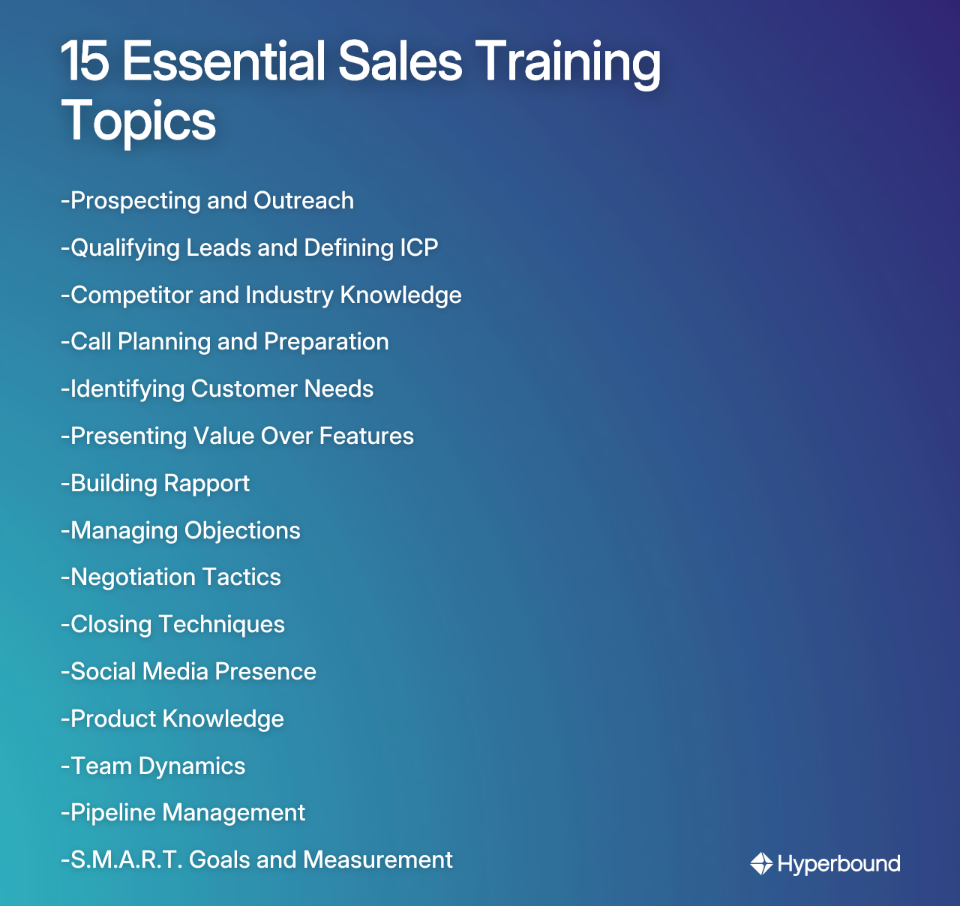
Before diving into specific topics, let's address why ongoing training is non-negotiable. Organizations that invest in comprehensive sales training can see an 8-14% increase in revenue. With 77% of customers making buying decisions based on service quality, the skills your team develops directly impact your bottom line.
One-time workshops aren't enough—training must be continuous. As one sales leader on Reddit noted, "it took a guy 5-6 months to become confident enough, so later he became number 1 salesperson in the whole company." Great salespeople aren't born overnight.
Generating a healthy pipeline is the foundation of sales success, yet it's a significant challenge for many teams. Your Business Development Reps (BDRs) need specific skills to find and engage potential customers effectively.
Training elements should include:
Salespeople waste enormous amounts of time chasing bad-fit leads. Effective qualification ensures their efforts focus on prospects who genuinely need your solution and are likely to buy.
Training elements should include:
When prospects compare you to competitors (and they will), your team needs to be prepared. Staying aware of industry trends helps reps position your solution strategically.
Training elements should include:
Preparation is a key differentiator between average and top performers. According to LinkedIn research, going into a call unprepared not only wastes the prospect's time but significantly reduces the chance of success.
Training elements should include:
Sales is fundamentally about solving problems, and understanding a buyer's goals and pain points is essential to framing your product as the solution.
Training elements should include:
Customers don't buy features; they buy outcomes. Your team needs to connect product capabilities to tangible business value.
Training elements should include:
As one sales professional on Reddit noted, "Sales is simple, it's relationships and understanding people do business with people they know, like, and trust." This fundamental truth is often overlooked in technical training.
Training elements should include:
Objections are a natural part of the sales process, not a dead end. Many salespeople struggle when faced with customer pushback, but proper training can turn objections into opportunities.
Training elements should include:
Poor negotiation skills can erode margins and devalue your product. Your team needs the confidence and tactics to hold firm on value and reach mutually beneficial agreements.
Training elements should include:
Many reps struggle with directly asking for the sale. As one Reddit user observed, "so many people scared to ask the question like the customer doesn't realize you're trying to sell him something." Closing is a skill that requires creating urgency and assessing customer readiness.
Training elements should include:
Reps cannot sell effectively what they do not understand. Deep product knowledge is essential for answering questions confidently and articulating unique selling points.
Training elements should include:
A toxic, overly competitive sales floor can lead to information hoarding and high turnover. A collaborative environment fosters peer-to-peer learning and collective success.
Training elements should include:
Effective pipeline management—building and prioritizing leads based on quality and urgency—is highly correlated with rep performance and forecast accuracy.
Training elements should include:
Without clear goals and metrics, training is just an activity. To ensure it translates to results, define what success looks like and how you'll measure it.
Training elements should include:
Platforms with AI call scoring and coaching can automate the measurement of behavior change and its correlation to results, providing clear data on training ROI.
An unstoppable sales team isn't born; it's built through commitment to continuous, comprehensive training. The 15 topics covered provide a holistic framework for developing well-rounded, confident, and effective sales professionals.
Remember that sales success takes time. As one experienced sales manager noted on Reddit, "Our training is 10 weeks because of this. Even then some reps really can expect about 3 to 6 months to really feel comfortable." Be patient with your team as they develop.
Don't try to implement everything at once. Start by assessing your team's biggest skill gaps. Pick one or two topics from this list and build a focused training module around them. The journey to an unstoppable team begins with a single, well-executed step.
By investing in these critical sales training topics, you'll create a team that consistently outperforms the competition while building valuable, long-term customer relationships.
Continuous sales training is necessary even for experienced teams because markets, customer expectations, and sales technologies are constantly evolving. It prevents skilled reps from developing bad habits, introduces them to new strategies for handling modern challenges, and reinforces core skills to maintain a high-performance standard and a competitive edge.
The most critical topics to start with are foundational, top-of-funnel skills like Prospecting and Outreach, Identifying Customer Needs (Discovery), and Managing Objections. Mastering these areas has the most immediate impact on generating a healthy pipeline and effectively moving deals forward, providing the biggest initial return on your training investment.
While minor improvements may appear quickly, it typically takes 3 to 6 months for sales training to yield significant, measurable results. This timeframe allows reps to move beyond initial learning, build confidence, and consistently apply new skills in their daily workflows, ultimately leading to improved KPIs like conversion rates and revenue.
You can make sales training more engaging by incorporating interactive and practical elements. Move beyond lectures and use role-playing scenarios, peer-to-peer feedback sessions, and competitive gamification. Leveraging technology like Hyperbound’s AI-powered role-play simulators allows reps to practice handling objections and navigating difficult conversations in a safe, repeatable environment.
The best way to handle sales objections is to listen carefully to understand the root cause, validate the customer's concern, and reframe the conversation with a clarifying question or value statement. Instead of becoming defensive, treat objections as requests for more information. An effective training program will build a library of common objections and practice empathetic, solution-oriented responses.
You can measure sales training effectiveness using a multi-level approach like the Kirkpatrick Model. Start by measuring Reaction (did they find it valuable?) and Learning (did they retain the information?). Then, track Behavior (are they applying the new skills in calls?) and, most importantly, Results (did the training impact key business metrics like pipeline growth, deal velocity, or win rates?). AI coaching platforms can help automate this process by scoring real customer calls against your methodology and correlating skill improvements with performance data.











Use Cases
Legal